 Stephen J Henstridge
 Jarrett Walker
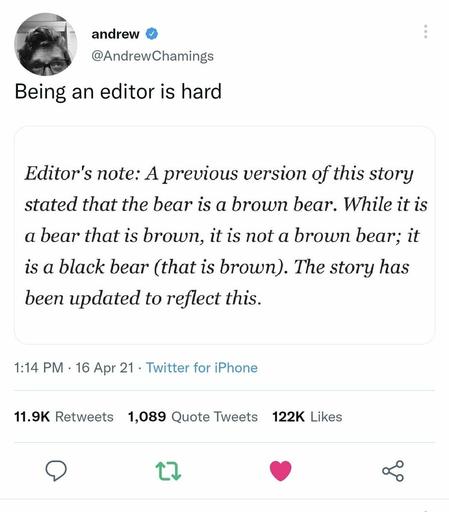
We biology geeks may sound elitist when we use scientific names instead of common names, but we're really just trying to avoid this:

Auf YouTube findest du großartige Videos und erstklassige Musik. Außerdem kannst du eigene Inhalte hochladen und mit Freunden oder mit der ganzen Welt teilen.

@humantransit I have a Brontosaurus to sell you!
But seriously, I think scientific names have a serious problem with stability. It’s really bad in palaeontology.
@humantransit this is very goofy! 😅
In general, but esp because the image is so important to the meaning of this post, it’d be great if you can include alt text.
For those interested: tweet reads “being an editor is hard” and includes a screenshot that says “Editor’s note: a previous version of this story stated that the bear is a brown bear. While it is a bear that is brown, it is not a brown bear; it is a black bear (that is brown). The story has been updated to reflect this.
@humantransit I had a Montreal Cognitive Assessment (MoCA) done after surgery (postop issues). I grew up learning about all kinds of animals, what with having wanted to be a marine biologist. So, when the doctor showed me animal pictures, I answered.
- The elephant was not just an elephant, it was an Asian Elephant.
- The alligator was actually a crocodile.
Said doctor had never heard a patient so accurately label the animals getting a mini lesson on animal identification.
@humantransit
English is a wonderful language but it fails at expressing technical topics. In my field ...
"'The fuse blows ..." 'Blows,' you mean it explodes?
No. "The fuse open..." What, the case ruptures?
No. "The fusible element within the protector opens, as per design in the event of a fault, removing power from the downstream circuit."
@humantransit All geeks and nerds, specialists in any field, sound "elitist" to people who don't speak the lingo. It sounds like "Greek".
This is the nature of the beast. As something of a polymath, I've often told people not to be afraid of a new subject or field. Don't be put off by the terminology. Instead, learn the terminology. Once you know the terminology and how to use it, you're 80 percent of the way to learning the field because you can read and understand what you read.
When you first begin, it's like a brick wall and you're already lost on page 2. Push through it. Read the book even though it seems you're not understanding anything. In fact, your brain is picking up clues. Then read the book again and be amazed at how much more sticks.
Okay, I actually did laugh out loud.
 Paul Kidd
 Kelt
Kelt Dawn Tåke 🏳️⚧️
 Tris Hussey
 panisuze
 Tim Ward ⭐🇪🇺🔶 #FBPE
 Cycling_mike
 artfulrobot
 Christina Sørensen
 Andrew Abernathy
 nushpowell
 Ben Curthoys
 Dr Michael Ward
 ClipperChip
 Sammi
Sammi PoeticLicenseDK
 Ariane Wilkinson
 Ana Distracted
 mrpieceofwork
 Confused Middle Aged Dad
 John Conway
 was B (this is my old account)
 Kelvin Voskuijl
 VC Roy
 alex roberts
 altertexaner
 Novio de la Suerte 🎲
 Megan Marie Hart
 James
James Stace
Stace ⏚ Antoine Chambert-Loir
 Phil Landmeier
 Philosphene
 Propinqua
 Lapscallion
 Desert Dweller 🌵
 Linkmeister