 Thomas Rid
This is brilliant https://fedi.tips

 danny roa
 Jacob Moena 🇩🇰
@ridt it would be even more brilliant if it were captioned, or simply plain text 🤗
 calcifer 🧯
 Keith Jones
 kemuri 🦀
@ridt
With all due respect, that is not an explainer, that is a conflater. It conflates federated network the technology with federated network the concept, and put in some positive words to make fediverse people feel good.
To wit, different datacenter providers around the world exchange YouTube video data. Is YouTube a "federated network"?
 Michał Kawalec
@kemuri @ridt Fediverse is closer to a physical world federated network than a closed ecosystem like the YouTube example. No one but Google can join the YouTube ecosystem, the protocol is non-public and the direction is driven by a central authority. This is in contrast to a post office, or Fediverse, where participants agree on common rules, but the details are up to each instance.
@monad_cat @ridt Where is the protocol for opening a USPS post office? Do DHL, UPS, FedEx, USPS interconnect with each other? If they do, where and how?
These questions prevent me from seeing a postal network as analogous to a Fediverse network.
Pardon me for the US-centric formulation of the questions, but if you know about similar situations in other countries, I am all ears. USPS is the US state-owned postal service, while DHL, UPS, FedEx are private shipping companies.
@kemuri @ridt There is an international post union (https://www.upu.int/en/home) that federates all the different national posts. The US private companies are not it’s members, but for most of the world we have public postal companies which speak the same protocol between each other.
This allows me to go to my post office and send a postcard to Brazil, which will likely travel along a route similar to PL->DE->PT->BR, with each of these postal companies handling their own part of the delivery route.
@monad_cat
Thank you so much for the link to UPU, that explains so much more than the "explainer". So if I am the head of government of a new country, I can create a new postal service and operate according to the UPU standard, which enables me to interoperate with other national postal services. My citizens may emigrate and others may immigrate. That indeed then is a federated network. Great! If the "explainer" explains like that, I'd praise its clarity.
But it goes on with "federated networks have been the default for human communications from the earliest days". That threw me way off, and now I know why. UPU is only established in 1874, and UPU Standards for interoperation seem to be only 20 some years old. The oldest such international organization being the International Telecommunication Union, it really only started with the advent of telegraph.
Federated network doesn't go back all the way "from the earliest days". It is a modern innovation, and I love it for that. If I discard the second paragraph, the first paragraph makes all the sense it needs already. Thank you again for this revelation.
 Karlosity
@kemuri @monad_cat
well ...there's always Libraries.
We could look at their purpose as essentially staying the same throughout their (long) history changing focus as they developed new technologies which affected their patrons/societies and then back to them in a feedback loop.
We've just got to talk to some Systems Librarians to get their long view blend of networks & human based goals.
 Brendan Boerner
@kemuri @monad_cat @ridt USPS has relationships with UPS, FedEx, etc. (perhaps not all) to handle their "last mile" delivery in some cases e.g. UPS Mail Innovations, FedEx SmartPost.
 Charles Edward Miles
@monad_cat @ridt @kemuri USPS is the last mile carrier in some rural areas for the private carriers. They do interconnect and have specific policies and protocols to do so, driven by interconnect agreements.
 Jonathan D. Abolins
 🐌’s Pace
@ridt ohhh. Thank you for posting. Clears up a lot.
 Hetav Rojan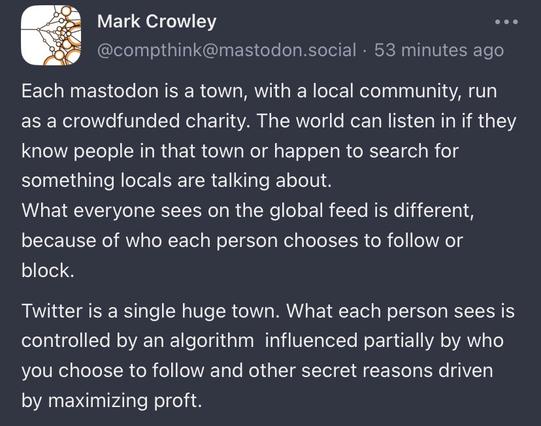
 Michael Downey
 OCR Bot
@downey
Mark Crowley eee
@compthink@mastodon.social - 53 minutes ago
Each mastodon is a town, with a local community, run
as a crowdfunded charity. The world can listen in if they
know people in that town or happen to search for
something locals are talking about.
What everyone sees on the global feed is different,
because of who each person chooses to follow or
block.
Twitter is a single huge town. What each person sees is
controlled by an algorithm influenced partially by who
you choose to follow and other secret reasons driven
by maximizing proft.
 Jozef
Jozef@hetavrojan @ridt personally this is what I'm struggling to get my head around with Mastodon. I have this account on .social and I like that because I feel like it has a really large audience of regular users, but I feel like at the same time I'm missing out by not being on a gamedev instance. I like the separation but I wish you could follow multiple instances rather than just having one as 'local'.
 Luke R
@ridt the concept is great, but could it scale to, say, Twitter-level size?
 Patrick Vanhoucke
 Hifilarry
@ridt seems to me the argument for a federated network is if a) pre existing smaller networks had cause to share information or b) there were distinctive advantages for being in a smaller club and confederation gave access to overlapping interest groups or c) the resilience conferred by cellular approach was advantageous.
I may well have missed something?
 mcneely
@ridt one thing I have been wondering about people's aversion to #fediverse's decentralization of online spaces is how it relates to the fact that for the last 20 years we've been mostly trained on centralized services.
We actually know how decentralized services work and as this points out we use them very frequently with no issues. The biggest break with Mastodon is shifting our mental models around social contact (he says as if that's some small barrier)
 JauntyWunderKind
@ridt but oh no you need to know a tiny little bit about how the www works for it to click & be obvious.
 Sven Slootweg
@ridt Hey, just a heads-up: please try to add captions to your images, so that they're also accessible to the many blind and visually-impaired users on here.
For pictures a few words is usually enough, and for text posts like this, you can click the OCR button in the 'edit image' window while writing your toot, and it'll automatically extract the text.
 redcat
 Nukolator
Federated networks have been around for centuries, and all of us have used them all our lives. The entire world is built around federated communications networks. The postal service is federated, different post offices around the world exchange letters and parcels. The traditional telephone network is federated, and so is email.
That's why you can make a call or send an email to someone else even if you're using a completely different provider, because the providers on a federated network talk to each other.
Federated networks have been the default
for human communications from the
earliest days, since before computers or the internet even existed. It's this sensible, sustainable, common sense tradition that the Fediverse is bringing to the modern social media world.
@nukolator @ridt thank you very much.
@ridt This is the source:
https://fedi.tips/mastodon-and-the-fediverse-beginners-start-here/

 Orcmid
@ridt Well, they are not so much decentralized or distributed. And adherence to standards is pretty acute. Where I live, you don't get to create an additional postal service, create an additional telephone system, add a television network, or work around the Internet backbone. There are ways to do some of those things, but under a prevailing regime. The fediverse definitely runs atop such an established network structure.
The analogies are appealing. But governance.
 Ken
Ken@ridt , thanks!
 Nick Giordano
 Jacobunny
@ridt well, this answers my #fediverse? question - thanks for sharing 👍🏾
@ridt I'm having flashbacks back to the late 90s when I maintained a Usenet News server (C News) leaf node. 😊
 lakelady
 Shoq 🌿
Check what out? Feditips? I'm well aware of that account and the concept is precisely why we need ideas that help it scale.
@shoq I was trying to tag you to see a particular quote. that's all
 Chappo
@ridt love it, centralised communication has dire consequences as we are all finding out, Murdoch, Zuckerberg and now Musk
 grundgedanke
 Snop
Snop@ridt This is the only way humans have communicated on a large scale. Smoke signals across landmasses was also a federated system. The only other way we communicate across large spaces or times, is via the arts, drama, images & storytelling. It’s why our writers and artists are so important & why spaces like this need to be cherished.
 John
John 

@ridt it's where the internet was taking us before we were railroaded into the walled gardens. It was all personal blogs and RSS feeds.
 Ade Malsasa Akbar
@ridt really nice. Thank you very much.
 Desert Dweller 🌵
@ridt Perfect!!! ⚡
 Ed
Ed@ridt One thing to think about, is that in a given legal jurisdiction, you almost always have zero choice. There is exactly one postal service, so yes there are different post offices, but they are all part of the same organization in truth. Same with telephones. Yes you can call someone on another network but in a given country or city or state, only one company owns the phone lines. Not only that, but there is a central org (ITU) that deals with country codes and area codes.
 Elahn Danee
@ridt @Suzyanalyst1 This makes so much sense