 cmrosens
Essay: Darklands (1996) and the Question of Welsh National Identity
Darklands (1996) dir. Julian Richards, Director’s Cut (2023)
Title: Darklands
Director: Julian Richards
Country: Wales/UK
Genre: Horror
Age: Adult
Format: Feature Film
Film blurb (Shudder): A newspaper reporter is lured into a conspiracy of pagan rituals and human sacrifice when he investigates the death of a steelworker.
This essay/review contains full spoilers for Darklands, and discussion of its context in 20th-century Wales.
~
“The First Indigenous Welsh Horror Film Produced by Welsh Filmmakers”?
I first became aware of this film via the site Wales in the Movies, and this post, which I basically agree with. On my first watch, as part of the #100HorrorMoviesIn92Days challenge, I wrote this review on that version, with the 6mins of footage uncut. I decided to rewatch it, but this time the 2023 Director’s Cut version, to see what difference the 6min shorter runtime made, and what exactly got cut and where. This was quite revealing, as were the director’s interviews about the new version, given to various Horror sites and screenings in 2023.
This film is considered “one of the three cornerstones on which the 21st century British Horror Revival would be founded”, according to M.J. Simpson in his book, Urban Terrors.
(The other two films that influenced this revival are, for Simpson, I, Zombie (1998) dir. Andrew Parkinson, set in London, and Urban Ghost Story (1998) dir. Geneviève Jolliffe, set in Glasgow.)
This positions it as an important film in the British horror scene, but Richards went one step further in his interviews around the Director’s Cut release, where he described the film as:
“the first indigenous Welsh horror film, produced by Welsh filmmakers and financed by the Arts Council Wales … exploring contemporary Welsh themes including nationalism and cultural identity.” – Blazing Minds, January 2025: Horror-on-Sea Interview with Julian Richards
This is also stated as fact by the Horror Society article about the Director’s Cut release, which the version currently on Shudder.
This statement isn’t accurate.
In fact, it isn’t even the second Welsh horror film produced by Welsh filmmakers.
(We’ll leave ‘indigenous’ as a term aside, as, while the Welsh are closest to the DNA of Ancient Britons, the Britons were not the indigenous group, as they weren’t the first settlers in Britain, just the ones who hung around the longest. We can argue the toss about what the definition leaves room for, but let’s not.)
What Richards meant to say, I’m sure, is that this is the first Welsh horror film produced in English, or perhaps the first truly feature-length Welsh horror film.
To find the first Welsh horror film made by Welsh filmmakers, we have to go back to the 1970s.
I was wondering if the psychosexual drama/horror, The Other Side of Underneath (1972) written and directed by Jane Arden, should count, but it was produced by Jack Bond, who is not a Welsh filmmaker.
Arden was a Welsh writer and director from Pontypool in South Wales, and a leading figure in the Women’s Liberation Movement, who wrote this film initially for the stage under the title, A New Communion for Freaks, Prophets, and Witches (1971). It was the sequel to her previous stage play, considered the first play of the Women’s Liberation Movement, Vagina Rex and the Gas Oven (1969). I am sad this film doesn’t count, but Arden deserves an honourable mention.
The first Welsh horror film produced by Welsh filmmakers and financed within Wales was, as far as I’m aware, Gwaed ar y Sêr/Blood on the Stars (1975), dir. Wil Aaron, with a 60mins runtime.
The second, again, as far as I’m aware, was Aaron’s second film, O’r Ddaear Hen/From the Old Earth (1981), with a runtime of 50mins.
Both films were funded by the Bwrdd Ffilmiau Cymraeg [The Welsh Film Board], and were more recently remastered on Blu-ray by Severin Films, who included them both in their Folk Horror volume 2 box set, All the Haunts Be Ours.
Now we’ve got that out of the way, let’s get on with the film, and you’ll see why Richards has chosen to frame it in this way.
Darklands (with Spoilers)
Content Warnings: adoption reveal, forced adoption, animal sacrifice (graphic), anti-indigenous discourse, antiziganist tropes, Arabophobia, and male rape in a prolonged scene (by a woman dressed as Lilith, character name ‘Rebecca’, for an added dash of antisemitism).
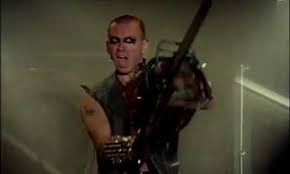
Cult member with a chainsawDarklands is essentially The Wicker Man meets Rosemary’s Baby set in Port Talbot, with a Goth folk punk/industrial metal aesthetic that reminded me very strongly of the cannibal cult in Doomsday (2008), and I watched it mainly because the anti-Welsh Nationalism discourse was really interesting.
From the get-go, in addition to the content warnings, expect all the usual misconceptions about paganism, completely garbled historical inaccuracies, and all the usual ‘Celtic’ inaccuracies.
(Port Talbot’s steel works and industrial skyline were the inspiration for Blade Runner (1982), by the way, and they also form a core part of the Darklands aesthetic and setting. If you watch the film and think, hey, that looks weirdly familiar: that’s why.)
The Director’s Cut was released in 2023. This is the 86min version currently available on Shudder.
The film opens with some absolutely iconic footage of the steelworks at sunset to set the mood, and our folk-punk druidic cult in a warehouse, sacrificing a pig. A Man in Black (played by Dave Duffy) looking like a gangster in a Guy Ritchie film, is presiding.
Pay attention to him, we will see him again later.
No pigs were actually harmed during filming, but there is a graphic throat-slitting scene.
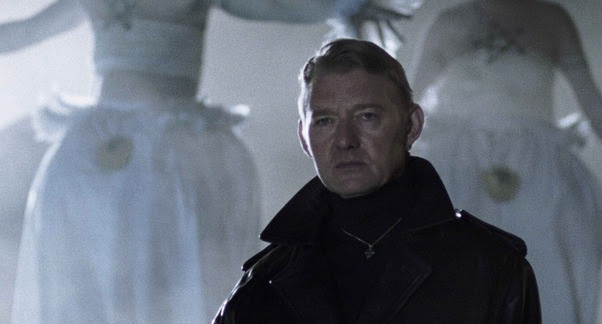
The Man in Black stands in front of the Women in WhiteThe protagonist, Frazer Truik (Craig Fairbass), is a journalist who grew up in Port Talbot but moved to London as a Welsh child with a strongly Scottish first name and a very rare surname in Britain and Ireland, and acquired a strong London accent. He has returned to his hometown because he upset some powerful people in London while reporting on an embezzlement case.
This foreshadows the conspiracy he is about to face, which extends across every facet of society, from the police to the local council, and even into the National Health Service (NHS).
He meets fellow journalist and newbie at the paper, Rachel Morris (Rowena King), and immediately fancies her. They go off to cover the opening of some new thing in town, at which David Keller, the local councillor up for re-election, will be cutting the ribbon and giving a speech.
It’s very notable that almost nobody in this film has a Welsh name. Welsh names are almost erased entirely, and perhaps this is due to Pembrokeshire’s unique flavour as being a “Little England”, historically a melting pot of settlers from England, Flanders, and Normandy, but it does seem very incongruous here.
Wales for the Anglicised vs Wales for the Cymuned
Frazer strongly dislikes Keller, because, in his words, “I’m just not into this back-to-your-roots shit.” That’s quite a thing for a Welshman to say when he has, quite literally, come back to his hometown after years away.
He expands on this opinion, which just makes it worse: “You see, Keller is a nationalist,” he tells an amused Rachel. “If he had his way, we’d all be dressed as Arabs, playing harps, and speaking gobbledegook.”
There’s a lot to unpack here, from the casual Arabophobia to the casual denigration of the Welsh heritage and language using cultural stereotypes, but to get at what Frazer really means, we don’t have to wait long. Before Keller can give his speech, Frazer interrupts and asks him what he means by his talk of cultural change; Frazer asks what about the culture that already exists in the town?
(We never get a definition of this – the only subculture we see is a rave, and two amiable lads outside the club selling drugs, which, arguably, was peak 1990s culture).
It’s probable that, at the time, no description or definition was actually necessary. I know, for example, what that would mean in the context of my majority-English-speaking hometown, without someone having to tell me. I also know that its culture is distinct from other areas of Wales while being (for me) quintessentially ‘Welsh’ in its own specific way, and impossible to erase or disentangle from the history, heritage, and landscape of the place.
I think what’s really interesting here is Frazer’s apparent fear that the town he only briefly grew up in and calls “the armpit of the world“, should become a place that has nowhere for him, a wandering, monoglot Anglophone, to fit into.
That prompts this foreshadowing exchange:
KELLER: And what sort of culture is that? It is a culture born from the rape of this fair country. It is a culture left to rot on the scrapheap like a knackered pit-pony.
FRAZER: What about the people who were born here, grew up here? Do you deny their culture?
KELLER: Oh, not at all. We are giving them their chance to regain their pride. To rise to the challenges of life, like their Celtic forefathers. We will give them jobs, not welfare. Let them earn their own homes, and feed themselves.
[audience applauds]
This exchange comes out of tensions between Welsh Nationalists, a minority in the 1990s, and those who saw them as dangerous extremists.
Paramilitary groups like the Meibion Glyndŵr (the Sons of Glyndŵr) were active into the early 1990s. They firebombed around 220 English-owned homes in Wales between 1979-1994, and planted bombs in the Conservative party offices in London and in estate agent offices across England and Wales. In 1989, clarifying their position and explicitly rejecting violence against migrants and immigrants of colour, they declared, “every white settler is a target. We will bury English Imperialism”.
The reasons for the founding of the Welsh-language TV channel, S4C, in 1980, were also controversial. The late Plaid Cymru MP, Gwynfor Evans, threatened to go on hunger strike if the channel was not funded, a move that was criticised both at the time and since by political opponents and some of his political successors.
For more, you could read Freedom Fighters: Wales’s Forgotten ‘War’ 1963-1993 by John Humphries, (University of Wales Press, 2008).
The problem with somewhere like Port Talbot, and indeed the Welsh Valleys, is that a lot of people were or were descended from ‘white settlers’ from England who migrated to the steelworks and coalfields over a period of several centuries. These are people who count themselves as Welsh, and heard in these more extreme nationalist statements an explicit rejection of their identity and heritage, their familial and historical ties across the border, and their (English) language. I think this is where Richards’ script for Darklands is mainly coming from; but it swings too wildly and misses to wide.
For monoglot English-speaking Welsh people, those with English heritage due to migration, and those who clung to Anglicisation as a civilising force thanks to the prevalent attitudes within the education system, political rhetoric, and mainstream media, Frazer’s attitude was far from a fringe position in 1996.
We only have to look at the Devolution’s No Vote campaign and its supporters to see this was true. By the time this film was released, the 1997 Welsh Devolution Referendum was around the corner, but it only won by less than 7,000 votes, squeaking in by the narrowest of victories at 50.3% to the Yes Vote.
It wasn’t until 2011 that these concerns had largely dissipated, and all but one local authority area (Monmouthshire, a border county which has been batted about between England and Wales historically and whose population are traditionally more Anglicised, wealthy, and Conservative), voted in favour of further devolution of power to the Senedd.
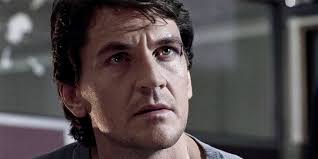
Frazer (Craig Fairbass) realises he has bitten off more than he can chewSigns of the Times
Frazer is positioned in this film as an everyman who voices the concerns and anxieties of a lot of people at the time, and the focus on modernity versus a return to a savage, incomprehensible past is a major preoccupation of the film.
One of the main stories he covers is the desecration of local Church in Wales parish churches, which Frazer suspects is the work of a modern-day druidic cult trying to reclaim sites coopted by Christianity. (The film’s grasp of the actual historical process of Christianisation of Wales, its subpar understanding of ‘Celticness’, and its conceptualisation of modern/contemporary Paganism, is frankly painful).
Frazer thinks the cult are getting their pigs from a Kale camp on private land near the steelworks. When he goes to check this out and take photographs without permission, he’s beaten up by Welsh-speaking Kale men.
The strange Man in Black appears and makes the men at the camp leave Frazer alone, but tells him to go away and get permission next time. (The Kale are initially positioned as defenders of their privacy, but are ultimately thugs for hire and turn out to be druidic cult members/sympathisers/muscle).
It is darkly funny that the Welsh(?) spoken on the camp is subtitled as “speaks foreign language”. Foreign to whom?
Rachel, meanwhile, tells him that she’s really in town because her brother, Edward Morris, was in an accident at the steelworks, but the last time she saw him made her suspect he wasn’t killed in a work accident. She believes Edward was mixed up with the cult and became a human sacrifice.
Frazer believes the druidic cult is recruiting from the disaffected steelworkers like Edward, 20% of whom have been laid off recently. There are some really interesting (to me) shots of the steelworks, and some great footage that shows what a dangerous job it is. (My grandad was a steelworker who suffered third degree burns up his legs when his overalls caught fire at one of the blast furnaces).
I like that the film doesn’t have a rosy view of either industry or modern Wales, and it’s interesting that even the druidic cult is presented as diverse and not ethnonationalist (Rachel and Edward are cast as Black British/mixed race), implying that neither recruitment nor sacrifice have racial conditions.
This isn’t a point in the cult’s favour, of course, it’s more to say that everyone, including Welsh minorities, will suffer equally if the cult’s activities continue.
Indigineity Meets Modernity: The Civilised Future is Anglophonic
Rachel and Frazer quickly become lovers – cue my favourite cutaway of the steelworks with a tower of flame going up at the moment of climax – and she tells him about a book “in Celtic” (she means Welsh), which her brother had. This sets Frazer off to the library, where he swiftly locates a copy of Yr Arwydd Paganaidd, or, The Pagan Sign, written in Welsh by Keller’s father.
Here comes another, very telling exchange, between Frazer and Keller.
At Keller’s ancestral pile, Frazer examines a painting of native South American peoples depicted beneath the Virgin Mary and conquistadors. Seeing Frazer examining it, Keller asks what this painting means to him.
FRAZER: The modernisation of the native world.
KELLER: I prefer to see it another way. On one side, you have the manipulative powers of the Church, on the other, the conquistadors, who forced their laws and beliefs on the natives at gunpoint.
FRAZER: A very interesting argument, and partly why I came to see you…
I believe that there was a longer discussion here originally, which contained more explicitly anti-indigenous sentiments from Frazer, which, fortunately, seems to have been cut. I remember there being some discussion along the lines of, “but they were cannibals and savages, and so white colonialism was a good thing actually”, so I can very much see why this conversation has been trimmed down for the 2023 re-release.
But that line, “the modernisation of the native world”, is also how Frazer sees the Anglicisation of Wales, and he resists the drive to turn the clock back to a time of pagan savagery, as if this is the only natural outcome of a Wales that honours and remembers her history and heritage.
Keller cooperates with him, saying he doesn’t want to align himself with the druidic cult either, and helps Frazer out with his father’s book, and some information. He asks Frazer what he learned from the book, and Frazer says that he can’t read it.
Keller responds: “You should learn. It’s your language.”
Frazer has no response to this, except apathy; according to the 1991 census, only around 18.5% of the population were fluent Welsh speakers. Welsh was seen at the time as an insular language, which wouldn’t help you get a job or be useful anywhere but in a few Welsh-speaking areas, where everyone spoke English anyway. We wouldn’t be expecting anything from Frazer, of course: we already know he’s “not into this back-to-your-roots shit.”
Frazer then gets a visitor at the news office, the local reverend, who drops the bombshell that Frazer is actually adopted, and he is part of something much bigger than a few dead pigs and goats descecrating the church – he is, in fact, integral to the cycle of rebirth and regeneration that has been going on since before the birth of Christ, and he is in danger, and can trust no one.
This is where everything goes downhill for Frazer, and people around him start getting murdered.
The Midpoint Twist (into Misogynoir)
His parents are indeed from Port Talbot, but are not who he thought they were. Rachel turns out to be lying about who she is – Edward Morris never had a sister.
Unsurprisingly for our noir-coded protagonist, she is a paid actor, under the control of the Man in Black – and she is being paid to conceive Frazer’s child, a condition that primes Frazer for human sacrifice. The other is that Frazer must enter the place of sacrifice of his own free will, like his father before him, and then the sacrifice can be made.
Who’s There? Rachel Morris (Rowena King) realises she is not home alone…Rachel is murdered for trying to hide her infertility from the Man in Black and escaping with his money; this is an extended cat-and-mouse scene, one of the better moments of tension in the film, but also the murder of the only main character of colour. It also repositions a mixed woman as someone who cannot be trusted by the white male hero, and her body and reproductive abilities is a site of contension and ownership by the white male villain.
Again – while the cult don’t seem to care about race and ethnicity, in that it is fine for her to carry the regeneration cycle child, her body is simply a vessel and a site of coercion and violence.
This is also the case with the (white, Jewish-coded) woman who replaces her, so the druidic cult remains intensely patriarchal, and is a backwards step for modern ‘90s women regardless of race and ethnicity.
Frazer, for all his striving for a Wales that embraces its modernity, is the product of a regeneration cycle that primes him as the human sacrifice required to end the economic recession.
Darklands tries to show that while the conditions of modernity and recession are shit, and Port Talbot is, to Frazer, “the armpit of the world”, going backwards would be worse, because Back There is the savage Land Incomprehensible, inaccessible to a modern, English-speaking man.
(I genuinely think there is something fascinating about the apposition of modern ‘90s rave culture, which is the only actual ‘90s subculture we see in the film, versus the industrial metal/folk-punk aesthetic of the May Queen and her druidic cult entourage, and the way alternative cultures were demonised in 1990s Britain, but I’m not sure that is something to get into here.)
The Ending
The graphic rape of Frazer at the end of the film by another (white, female) cult member, while senior members of the community stand around his hospital gurney looking on, is in itself a manifestation of the No Vote’s anxieties.
The cyclical nature of corruption at all levels of society, the violating coercion of the working man, will continue, especially if the Nationalists gain power. The English-speaking Welsh, especially those who welcome and defend Anglicisation and don’t want their current culture to change, will be violently forced into a world they don’t understand. Their children will grow up in a world filled with the same corruption and backwards-leaning ideology pulling the strings of their lives, and their parents will have no say in it. The cycle goes around and around.
I am pretty uncomfortable with the female cult member being called Rebecca and being dressed as Lilith (in red with her tits out, a very typical Lilith pose), and these Jewish-coded elements add to the mess of conspiracy and prejudicial biases against Welsh Nationalism in the film.
It really does feel like there isn’t any group the script hasn’t casually thrown under the bus; literally everyone has, at this point, turned out to be evil or been brutally murdered or both, except the protagonist who has a Scottish name and a Cockney accent, and he ends the film by being raped, brutalised, and having his throat cut.
The end of the film, with its victory for the cult and its leaders, and the shout of “The old flesh is dead! Long live the new!” as Frazer is finally killed alongside the hanging bodies of the pig and the goat from earlier, rings out through the warehouse.
It echoes The Wicker Man (1973) dir. Robin Hardy, with the added kicker of the forced adoption of Frazer’s daughter nine months later. The cycle must continue, and there is nothing anyone can do to stop it.
Similarly, the Wales of Darklands is presented as being forever trapped in cycles of recession and oppression, and this is partly, implicitly, blamed on the backwards-looking Welsh themselves, who cannot fully let go of the things that hold them back from embracing a hybrid, Anglicised, modernity.
Conclusion
In many ways, Darklands is a time capsule, as well as a horror film. While it doesn’t do anything new with its themes and tropes, it positions them in a pre-Devolution landscape that speaks directly to the status-quo conservatism of the time and is in direct conversation with the fears of that demographic, whether or not Richards intended it to be when he wrote it. I think this is partly behind its 2023 retconning as “the first indigenous Welsh film, produced by Welsh filmmakers”, which seeks to legitimise the film and perhaps answer criticisms in reviews that point out it makes most of the Welsh characters in the film look like a bunch of lunatics.
It also repositions Richards himself as proud of his heritage – an ironic contrast to the message of the film, where almost none of his characters even have Welsh names – and therefore telling an ‘authentic’ story that represents some form of Welshness and tackles themes of national identity from within.
The anxieties that shaped the script of Darklands were indeed Welsh views and fears that have taken decades to reckon with; people who still hold these views are now a political minority, but in recent days, we have Reform trying to reignite these old tensions to undermine devolution and restore Wales to Westminster.
So, while it is easy to dismiss Darklands as a time capsule, perhaps the true horror is that it cannot be so readily ignored. The Director’s Cut, released in 2023, still finds some resonance in contemporary political discourse.
It also, perhaps unintentionally, lays bare the underbelly of these fears via Frazer’s mix of apathy and aversion to his own heritage and history; his unexamined racism, particularly his anti-indigenous, pro-colonial biases, are a large part of this.
This offers Welsh audiences a very uncomfortable mirror in which to examine our pre-Devolution past, ourselves in our current Reform-beset present, and the trajectory of our future.
For audiences who will miss the conversation with the sociopolitical landscape of Wales in the mid-1990s and the present day, it offers good shots of the steelworks, a solid thriller/giallo-paced plot, some dated and offensive 1990s attitudes and language, and a blend of The Wicker Man meets Rosemary’s Baby with an industrial/black metal aesthetic.
Darklands is streaming on Shudder (UK), and you can find your own subscription service with JustWatch.
#filmReview #horrorFilms #horrorMovies #welshGothic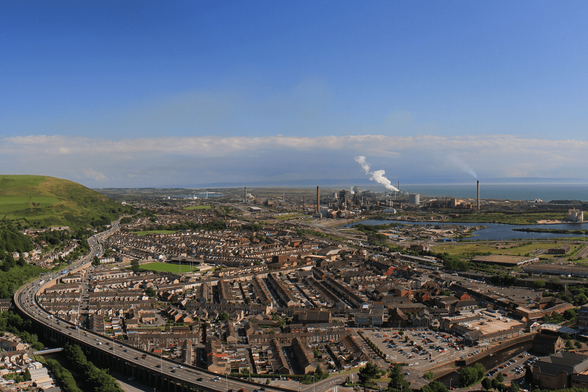
 Rita Singer