 Sharon A. Hill
Pop Cryptid Spectator 5
Hello and welcome to the 5th Pop Cryptid Spectator – my chronicle of observing the changing appearance of and attitudes towards “cryptids” in popular culture.
My interest is in exploring the expansion of cryptozoology into a mass cultural phenomenon. This edition provides more examples of how cryptids are part of our everyday lives. They are a way of framing the world in terms of mystery and wonder about monsters, and animals that may still be out there to find. Or, they are useful as liminal creatures formed from and existing only in our imaginations, or on the internet, but that we enjoy believing are real.
In this edition:
- Bigfoot makes an appearance in a divorce case
- Sidenote – Hunt for the Sasquatch race
- The Times of London promotes growing belief in Bigfoot
- E-DNA and the Enormous Eel Effect
- Sidenote – Excited whale parts
- The Utah Yetis dream dissolves
- Reality Shifting and Cryptids
- The Goosepig of Alexandria, Virginia
Bigfoot makes an appearance in a divorce case
A recent news story shows how important Bigfoot is to some peoples’ personal identity, so much so that it impacts their relationships and their work life. A man in British Columbia lost a claim for spousal support after a judge concluded that if he was capable of hunting Bigfoot, he was capable of getting a real job. The judge made multiple references to the unnamed man’s love for “camping, fishing, hunting, riding ‘quad’ motorcycles, and exploring remote areas of B.C. in search of sasquatch”. During a camping trip in 2020, the man was joined by an ex-girlfriend, who apparently shared his interest in cryptid hunting, without the wife’s knowledge. This led to the dissolution of the marriage. He claimed that a fall in 2016 while on a Sasquatch expedition caused him injuries and chronic pain that still prevented him from being able to work. The judge did not agree since evidence was provided that his still pursued his hobby and he had a capable brain for jobs that didn’t involve physical exertion. Sounds like he might do well as a Bigfoot reality TV star.
Sidenote – Hunt for the Sasquatch race
In a tangentially related side note, a Bigfoot “hunt” for the more physically fit occurs in Polk County, Florida on February 1 when Parks and Recreation will host its 9th annual The Hunt for Sasquatch trail race. Here’s hoping the winner finds a Sasquatch!
The Times of London promotes growing belief in Bigfoot
The Times (UK) has an article out this week, which highlights the continued interest in Bigfoot. Unfortunately, however, it features Matt Moneymaker of the Bigfoot Field Research Organization and Finding Bigfoot TV show, a person who is less than reasonable or cordial to anyone who doesn’t unquestionably accept his fringe claims. Just skip over his parts to see that the article states Bigfoot is “one of the most enduring myths in the United States has inspired a thriving subculture”. The writer cites a 2022 poll that shows 13% of American adults agreed with the statement that Sasquatch is a real, living creature, and suggests that percentage is growing. There is an unavoidable problem when polling people about beliefs, or anything else – they give you their opinion of the moment. This is heavily influenced by the media they consume and maybe the last person they talked to about it, or perhaps they answer “Sure, why not?” just because they are in a cheeky mood. We don’t know. But it is a reasonable estimate for interest in the subject for that particular population sampled.
E-DNA and the Enormous Eel Effect
In 2019, Professor Neil Gemmell, a geneticist from the University of Otago in New Zealand, used eDNA collection procedures and analysis at Loch Ness. The result was a bit of a bust since he found no mystery DNA that provided evidence of an unknown animal in the lake. But, he found lots of eel DNA, and then, inappropriately concluded that there may be giant eels which might be what people are seeing in that loch. Gemmell hit the jackpot by hooking his research to Nessie as it made headlines worldwide. The giant eel nonsense has reared its head out of the water again.
Prof Gemmell is once again planning to head back to the lake for Loch Ness 2.0 where he wants to use a different type of DNA sequencing to show the proportional change in a species’ population over time. The project has real world value regarding biodiversity, but Gemmell continues to use Nessie as the gimmick for attention even though he doesn’t expect to find a monster (eel or otherwise).
“[L]ast time around with Loch Ness 1.0, being able to capture that excitement and communicate it to the world was so much fun.”
He might still be pushing the big eel idea that no knowledgable Nessie researcher takes seriously. Of course there are eels in Loch Ness, but there is no evidence, not even DNA, that suggests a giant eel lives there. Gemmell erodes his cred by taking such a leap, previously saying, “Well, our data doesn’t reveal their size, but the sheer quantity of the material says that we can’t discount the possibility that there may be giant eels in Loch Ness. Therefore we can’t discount the possibility that what people see and believe is the Loch Ness Monster might be a giant eel.”
The enormous eel trope stuck with other DNA researchers too. When Prince William was visiting scientists at NatureMetrics, a research lab near London that also uses eDNA processes, he joked, “Does this mean you can find the Loch Ness Monster?” Firm founder Dr. Kat Bruce then claimed that the so-called creature was more likely a “very big eel” — at least according to testing done on one of the world’s most infamous lakes. Ugh! Silly ideas can be so sticky!
Sidenote – Excited whale parts
In the same Prince William article, the NY Post tabloid also printed that “A few years back, one daring academic proposed that the mythical beast is actually a “whale’s penis” — only to retract the whopper of a theory after being ridiculed mercilessly.” That’s incorrect. The whale penis suggestion is not ridiculous – the appearance of such a spectacle almost certainly happened in the past and threw observers for a loop – but it was in relation to sea serpents, not lake monsters like Nessie. For more on that story – see this compilation. (It’s SFW.)
The Utah Yetis Dream Dissolves
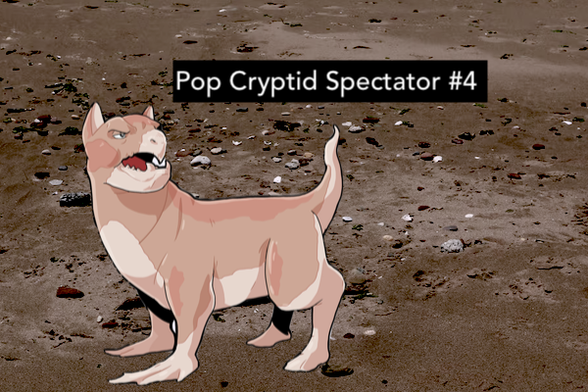
Here’s an update on the story from Pop Cryptid Spectator #4, there will be no new cryptid-named NHL team. You can thank your vacuum-sealed double-walled water bottles and coolers. The Utah hockey club stated the following: “An SEG executive shared that it explored every avenue to make Yeti work but that YETI Coolers, LLC was ultimately unwilling to agree to a co-existence agreement. SEG has confirmed it is no longer pursuing Yeti as a potential name for the team.” That’s a real shame. The next best name is the Mammoth, especially since mammoths did once roam the area now known as Utah.
Reality Shifting and Cryptids
There is an undeniable rift in the cryptozoology scene now. On one side is the idea that cryptids exist in our reality – that we can search for them, maybe find them, even if they have non-natural attributes. On the other side is that cryptids are made part of our reality because we put them there, we create them, and believe in them for strong personal reasons. For the latter, discovery is not the goal. The creatures exist in our defined reality because we allow them to and they serve a purpose that is not zoological.
If you are still following along and haven’t rolled your eyes and checked out, I thank you. I think the concept of reality shifting is important to why we are are experiencing the explosive growth of “cryptid” in its popular context, why cryptid cosplay and merchandise is so popular, and why cryptids are now incorporated into how some define their identity.
Reality shifting is a deliberate activity where a person, usually under the age of 30 (a generation known as Gen Z or Zoomers, born after 1996), decides to construct their own reality and live in that instead of the stressful, unrewarding, day-to-day grind of modern times. The world feels unreal and upside down to many people, so they go online. While the concept of reality shifting appeared in 2019, Covid lockdown created a surge of people constructing their alternate reality. People who create their own fantastical reality can include cryptids or even be cryptids themselves.
Internet folklorist, Gunseli Yalcinkaya, writes about reality shifting. And, she is also a huge fan of cryptids. I was introduced to her work via the Reality Studies vidcast from August 2024. Calling reality shifting an “ascendant form of zoomer spiritualism”, she talks about the development of shared fantasies online, where reality and fantasy merge. People take up a desired reality as a form of escapism and creative expression. The current internet landscape makes this very easy to do.
“To imagine the cryptid – a creature that is by definition unknowable – demands us to suspend real-world rules and immerse ourselves in the fantasy of what’s ‘out there’. […] The desire to uncover hidden truths extends across our post-truth landscape, from the tin-hat conspiracies we consume, to our ongoing fascination with creepypastas like Slenderman and Loab, and the UFOria sweeping across the mainstream. Similarly, we cannot fully comprehend the cryptid because it exists outside the human world.” – Gunseli Yalcinkaya
Gunseli talks about cryptids mostly in the pop cryptid framework, which is where she excels, but sometimes slips into the old timey cryptozoology tropes. She defines cryptids as creatures that may or may not exist under a Western scientific framework, in the sense that any undiscovered animal is a cryptid. She counts interesting animals, like the gorilla, as cryptids prior to them being discovered; I don’t agree with framing historical finds as cryptid prior to the establishment cryptozoology as a thing. But she has keen insight into the modern view of cryptids that sci-cryptozoology lacks. In one article, she noted that the appeal of Bigfoot may be that it manages to “exist” in reality, or as just an icon, but still manages to avoid being overtaken, tracked, and captured by technology. Her way of using cryptid, however, is often missing the concept of it being “ethnoknown” (a subject that exists in prior human knowledge, usually from local cultural tales). The minimizing, or total loss, of the historical, anecdotal basis for cryptids is evident with new AI cryptids that appear online – LOAB, crungus, and erosion bird. They are shared online in a form of “existing” but their origin is hidden; it remains unclear how or why they appeared. They might appear so often in your online environment that they begin to feel “real”. If any faked or fictional thing sticks around long enough, it can become real – like when fakelore turns into folklore and people tell the stories about encoutering the creatures that originated in Internet liminal space.
I talked about AI cryptids in the Pop Cryptid Spectator #2, but there far is more to be said on these creatures. I know that talking about very modern pop cryptids, from the view of the “extremely online” population of mostly young people, is so far from the original concept of cryptozoology that it makes many people uncomfortable. But fields of study evolve in response to changes in society and technology. That is certainly happening with cryptozoology.
Check out this talk by Gunseli called Cryptid: A Theory of Post-Digital Selfhood for some more brain stretching exercises. I really love the statement early on that the cryptid is defined by the “patchwork of stories” about it.
https://www.youtube.com/watch?v=H0X8C8WmCUM
The Goosepig of Alexandria, Virginia
A fakelore cryptid is thriving at Spa Spring in Alexandria, Virginia. The “goosepig” legend gets a boost by appearing on signage designating historical areas. The creature, resulting from the cross-breeding of pigs and geese, derived from the town’s history of banning these two animals from the city via a local ordinance. Pushed to the fringes, they interbred creating an impossible four-legged animal with a beak. The source of the story on the historical marker is a book on local pets dated 1972. But the story derives from tales referenced from 1928. It might have circulated even earlier as a town historian says that swine and geese were banned from the town beginning at least around 1811.
The new Alexandria Historical Sign Finder map will certainly help boost the goosepig story as more people will find and popularize the sign celebrating the creature. Although the animal is fake, it represents a social event that pushed livestock, and a way of living, out of a city aiming to modernize. While the goosepig does not qualify as a “mysterious animal” in terms of the original intent of “cryptid”, it is set to become a pop cryptid similar to the Hodag of WI and the Squonk of PA. Next logical step is for a goosepig festival to appear!
For more, click on Pop goes the Cryptid landing page. Make sure you subscribe to all the posts – it’s always free and I don’t send annoying spam.
You can email me with comments, suggestions or questions at Popcryptid(at)proton.me
Pop Cryptid Spectator is also available on Substack. Please share this with cryptid fans you know!
#2 #4 #Bigfoot #cryptid #EDNA #GiantEel #Goosepig #LochNess #Nessie #popCryptid #PopCryptidSpectator #PopGoesTheCryptid #Sasquatch #utahYetis

 𝕽𝖔𝖉𝖗𝖎 / Родри✈️ 🌈 🏒 🇲🇽 🇷🇺

 Lance Taylor #VA6LAT