 Data Literacy Alliance - DALIA
Last week, we had a wonderful time at the User Conference 4Base4NFDI 2024 in Berlin and presented https://search.dalia.education/basic . In case you missed our contribution, check out the slides:
https://zenodo.org/records/14183168
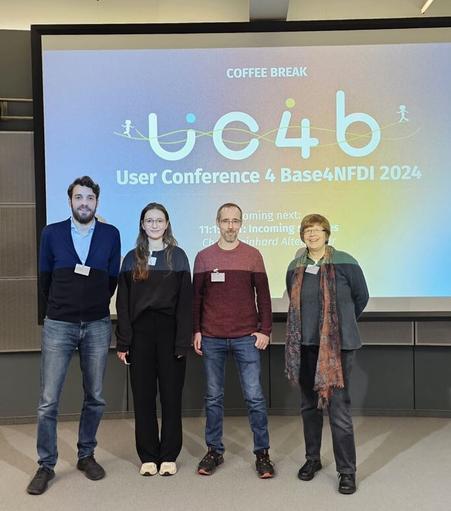
Last week, we had a wonderful time at the User Conference 4Base4NFDI 2024 in Berlin and presented https://search.dalia.education/basic . In case you missed our contribution, check out the slides:
https://zenodo.org/records/14183168
The poster for the @BERD_NFDI is now also published on Zenodo [1]. The terminology service is accessible via [2].
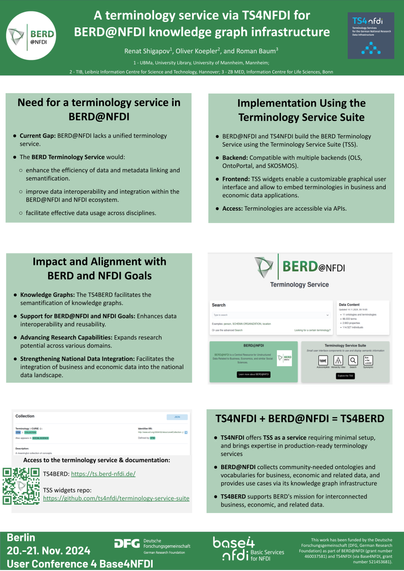
The use of standardised terminologies facilitates interoperability and data integration, making research data FAIR (Findable, Accessible, Interoperable, Reusable). Terminologies are often made available via terminology services through graphical user interfaces (GUIs) and APIs. Several domain-specific terminology services already exist within the NFDI consortia such as SemLookP [1, 2], BiodivPortal [3], and NFDI4Chem Terminology Service [4, 5]. In the social sciences, services such as the GESIS Controlled Vocabulary Service [6] which is based on SKOSMOS and the STW Thesaurus for Economics [7] hosted by the ZBW are notable examples. However, a common terminology service for BERD@NFDI does not yet exist. BERD@NFDI is developing a knowledge graph infrastructure (KGI) for German company data, transforming analogue books into multiple knowledge graphs through optical character recognition, automatic structuring, and semantification [8, 9, 10]. These knowledge graphs are a part of distributed KGI4NFDI [11, 12]. A common terminology service for BERD@NFDI would significantly enhance the efficiency of semantification and linking processes. One of the aims of BERD@NFDI is to ensure that data management adheres to the highest standards of integrity and accessibility. To achieve this, we are setting up a terminology service for BERD@NFDI using the Terminology Service Suite (TSS) [13]. The widgets of the TSS could handle multiple backends such as SKOSMOS, OLS and OntoPortal. This ensures that the newly developed terminology service for the BERD community meets the standards of other terminology services, promoting interoperability with services such as the GESIS Controlled Vocabulary Service, which utilises SKOSMOS as a backend system. The new terminology service can be seamlessly integrated into the BERD knowledge graph infrastructure. The GUI of the terminology service, constructed using TSS widgets, allows for straightforward embedding of terminology service data into other applications or services within the Business, Economic, and Related Data domains. Additionally, terminologies canbe accessed via the provided APIs, ensuring wide usability and integration. By implementing a standardised terminology service, BERD@NFDI not only enhances the semantification and linking of knowledge graphs but also ensures that these processes are aligned with the broader NFDI goals. The terminology service supports the overall mission of the NFDI by promoting data interoperability, thereby advancing research capabilities across various domains. Keywords: terminology service, knowledge graph, FAIR research data [1] Baum, R. (2024, Januar 18). SemLookP widgets - Embed ontologies in service applications. Zenodo. doi.org/10.5281/zenodo.10529181[2] https://semanticlookup.zbmed.de/[3] https://biodivportal.gfbio.org/[4] Strömert, P., Limbachia, V., Oladazimi, P., Hunold, J., Koepler, O., Towards a versatile Terminology Service for empowering FAIR research data: Enabling ontology discovery, design, curation, and utilization across scientific communities. Studies on the Semantic Web, Vol. 56 Knowledge Graphs: Semantics, Machine Learning, and Languages. IOS Press; 2023. doi:10.3233/ssw230005[5] https://terminology.nfdi4chem.de[6] https://lod.gesis.org/en/[7] https://zbw.eu/stw[8] Shigapov, R. (2022, November 28). Knowledge graphs in BERD and in NFDI. Focused Tutorial on Capturing, Enriching, Disseminating Research Data Objects. Use Cases from Text+, NFDI4Culture and BERD@NFDI, Mannheim and online. Zenodo. doi.org/10.5281/zenodo.7373258[9] Kamlah, J., Schmidt, T., & Shigapov, R. (2022, November 28). Extracting research data from historical documents with eScriptorium and Python. Focused Tutorial on Capturing, Enriching, Disseminating Research Data Objects. Use Cases from Text+, NFDI4Culture and BERD@NFDI, Mannheim and online. Zenodo. https://doi.org/10.5281/zenodo.7373135[10] Kamlah, J., & Shigapov, R. (2023, Mai 5). The German Production Pipeline: Mannheim - OCR & Knowledge Graphs. Zenodo. https://doi.org/10.5281/zenodo.7900133[11] Rossenova, L., Schubotz, M., & Shigapov, R. (2023). The Case for a Common, Reusable Knowledge Graph Infrastructure for NFDI. Proceedings of the Conference on Research Data Infrastructure , 1. https://doi.org/10.52825/cordi.v1i.266[12] Rossenova, L., Shigapov, R., Schubotz, M., Limani, F., Zapilko, B., & Förstner, K. U. (2024). KGI4NFDI - Knowledge Graph Infrastructure for the German National Research Data Infrastructure. Zenodo. https://doi.org/10.5281/zenodo.13118749[13] https://github.com/ts4nfdi/terminology-service-suite
Part of the #PID4NFDI team was at the User Conference 4 #Base4NFDI on 20/21.11.2024 in Berlin.
It was a great oppurtunity to meet people and exchange ideas and perspectives.
PID4NFDI presentation explained how a strategic framework based on Persistent Identifier (#PIDs) can change research data management in #FAIR and thus pave the way for improving the reliability and accessibility of scientific research.
👉 Slides: https://zenodo.org/records/14201186
This presentation will demonstrate how a strategic, PID-based framework can transform research data management into FAIR, paving the way for enhancements in the reliability and accessibility of scientific research. One of the main goals of the basic service PID4NFDI is gaining insights from extensive surveys to optimize PID application across varied research outputs, addressing current challenges within NFDI services according to diverse requirements and different maturity levels of PID usage. We will also explore how PIDs do more than ensure persistence and identification; they significantly enhance metadata quality and research integrity. By integrating Persistent Identifiers (PIDs) with diverse research elements – such as instruments, methodologies, datasets, DMPs and publications – we enhance both the replication of experiments and the reuse of research data. This connectivity enables researchers to access all necessary components for comprehensive studies, thereby increasing the reliability and utility of research findings. Additionally, by making the provenance and production/creation process of diverse research outputs more transparent and by providing accessible licensing information through PIDs, we foster a transparent research environment that maintains high standards of integrity and promotes open science. In addition, PIDs offer context information by providing metadata on protocols and methods, software and input/output datasets, creators and contributors including affiliation organizations. They enable us to trace other related publications e.g. citations and references where an instrument or physical sample is used. Ultimately, leading to reduced duplicate efforts, and allows higher re-use of research data, making it more transparent and impactful. PID4NFDI is committed to providing clear guidance on choosing and implementing the right PIDs for different types of research outputs. We are developing a comprehensive matrix that identifies suitable PID services for various research entities at different stages of the data lifecycle. This information will help researchers identify the most effective PIDs for their needs. The proposed solution/outcome is in direct response to the challenges identified by NFDI service providers, as highlighted in our survey responses and further feedback from consortia. We will present the results of our landscape analysis and the resulting outcomes to guide subsequent implementation phases of a PID4NFDI basic service. Additionally we will highlight preliminary results from our cooperation with selected use case partners, where we examine use case-specific challenges, interoperability issues with existing PID infrastructures, and metadata quality insights. Comprehensive, open and linked metadata of research resources and entities is crucial for an ecosystem of well-functioning PIDs offering the above mentioned benefits to support academic collaboration through data sharing and trustworthiness of scientific processes. However, these can vary greatly depending on the discipline, subject of research and methods, and accordingly require different approaches to documentation and referencing. At the end of the first project phase, a first collection of best practices should be available that can be reused by the consortia for typical use cases in NFDI service infrastructures. Referring 1 to our evolving training and support concept, we will outline in our presentation how the PIDs4NFDI basic service can support consortia in the future. PID4NFDI is funded by DFG as part of NFDI. Grant Number: 521466146
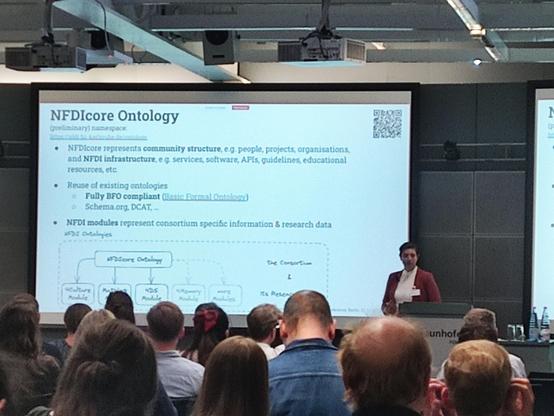
@tabea @lysander07 @fizise @fiz_karlsruhe @sashabruns @joerg @epoz @sourisnumerique @enorouzi @nfdi4culture And here we go, Tabea presenting the current state of NFDIcore and its further development 🗃️
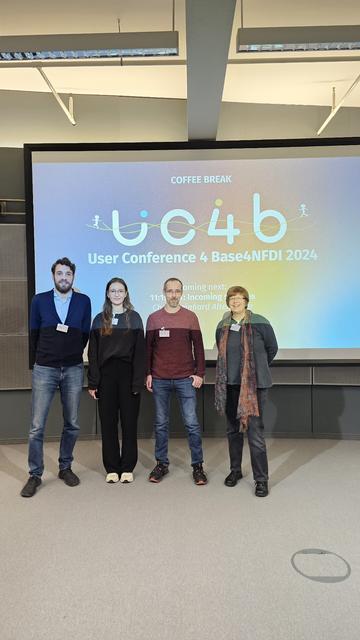
The slides of the #TS4NFDI talk are now publised via Zenodo.
Terminologies are crucial for creating semantically rich metadata that convey the full meaning of research data. They establish consensus definitions for entities, ensuring conceptual consistency across various disciplines, despite differing nomenclatures. Terminology Services provide access to domain-specific collections of ontologies, terminologies, or vocabularies, offering comprehensive functions for human users via GUIs or for machines via APIs.The basic service Terminology Services 4 NFDI (TS4NFDI) aims to develop a cross-domain, interoperable service to provide, curate, develop, harmonize, and map terminologies for the communities of the National Research Data Infrastructure (NFDI). The service will foster the harmonization and standardization of terminology management within the NFDI, facilitating consensus-building across communities.We present our work on the initialization of the Basic Terminology Service, addressing the following key objectives: Provision of a consortia-agreed IT-Architecture with a harmonized API gateway to access multiple terminology services technologies based on OLS [1], OntoPortal [2] or SKOSMOS [3]. Development of a Terminology Service Suite (TSS) to support uniform terminology access for provision, management, curation, publication, archiving, and subscription of terminologies. Promotion of consensus-finding, harmonization, and alignment by integrating TS4NFDI service components and adopting common practices to harmonize terminologies across disciplines. We report on the measures taken to achieve the objectives and their respective outcomes. Our comprehensive requirement analysis included a detailed analysis of current terminology service technology stacks, tools, and services used by NFDI consortia to identify needs and gaps. Results were obtained by a survey and extensive interviews with experts from various NFDI consortia representing the diversity of scientific disciplines. We demonstrate reusable JavaScript-based GUI widgets for easy integration into user interfaces and visualization of semantic information as part of Terminology Service Suite. Several small prototypes and demonstrators were developed within the various NFDI consortia, showcasing the desired networking of terminology experts and the TS4NFDI project. We further present a pilot implementation of a service wrapper and API gateway integrating selected backend services of the aforementioned three main terminology service technologies. We further report on the integration of a central Mapping Service to create, manage, and provide cross-domain mappings for terminologies, utilizing the Simple Standard for Sharing Ontology Mappings (SSSOM) [4]. We present collected and derived use case scenarios and their evaluation against the pilot to prove the concept of envisioned architecture. As an outlook, we will provide future work on the integration phase of the Basic Terminology including necessary steps to incorporate the service into the common NFDI service architecture. We will expand the use case scenarios including further participants from additional communities. The work will also include additional features and functionality to support the measures of ontology harmonization and mapping across the NFDI consortia. [1] S. Jupp, T. Burdett, C. Leroy, and H. Parkinson, ‘A new Ontology Lookup Service at EMBL-EBI’, in SWAT4LS, 2015.[2] ‘Welcome to the OntoPortal Alliance’, Ontoportal Alliance. https://ontoportal.org/[3] O. Suominen et al., ‘Publishing SKOS vocabularies with Skosmos’.[4] N. Matentzoglu et al., ‘A Simple Standard for Sharing Ontological Mappings (SSSOM)’, Database, vol. 2022, p. baac035, Jan. 2022, doi: 10.1093/database/baac035.
The project #PID4NFDI is at the Base4NFDI User Conference in Berlin today and tomorrow.
Tomorrow at 9:40 am we will present the progress and plans of PID4NFDI in our presentation. We look forward to exchanging ideas during the coffee lectures.
👀 There will be FAIR. Insights into the PID landscape analysis
Abstract: https://shorturl.at/n8dxa
#fair #base4nfdi #pids #NFDI #uc4b @PIDNetworkDE @gwdg @tibhannover
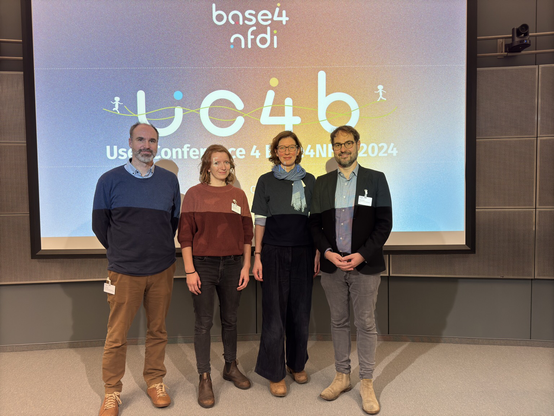
We are very much looking forward to these two conference days, which will further advance the research on a national research data infrastructure. Let's showcase the basic services and allow the audience to understand the service offering, examine how they can integrate the service into the NFDI community, and critically evaluate what this means in real-terms in terms of technical interoperability and local policies.
More information: ➡️ https://base4nfdi.de/news-events/events/user-conference-2024
 Roman Baum
 Steffi Genderjahn
 IBI HU Berlin
 Jonatan Jalle Steller 🦖
 Petra Steiner
 Fraunhofer FOKUS