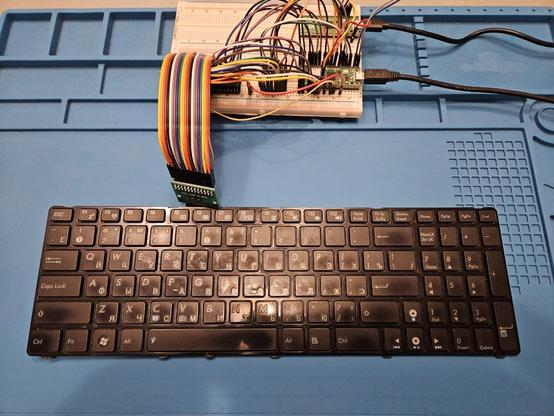
Maybe someone can help me here with the #ch32v208 chip I'm trying to program. I'm trying the official examples from the #openwch repository, and they all work on the 203, but I can't get any of the USB device examples to work on the 208. They compile and run, and I get all the serial debugging messages correctly, but the USB device never enumerates. Nothing in dmesg. On the same board, I have #TinyUSB examples working, so the hardware seems to be fine.

https://github.com/deshipu/ch32v208-mite-test

GitHub - deshipu/ch32v208-mite-test

Contribute to deshipu/ch32v208-mite-test development by creating an account on GitHub.

GitHub

I don’t think there’s any obvious way to detect whether a client program has connected to a TinyUSB CDC interface. During bring-up, I don’t want to start the emulator until its diagnostic port is being viewed. Can sense when the Pico is plugged into the host, but can’t sense when minicom is connected. (but, still, progress)

Any ideas?

#RaspberryPiPico #TinyUSB

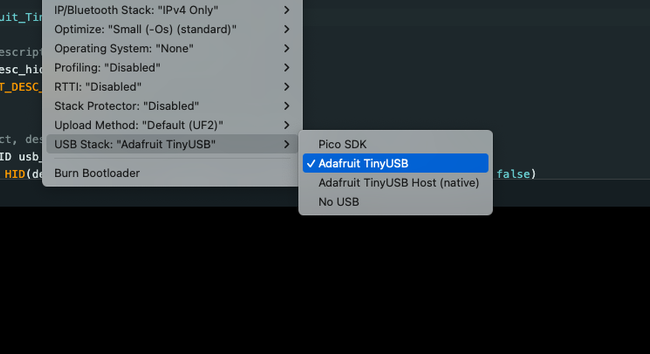
After 2+ hours of searching, reading, and testing it appears you cannot use arduino-cli with an RP2040 board and the Adafruit TinyUSB Stack because it will always defaut to Pick SDK and there is no way in the cli to specify which stack to use.

(You can obviously select it in the GUI version of the IDE, so that's the only option.)

#arduino #TinyUSB #microcontrollers

STM32 Tutorial #81 - AMAZING TinyUSB Library

In this video we will use the TinyUSB library with STM32CubeMX, STM32CubeIDE and HAL to create a composite USB CDC (communication device class) and MSC (mass storage class) device on a STM32H562.

#STM32 #GettingStarted #Tutorial #STM32CubeMX #STM32CubeIDE #TinyUSB #STM32World #USB #Composite

https://www.youtube.com/watch?v=ZywYPsIohcw

STM32 Tutorial #81 - AMAZING TinyUSB Library

YouTube

Spent some time getting a usb bulk data stream working on a Raspberry Pico 2W using TinyUSB.

Biggest hurdles were device/configuration descriptor and realizing tud_task() needs to be called frequently.

https://embeddedjourneys.com/blog/first-time-usb-data-stream-on-pico/

#pico2 #tinyusb #embedded

First Time USB Data Streaming from the Raspberry Pico 2W Using TinyUSB

Embedded Journeys
Getting up to speed regarding USB's states, enumeration process... helps to get a better grasp on tinyUSB's USB stack! #usb #tinyusb #embedded

My native #tinyusb lessons published: https://www.revk.uk/2025/11/native-tinyusb-on-esp32s3-using-my-own.html

And work is progressing well.

Native TinyUSB on ESP32S3 using my own device class

This is a summary of what I did - for those that are searching, and I spent literally days on this. I finally managed to get some help from ...

OK, the support from there #tinyusb project is not that bad, thank you.

There seems to be a mechanism for adding a custom "driver" for any specific class you want.

Basically I can copy an existing driver, tweak a few bits, put in my project, and make the tinyusb see that as a valid driver and use it.

So that is next step, making a tinyusb CCID driver. Maybe then donate it to the tinyusb project.

More on USB

So "vendor" is not generic, it is specifically class 0xFF, and checks that. Removing that check from #tinyusb allows me to get as far as bulk in working, but not bulk out. I think "vendor" does not have bulk out.

It seems all existing drivers are very class specific, and even though SMART CARD is an enumerated class there is no driver.

What I would love is a generic driver, that does not care what the class code is but adds a bulk in and out, and has callbacks for that.

Of course, the second I say that I have a brainwave, and now have #tinyusb (not esp_tinyusb) getting as far as my Mac trying to "enumerate" it and failing, calling the config request 5 times, so clearly it does not like my config. This is massive progress!

I did manage an hour in the hot tub, a coffee, and a sausage roll, so maybe that did the trick.