 Hackaday
So Long, CHU, and Thanks for All the Time Signals
https://hackaday.com/2026/05/27/so-long-chu-and-thanks-for-all-the-time-signals/
So Long, CHU, and Thanks for All the Time Signals
https://hackaday.com/2026/05/27/so-long-chu-and-thanks-for-all-the-time-signals/
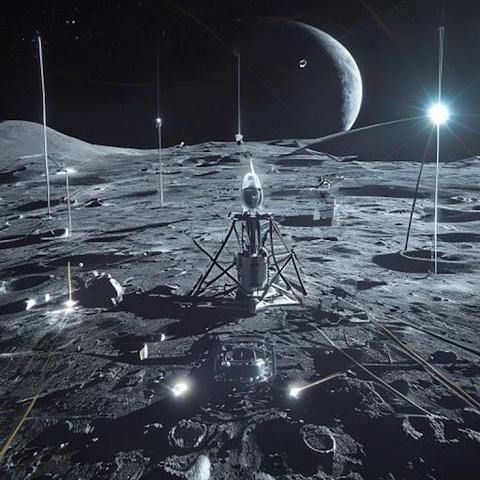
Ay’s kutup kraterlerine ultra hassas lazer saatleri yerleştirerek, bilim insanları geleceğin Ay üsleri için bağımsız bir zaman sistemi kurmaya hazırlanıyor. Uzayda zaman senkronizasyonuna yeni bir adım. 🚀 #Moon #Timekeeping
🚩 SpaceTech MoonTime LunarChronology AstroEngineering LaserGears SpaceInnovation MoonBase PrecisionScience
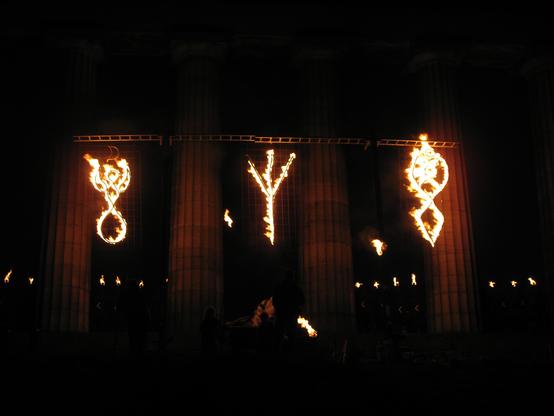
For those who celebrate, may the #Beltane fires awaken your spirit and guide toward renewal.
#MayDay is a #crossquarter day, falling halfway between the #vernalequinox and the #summersolstice
photograph of National Monument on Calton Hill, Edinburgh, during the 2007 annual Beltane Fire Festival, by B. McAdam via WikiMedia Commons (CC-BY-SA 2.0 G)
#calendar #timekeeping #seasons #astronomy #equinox #solstice
This is just one of the best, most creative things I've ever seen that came about as a direct result of a post on #Mastodon.
Direct link here:
https://boat.horse/clock/index.html
HT to the inspiration for this: @catsalad
This is terrible and this is amazing.
I just can't tell whether it's terribly amazing or amazingly terrible.
Either way, I love it, @catsalad and @secretsquirrel!
The Compression–Response Transition Index (CRTI) is a dimensionless diagnostic defined as T(t) = R(t)/\Phi(t), combining a structural quantity \Phi(t)—the spectral effective rank of a rolling covariance matrix—with a recovery quantity R(t) that captures return dynamics toward a reference operating state. While CRTI has been applied to ecological, financial, and organizational systems, the physical interpretation of its components remains challenging in data-driven contexts where structural and dynamical properties are not directly observable. This work proposes the classical mechanical clock—comprising a gear train, escapement, and pendulum—as a didactically useful, low-dimensional physical system in which the CRTI decomposition admits a clear mechanical interpretation. The escapement biases the covariance structure of the gear train toward a low-dimensional, synchronized manifold, corresponding to reduced \Phi(t), while the pendulum provides a stable limit cycle that enables a physically meaningful definition of recovery R(t) via stroboscopic (Poincaré-section) sampling. A conceptual phase diagram in the (\Phi, R) plane is constructed, identifying four qualitatively distinct regimes: stable operation (low \Phi, high R), quiescent state (low \Phi, low R), degraded/collapse regime (high \Phi, low R), and an unregulated transient regime (high \Phi, moderate R), which is explicitly characterized as non-stationary. This analysis is intended as a conceptual illustration that clarifies the physical meaning of CRTI components and their separability, rather than as a claim of universality. The clock example isolates the mechanisms of structural concentration and recovery under near-ideal observability conditions, providing a transparent reference point for interpreting CRTI in more complex systems. compression–response transition index; spectral effective rank; structural compression; recovery dynamics; escapement mechanism; pendulum dynamics; driven dissipative systems; phase portrait; early warning signals; Poincaré section
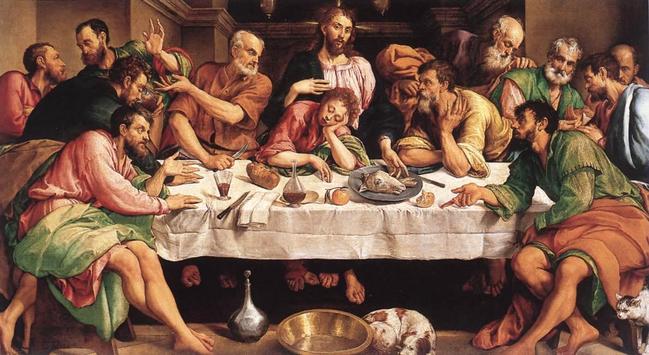
For those who observe, remember that the new commandment given this night is to love one another.
The #LastSupper ( #MaundyThursday ) is associated with a #Passover #seder observed by Jesus.
Hence, the "1st #fullmoon after the #vernalequinox " part of dating #Easter (Feast of the Resurrection), which occurs on the following Sunday.
Last Supper painting by Jacopo Bassano c. 1546 courtesy of Galleria Borghese 144
#calendar #timekeeping #astronomy
 S.v. N.Sönmez
 Jennifer Lynn Bartlett
 Hacker News
 Ehay2k
 Daniel M. Reck
 kolya
kolya N-gated Hacker News
 Bernd von Mallinckrodt 🦋