National Park Origins—Part 2:
National Parks in the U.S. originated in the context of Manifest Destiny. They became symbols of national progress, reinforced by art depicting western expansion, but their history is also marked by conquest and exclusion of Native Americans, displacing them from #sacred lands.

#NationalParks #ManifestDestiny #NativeAmericans #racism #Christianity #Animism #colonization #artists #ThomasMoran #JohnGast #Yellowstone

https://www.sacredwonderland.us/national-park-origins-2/

National Park Origins—Part 2: Shrines to a Manifested Destiny

National parks in the U.S. are often seen as places of natural beauty, but their origins are tied to Manifest Destiny—the belief that Americans were destined to settle and civilize the continent. National parks became symbols of national progress, reinforced by art depicting western expansion. While they offer refuge and inspiration, their history is also marked by conquest and exclusion of Native Americans, displacing them from sacred lands.

Sacred Wonderland
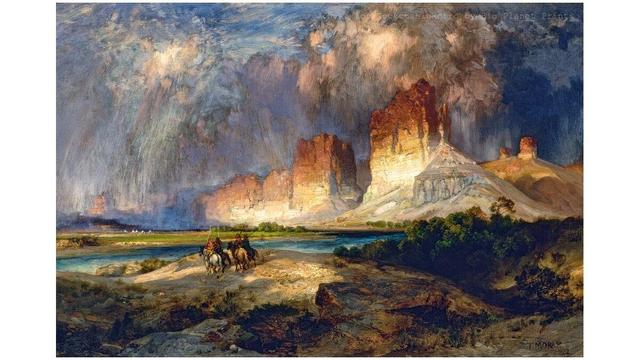
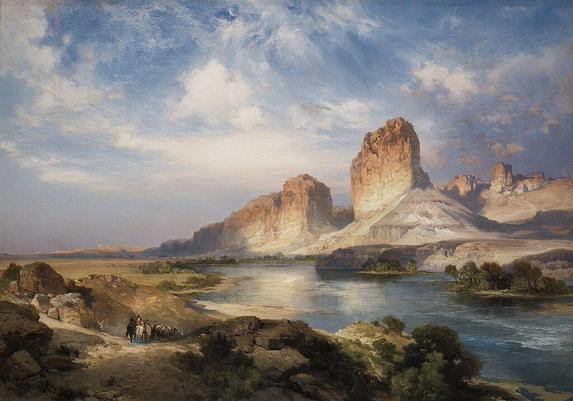
🟡 Native Men on Horseback, Cliffs of the Upper Colorado River, Wyoming Territory, 1882 Thomas Moran⁣

#19thcentury, #Cliffs, #Colorado, #Horses, #Indigenous, #Native, #Rivers, #ThomasMoran, #Wyoming

Vintage ◦ Classic ◦ Historical | Art ◦ Design ◦ Inspiration | Restored ◦ Enhanced ◦ Remixed⁣

Prints, T-Shirts, Stickers, & More by @rocketshipretro via RedBubble → https://bigplanetprints.com/go/ebbb9i
Native Men on Horseback, Cliffs of the Upper Colorado River, Wyoming Territory, 1882 Thomas Moran

Exquisite, majestic work showing the grand scenery around the cliffs and river. Four native men on horseback with spears look out onto the landscape, tents of an encampement visible in the distance.

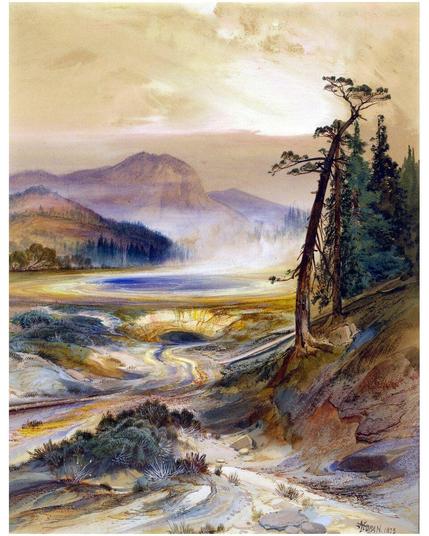
🟡 Excelsior Geyser, Yellowstone Park, Thomas Moran 1873⁣

#19thcentury, #ExcelsiorGeyser, #HotSprings, #NationalParks, #ThomasMoran, #YellowstonePark

Vintage ◦ Classic ◦ Historical | Art ◦ Design ◦ Inspiration | Restored ◦ Enhanced ◦ Remixed⁣

Prints, T-Shirts, Stickers, & More by @rocketshipretro via RedBubble → https://bigplanetprints.com/go/XEMf2e
Excelsior Geyser, Yellowstone Park, Thomas Moran 1873

A beautiful 19th century work depicting the Excelsior Geyser in Yellowstone Park.

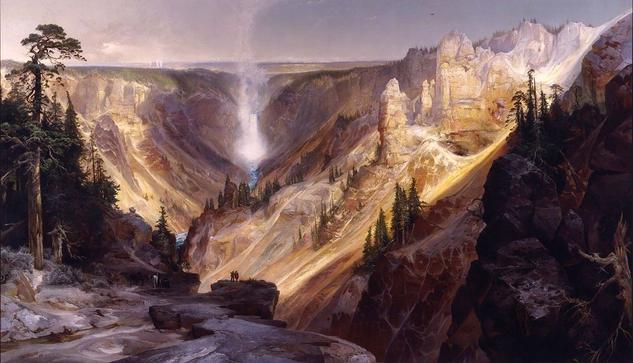
Artist Thomas Moran painted the earliest and most influential images of #Yellowstone. His paintings helped to create the national park in 1872, and his monumental Grand Cañon of the Yellowstone was purchased by the U.S. Congress for a record price. Soon prints of the painting hung in school rooms across the country. The painting now belongs to the U.S. Dept. of the Interior Museum.
#ThomasMoran #LandscapePainting #YellowstoneNationalPark #NationalParks #Artists
12 lutego 1837 urodził się Thomas Moran, amerykański malarz i grafik. Jego pejzaże Gór Skalistych i Yellowstone zachwycają i przyczyniły się do utworzenia pierwszego parku narodowego w USA. Moran należał do szkoły Hudson River i Rocky Mountain School. Upamiętnijmy tego artystę w rocznicę jego urodzin. #ThomasMoran #sztuka #historia #Yellowstone (fot. Wikipedia)
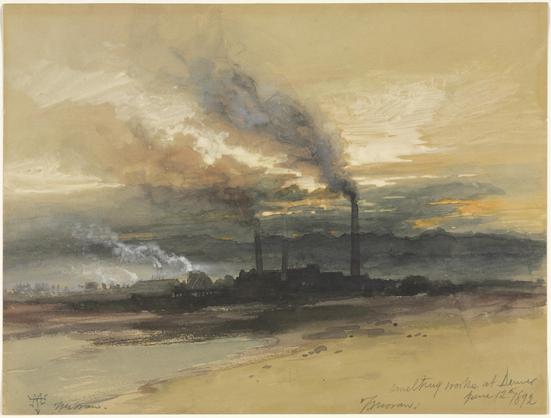
Thomas Moran’s "Smelting Works at Denver" captures the tension between industrial progress and environmental impact. A somber reminder of a time when factories heralded growth. How do we balance development with environmental stewardship today?
#Art #ClevelandArt #ThomasMoran #EnvironmentalArt #Industrialization
https://clevelandart.org/art/1938.56
Smelting Works at Denver | Cleveland Museum of Art

For today's viewers of Thomas Moran’s watercolor, the sight of factory smoke pouring into pristine mountain air might prophesy environmental ruin. Yet within the context of America’s western expansion, the imagery of factories was more ambiguous. Some in Moran's time regarded the factories as a force of destruction, while others interpreted them as symbols of progress. Moran himself viewed Denver’s budding industry with enthusiasm, writing positively to his wife about the city’s growth since he first visited while part of a government survey in 1873. Two decades later, when Moran returned to Denver to paint advertisements for the Santa Fe Railroad, smelting—the extraction of metal from heated rock—had transformed the city into an industrial hub. Although the brooding tone of this watercolor is unlike the artist’s bright, misty-eyed paintings of Edenic splendor, his depiction of the west’s emerging industrial landscape reinforces the same myth of manifest destiny—the belief that settler conquest of Native American lands was inevitable and justified—by illustrating the land’s richness in natural resources. Like the English Romantic painter J. M. W. Turner, whose style he emulated, Moran was primarily interested in the pictorial possibilities of industry. In this impressionistic study, Moran manipulates gray wash and white gouache to capture the vaporous quality of smoke and clouds as the two substances, industrial and natural, dissipate into the yellow atmosphere.

September 12 is the birthday of #American writer #HLMencken who we #quote and back with a picture of a #Fallbrook #sunset morphed into the style of #American artist #ThomasMoran. If this #quotograph speaks to you, please repost it.
Memory of a picture by Thomas Moran (1837-1926), painted with the fingers on the iPhone in the Notes app
#Erinnerung an ein Bild von Thomas Moran (1837-1926), gemalt, mit den Fingern auf dem iPhone in der App Notizen #notesArt #landschaft #kleineKunstklasse #notizenKunst #mastoart #fediart #skizzen #thomasmoran
Poligraf · The Artistic Impulse

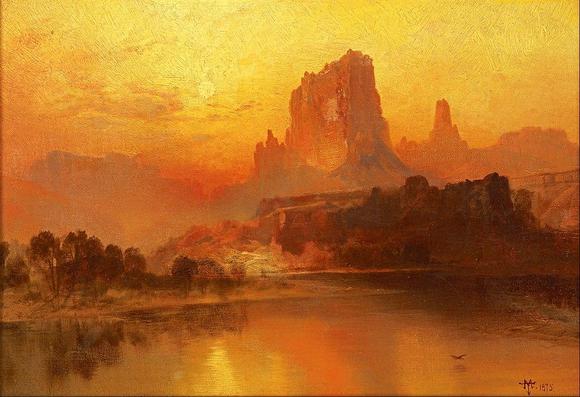
« Grand Canyon of Arizona at Sunset » by Thomas Moran

Tumblr
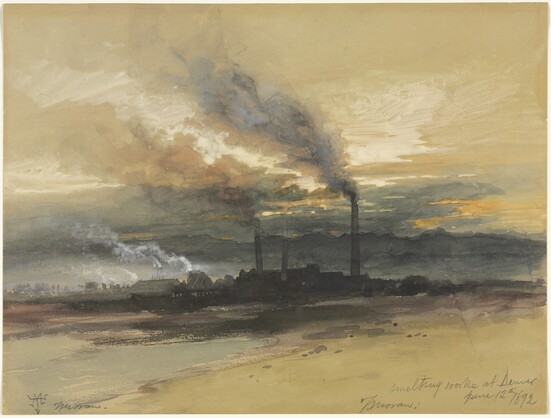
Discover Moran's energetic style in #ClevelandMuseumofArt's "Smelting Works at Denver" - capturing the dynamism of a growing city! How do you feel about industrial scenes in art? #ThomasMoran #DenverArt
https://clevelandart.org/art/1938.56
Smelting Works at Denver | Cleveland Museum of Art

For today's viewers of Thomas Moran’s watercolor, the sight of factory smoke pouring into pristine mountain air might prophesy environmental ruin. Yet within the context of America’s western expansion, the imagery of factories was more ambiguous. Some in Moran's time regarded the factories as a force of destruction, while others interpreted them as symbols of progress. Moran himself viewed Denver’s budding industry with enthusiasm, writing positively to his wife about the city’s growth since he first visited while part of a government survey in 1873. Two decades later, when Moran returned to Denver to paint advertisements for the Santa Fe Railroad, smelting—the extraction of metal from heated rock—had transformed the city into an industrial hub. Although the brooding tone of this watercolor is unlike the artist’s bright, misty-eyed paintings of Edenic splendor, his depiction of the west’s emerging industrial landscape reinforces the same myth of manifest destiny—the belief that settler conquest of Native American lands was inevitable and justified—by illustrating the land’s richness in natural resources. Like the English Romantic painter J. M. W. Turner, whose style he emulated, Moran was primarily interested in the pictorial possibilities of industry. In this impressionistic study, Moran manipulates gray wash and white gouache to capture the vaporous quality of smoke and clouds as the two substances, industrial and natural, dissipate into the yellow atmosphere.