https://newstainmentora.blogspot.com/2025/04/super-earths-are-quite-common-outside.html
#superearths #Space #Universe #solarsystem
"This result suggests that in Jupiter-like orbits, most planetary systems may not mirror our solar system," said co-author Youn Kil Jung of the Korea Astronomy and Space Science Institute, which operates the KMTNet."
I'm thinking big ol' Jupiter might hold the key as to why the inner Solar System is the way it is and why it's different from most other systems we know of so far.
https://phys.org/news/2025-04-super-earths-common-solar.html
An international team including astronomers from the Center for Astrophysics | Harvard & Smithsonian (CfA) has announced the discovery of a planet about twice the size of Earth orbiting its star farther out than Saturn is to the sun.
A super-Earth beyond Mars would have made Earth nearly uninhabitable | Space
https://www.space.com/the-universe/solar-system/a-super-earth-beyond-mars-would-have-made-earth-nearly-uninhabitable
#KnowledgeByte: #SuperEarths – a class of planets unlike any in our solar system – are more massive than Earth yet lighter than ice giants like Neptune and Uranus.
Studying Super-Earths are important because these might be more likely to hold onto elements that are key for life, like water.
https://knowledgezone.co.in/posts/What-is-Super-Earth-632ea6e987c2de7beb343d26
Astronomers have discovered three potential “super-Earth” #exoplanets orbiting a relatively nearby orange dwarf #star, marking an important development in the search for habitable #planets.
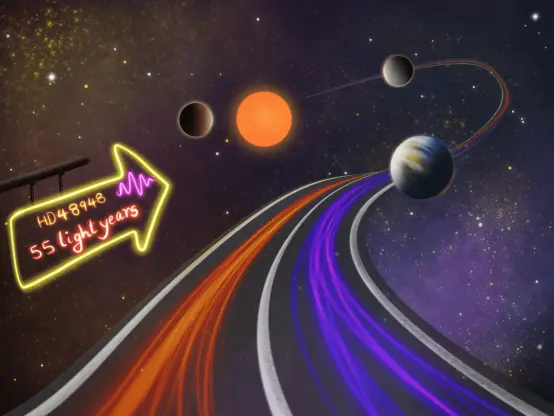
📷 Artistic Impression of planetary system HD48948 which is located at a distance of 55 light-years from #Earth. The #Voyager 1 #spacecraft with its current speed would take almost one million years to reach HD48948. Credit: Soumita Samanta
https://news.st-andrews.ac.uk/archive/astronomers-find-three-potentially-habitable-super-earths/
Artistic Impression of planetary system HD48948 which is located at a distance of 55 light-years from Earth. The Voyager 1 spacecraft with its current speed would take almost one million years to reach HD48948. Image Credits: Soumita Samanta Astronomers have discovered three potential “super-Earth” exoplanets orbiting a
in the #arXiv
Populating The Milky Way: Characterising Planet Demographics by Combining Galaxy Formation Simulations and Planet Population Synthesis Models
by C. Boettner and co-authors
https://arxiv.org/abs/2402.08029
#milkyway #galaxy #planets #demographics #planetdemographics #earths #superearths #neptunians #subgiants #giants #map #HESTIA #model #simulation #astronomy #astrophysics #astrodon #space #science #research #STEM
Stellar populations and their distribution differ widely across the Galaxy, which is likely to affect planet demographics. Our local neighbourhood is dominated by young, metal-rich stars in the galactic thin disc, while the stellar halo and galactic bulge host a large fraction of older, metal-poor stars. We study the impact of these variations on planet populations in different regions of the Galaxy by combining a high-resolution galaxy formation simulation with state-of-the-art planet population synthesis models. We construct a population model to estimate occurrence rates of different planet types, based on the New Generation Planet Population Synthesis by Emsenhuber et al., 2021. We apply this to a simulated Milky Way--Analogue in the HESTIA galaxy formation simulation. We study the planet occurrence rate in the metal-rich regions of the inner Galaxy, i.e. in the galactic bulge and thin disc, and contrast them to the frequencies in the more distant, metal-poor region like the thick disc and stellar halo. We find that the planet demographics in the metal-poor regions of the Milky Way-Analogue, differ strongly from the planet populations in the more distant, metal-poor regions. The occurrence rate of giant planets ($>300 M_\bigoplus$) is 10 to 20 times larger in the thin disc compared to the thick disc, driven by the low amounts of solid material available for planet formation around metal-poor stars. Similarly, low-mass Earth-like planets around Sun-like stars are most abundant in the thick disc, being 1.5 times more frequent than in the thin disc. Moreover, low-mass planets are expected to be abundant throughout the galaxy, from the central regions to the outer halo, due to their formation processes being less dependent on stellar metallicity. The planet populations differ more strongly around Sun-like stars compared to dwarfs with masses 0.3 - 0.5 $M_\odot$.
Data from Kepler reveals reason behind shrinking exoplanets
https://www.nasaspaceflight.com/2023/11/shrinking-subneptunes/
Located throughout the universe, there are billions — possibly even trillions — of exoplanets orbiting… The post Data from Kepler reveals reason behind shrinking exoplanets appeared first on NASASpaceFlight.com .
#Featured #Other #Science #Exoplanets #K2 #Kepler #NASA #planetary_science #planets #subNeptunes #superEarths
#Astronomers discover a key #planetarysystem for understanding formation mechanism of mysterious '#superEarths'
https://phys.org/news/2023-05-astronomers-key-planetary-formation-mechanism.html
A study led by researchers of the University of Liège and the CSIC—using observations from NASA's TESS telescope—presents the detection of a system of two planets slightly larger than Earth orbiting a cold star in a synchronized dance. Named TOI-2096, the system is located 150 light-years from Earth.