 Serhii Chrucky
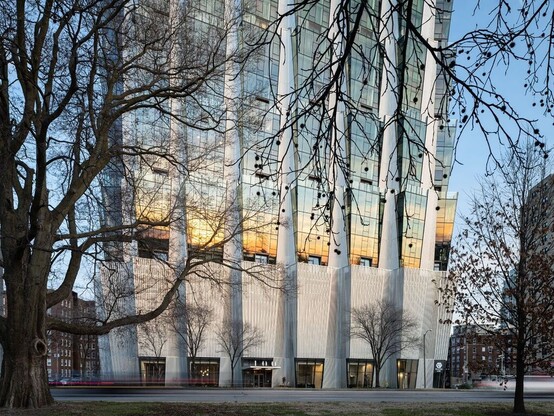
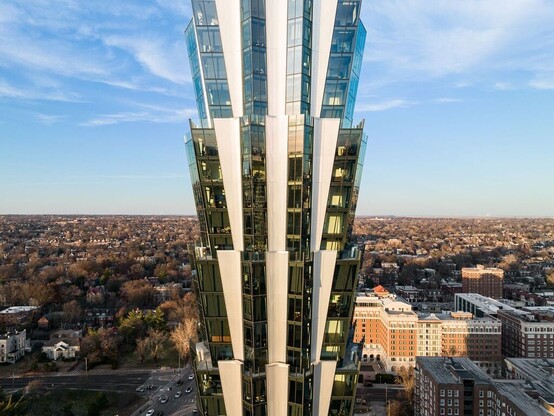
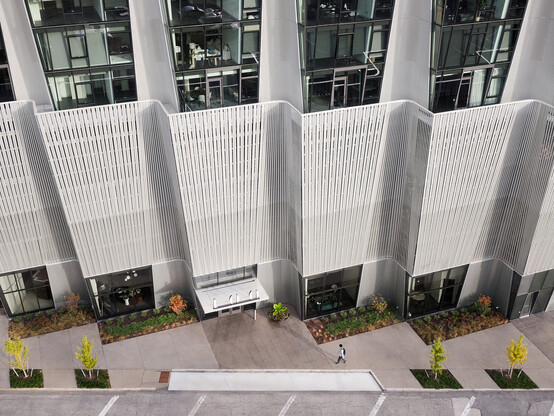
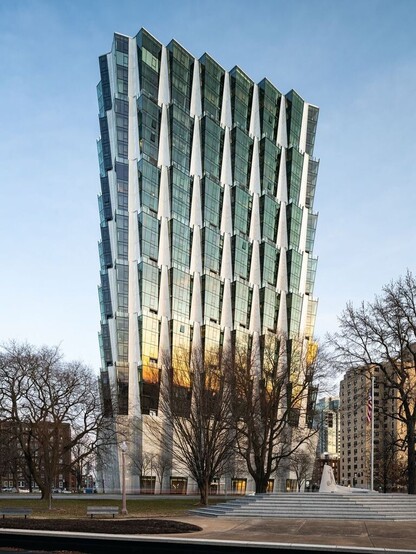
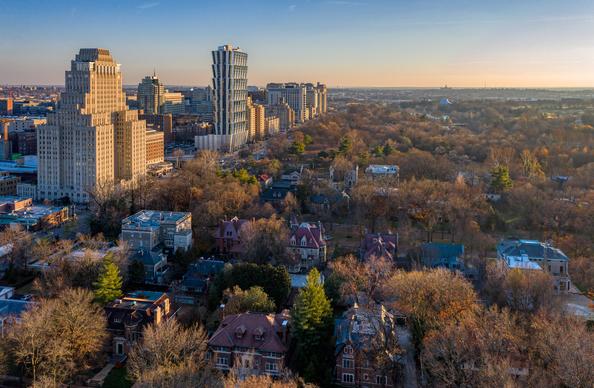
100 Above the Park \\ Studio Gang \\ St. Louis, MO \\ 2020
#stlouis #architecture #contemporaryarchitecture #architecturalphotography #studiogang
#stlouis #architecture #contemporaryarchitecture #architecturalphotography #studiogang
Studio Gang designs Brooklyn fire station to train elite firefighters
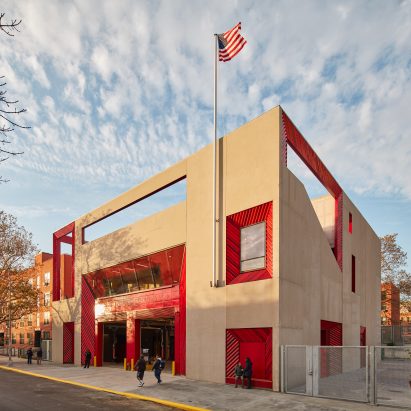
Studio Gang has completed a fire station for Brooklyn's elite force that doubles as a simulation and training facility for extreme rescue situations.
The new headquarters for the FDNY's Rescue 2 unit is located in Brownsville, Brooklyn. Each of New York's five boroughs has a dedicated Rescue team.
Studio Gang designed a firestation in Brooklyn
These teams are highly specialized in extreme conditions that include rappelling down buildings, navigating collapsed structures, and even deploying for underwater rescue operations.
The building serves as the elite unit's headquarters, where the firefighters sleep, train, and coordinate their operations.
"The rescue company is trained to respond to various emergency scenarios, from fire and building collapses to water rescues and scuba operations," said US firm Studio Gang.
The station hosts and trains Brooklyn's elite firefighters
"The new Rescue Company 2 facility is designed as a tool for training, enabling FDNY’s elite force of specialized rescue workers to stage and simulate a wide range of emergency conditions in, on, and around the building," the studio added.
The building is organized around a three-storey-tall volume that is meant to accommodate firefighters' rappelling training. On the exterior, various anchor points similarly allow the firefighters to practice using the building itself.
The double-height interiors allow for training within the building
"The void enables the team to practice rescue scenarios that mimic conditions common to the city, using its height and associated elements of balconies, bridge, doorways, ladders, and stairs," Studio Gang explained.
"At the same time, it introduces natural light and fresh air, improving the quality of everyday life within the building," they added.
The architects put in skylights for more comfortable habitation
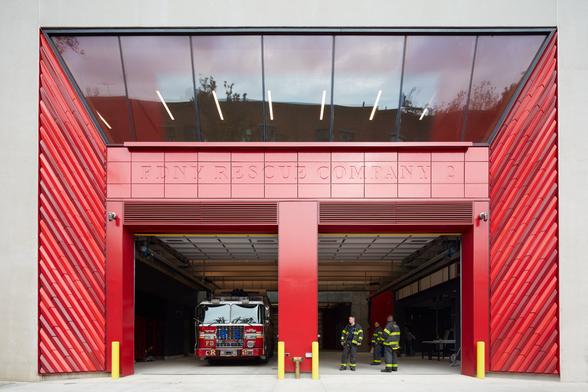
The ground floor contains two garage bays for fire trucks, which are flanked by the classic firefighter poles, as well as easy-access storage for a wide variety of tools and building materials that may be needed in an emergency.
At the back, facing a courtyard, the architects included a kitchenette and conference room, where on-duty firefighters spend their time between operations.
[
Read:
Studio Gang breaks ground on Populus building designed to be US' "first carbon-positive" hotel
](https://www.dezeen.com/2022/04/28/studio-gang-populus-denver-carbon-positive/)
The top two floors contain a range of rooms for the normal operations of the unit, including bunk rooms, a gym, and administrative offices. On the roof, the architects included planted areas and a space for the firefighters to enjoy the outdoors.
The concrete building is fronted with terracotta tiles that recall the red colour typically used for fire engines. These colourful accents line the surroundings of the windows, drawing attention to the building's function from the exterior.
The red terracotta tiles recall the red firetruck
"On the exterior, red glazed terracotta panels surround a smaller-scale series of voids (windows and doors) with highly crafted details animating these points of connection between the facility and the community it serves," the architects explained.
Studio Gang is headquartered in Chicago and has offices in New York City, San Francisco, and Paris. Other notable projects by the American studio include an expansion to the American Museum of Natural History, and a twisting residential tower in San Francisco dubbed Mira.
The photography is byTom Harris.
Project credits:
Structural engineer: Thornton Tomasetti
MEP & Fire protection: ads
Civil engineer: Langan, civil engineer
Landscape architect: SCAPE
Wayfinding and signage consultant: Once–Future Office
Lighting consultant: Domingo Gonzalez Associates
Cost estimator: Toscano Clements Taylor
Expeditor: KM Associates of New York
Construction manager: The LiRo Group
General contractor: ZHL Group
Precast concrete fabricator: High Concrete Group
Terracotta rainscreen fabricator: Boston Valley Terracotta
The post Studio Gang designs Brooklyn fire station to train elite firefighters appeared first on Dezeen.
#all #architecture #publicandleisure #usa #terracotta #brooklyn #firestations #newyorkcity #studiogang #publicspace #newyork
Studio Gang breaks ground on Populus building designed to be US' "first carbon-positive" hotel
As construction begins on Populus, a Denver hotel designed by architecture firm Studio Gang, developer Urban Villages has announced that it aims to be the "first carbon-positive" hotel in the United States.
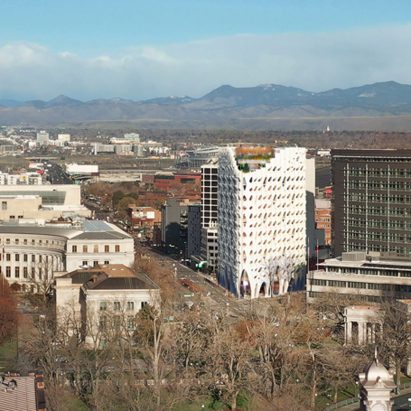
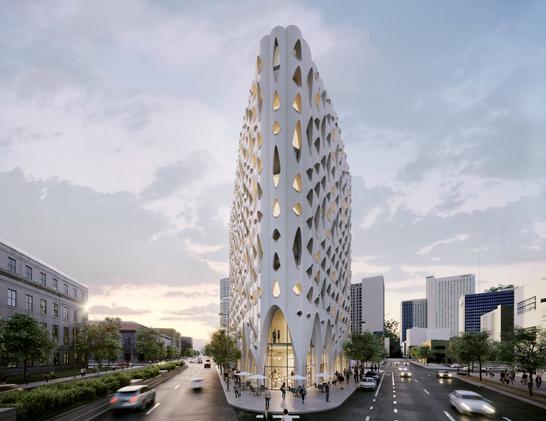
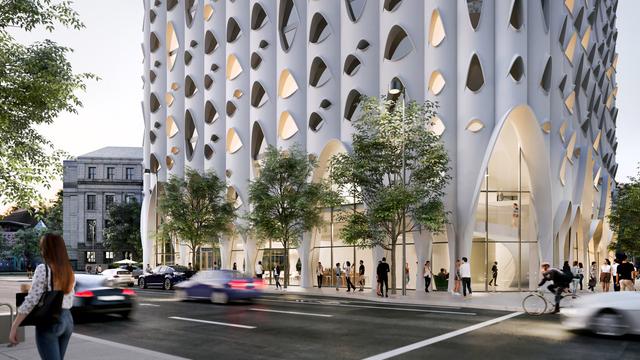
Created by Chicago-based Studio Gang, Populus' shape was informed by the aspen tree and the white hotel facade will be covered in windows that resemble the eye-shaped patterns found on the tree's bark.
According to Urban Villages, the hotel will achieve a "carbon-positive" design through "substantial ecological effort offsite, including an initial commitment to planting trees that represent over 5,000 acres of forest".
Studio Gang's in-progress hotel in Denver will be "carbon-positive"
While not a direct feature of the hotel, the developers said that this initiative will "offset an embodied carbon footprint equivalent to nearly 500,000 gallons of gas and [remove] additional carbon dioxide from the atmosphere".
According to Urban Villages, the construction process has been planned to mitigate carbon at every stage.
These plans include using low-carbon concrete mixture and "high-recycled" content materials, as well as maximizing structural efficiency and minimizing waste and finish materials.
The lidded openings in the facade were designed to resemble aspen eyes
"Before we started construction on Populus, we calculated the carbon footprint of the entire project," Jon Buerge, chief development officer of Urban Villages, told Dezeen.
"This included the extraction, production, transportation, and construction of every element of the building,"
"Not only will we plant over 700k trees, we are also committed to continually planting more trees to offset the energy we consume every day after the hotel opens," Buerge added.
[
Read:
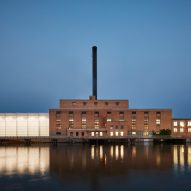
Studio Gang transforms Wisconsin power plant into Beloit College student union
](https://www.dezeen.com/2020/11/16/powerhouse-beloit-college-student-union-studio-gang/)
The aim is for Populus, which will sit on a triangular block near Civic Center Park in downtown Denver, to become the first carbon-positive hotel in the country.
"Improving the resiliency of our cities has never been more urgent—and it includes reducing carbon emissions as well as strengthening community bonds," says Jeanne Gang, founder of Studio Gang.
"We’ve designed Populus to be a new destination in downtown Denver that combines these environmental and social ambitions," she added.
The structure itself will mirror its triangular site, with the entrance at the slimmest part of the building. The rest of the structure will widen out toward the back of the structure.
A white facade structure wraps the hotel and comes to arched points at street level. Between the legs of the arches will be glazing covering the lobby and ground-level amenities.
Slits in the building's facade transverse floors and serve as lidded windows. They were designed to resemble "aspen eyes", the dark spots on the trunks of aspen trees left by limbs that have been shed.
The "lids" around the windows will provide shade as well as redirect rainwater, according to the studio. Some of the windows near the base will be 30 feet tall (9.1 metres).
"The windows and facade are also tuned for high environmental performance – self-shading, insulating, and channeling rainwater – as part of the architecture’s larger green vision," Gang said.
The rooms inside Populus will be minimal with views of the surroundings
265 guest rooms will fill the 13-storey hotel, which will also house eateries on the ground floor and have conference rooms for larger business meetings.
A staircase in the lobby will extend an "activated street-level experience to the curated second floor," said Urban Villages. The second floor will have large, flexible rooms for gatherings.
On the roof, a stepped cut-out will make room for a restaurant and public garden terrace.
[
Read:
Dezeen's top 10 low-carbon buildings of 2021
](https://www.dezeen.com/2021/12/14/low-carbon-buildings-review-2021/)
Renderings of the interiors show minimalist rooms with window seats that curve with the angle of the windows.
"We knew that for Populus to make an impact and be successful as the country’s first carbon-positive hotel, it needs to attract guests visually as well," Grant McCargo, chief executive officer of Urban Villages, told Dezeen.
The team broke ground on the hotel earlier this month.
Studio Gang is led by Jeanne Gang, and its recent projects include a skyscraper with angled facades in St Louis as well as an upcoming extension of the Natural History Museum in New York.
The images are courtesy of Studio Gang.
The post Studio Gang breaks ground on Populus building designed to be US' "first carbon-positive" hotel appeared first on Dezeen.
#hotels #all #architecture #news #studiogang #denver #carbonneutraldesign #colorado #us
Studio Gang designs One Hundred skyscraper with angled facades in St Louis
Architecture firm Studio Gang has completed a tiered residential skyscraper with angled glass elements that overlooks Forest Park in St Louis, Missouri.
Called One Hundred, the high-rise tower was completed in 2020 and takes its name from its location at 100 Kingshighway Boulevard in St Louis, which overlooks the park to the west.
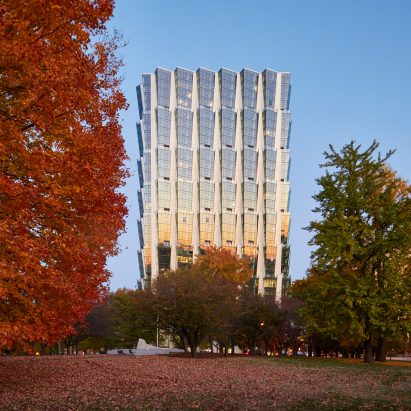
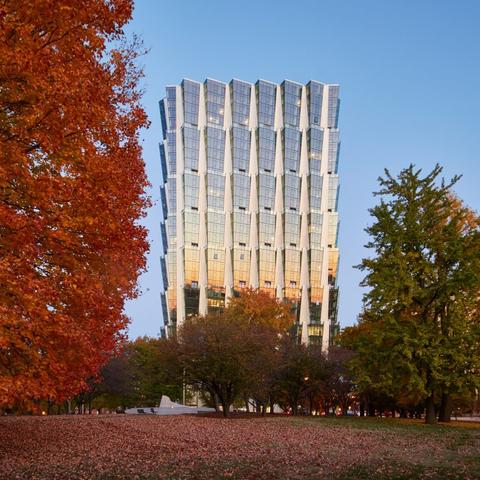
The tower overlooks Forest Park
The 380-feet-tall (116-metre-tall) tower has 316 units and measures 520,000 square feet (48, 310 square metres).
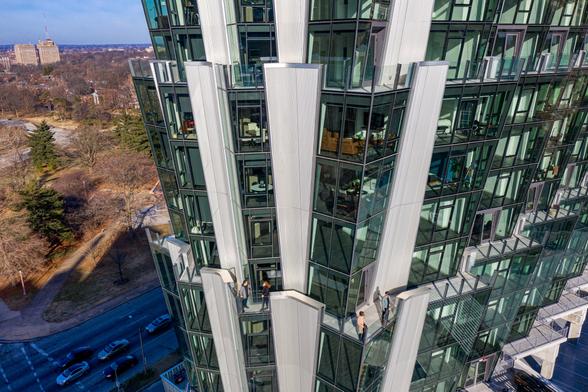
Tiers of four storeys tier each are stacked over the height of the tower. Fanned sections of glazing jut out and reflect the parkland opposite.
Trees are reflected in the building's gleaming facade
"The building reflects the changing light and weather in Forest Park, providing a dynamic backdrop for foliage and snow alike," said Studio Gang.
Outdoor spaces occupy the tops of each tier, which provide terraces for a quarter of the apartments. A green roof podium is shared between residents. The overlapping glass elements form the balcony rail.
Angled facades create outdoor spaces
With views of the city's Gateway Arch to the east, each apartment has a corner living room with double exposure windows that flood the interior with light.
The tower's ground floor includes public and retail spaces.
A community space in the building
Studio Gang was founded in 1997 by architect Jeanne Gang. One Hundred is the firm's first project in the city of St Louis. Recent designs from the practice includes plans for a hotel in Denver with a scalloped facade and the Mira tower in San Francisco.
More projects in St Louis include a subterranean museum below architect Eero Saarinen's arch and basketball courts painted with murals by the artist William LaChance.
Photography is by Sam Fentress and Tom Harris.
The post Studio Gang designs One Hundred skyscraper with angled facades in St Louis appeared first on Dezeen.
#skyscrapers #all #architecture #usa #towers #missouri #studiogang #usskyscrapers #stlouis
Studio Gang reveals folded concrete roof of Arkansas Museum of Fine Arts
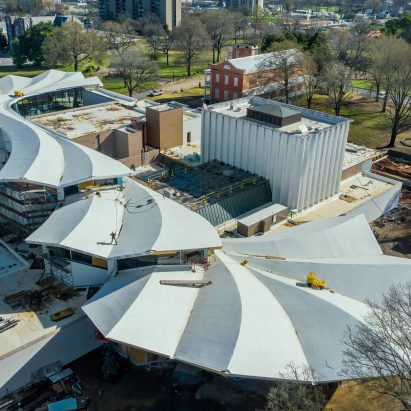
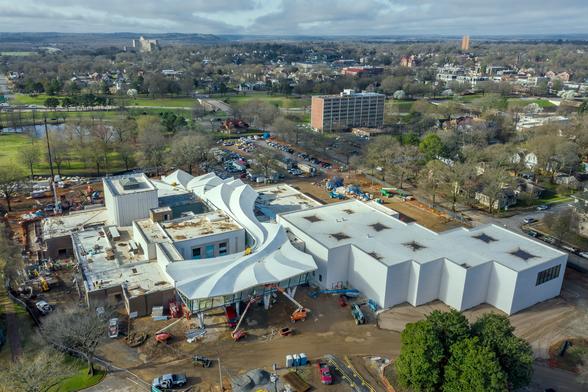
A folded concrete roof designed by Studio Gang is now in place at the Arkansas Museum of Fine Arts in Little Rock, which is currently being overhauled by the studio.
American architecture office Studio Gang and landscape architecture firm SCAPE released photos of the roof ahead of the museum's anticipated May 2022 opening date.
Arkansas Museum of Fine Arts will open next year
Encompassing 133,000 square feet (12,300 square metres), when complete, the museum will be surrounded by 11 acres of landscaped public parkland.
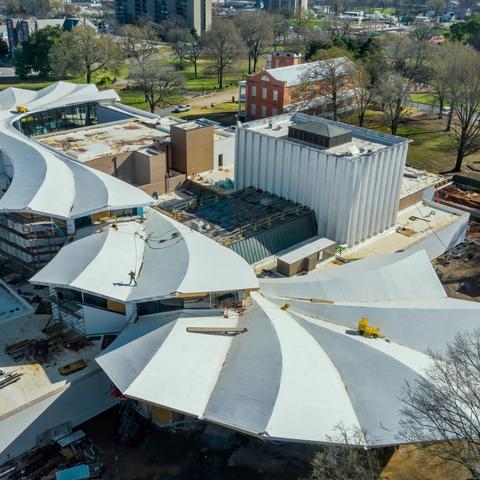
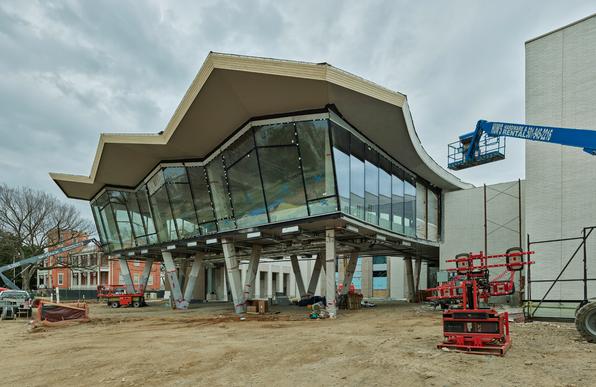
The faceted roof is made of thin concreted arranged in angular folds. It covers a series of curving pavilions that will connect the existing structures on the site, which are being renovated and remodelled as part of the scheme.
The north end of the new structure features a glazed second storey
SCAPE and Studio Gang founder Jeanne Gang designed the new Arkansas Museum of Fine Arts in partnership with Little Rock firm Polk Stanley Wilcox Architects.
Formerly the Arkansas Arts Center, the original museum was built in 1937 by architect H Ray Burks and has been extended numerous times.
To the south the building will open onto a terrace
As part of a $142 million redesign, the new buildings topped by the folded concrete roof will cross museum complex, forming a central axis.
Acting "like the stem of a plant", said Studio Gang, this new throughway will have renovated galleries and performance space branching off from it.
The concrete roof shelters the new connecting pavilions
At either end, the concrete roof will widen to frame the entrances. To the north, where the museum faces the city, the roof will wrap around a courtyard and frame a second storey hall with floor-to-ceiling glazing.
An expansion of the facilities undertaken in 1982 swallowed the original art deco limestone facade carved by local artist Benjamin D Brantly, so Studio Gang decided to re-instate it at the city-side entrance as part of the redesign.
The roof is now in place at the Arkansas Museum of Fine Arts
At the other end, the glass-walled entryway will open onto a terrace with a restaurant and gardens landscaped by SCAPE featuring 50 native species of plants arranged in petal-shaped gardens to echo the design of the roof.
Recent cultural projects underway from Chigaco-based Studio Gang include an extension to the American Natural History Museum in New York and the redesign of a park in Memphis.
Photography is by Timothy Hursley.
Project credits:
Architect: Studio Gang
Landscape architect: SCAPE
Local architect: Polk Stanley Wilcox Architects
The post Studio Gang reveals folded concrete roof of Arkansas Museum of Fine Arts appeared first on Dezeen.
#all #architecture #publicandleisure #news #usa #concrete #museums #studiogang #arkansas
 dezeen (unofficial)
