Working list: America’s tallest hydropillar water towers

The following list identifies the tallest hydropillar water towers identified to date in the United States, as well as those for which the height has not bee identified. As more are identified, they will be added to the lists. Hydropillars are sometimes also referred to as fluted, fluted column, or fluted pillar water towers.

Source: facebook.com

Hydropillars started to become popular in the 1960s and are still being constructed today, though not to the extent there were in the 1970s and 1980s. The oldest ones on these lists date back to 1967, while the newest ones on these lists were completed in 2018.

Source: commons.wikipmedia.org

Hydropillar water towers are constructed with an exterior all carbon steel from the ground up to and including the tank. The carbon steel hides the structural elements and are often wide/open enough to house a mixed of certain government funcitions or even in four cases (Dublin, OH; Union Township, OH; Shelbyville, IN; and Halthom City, TX – which moved out of the tower in 2022) to a have had complete fire station built within the base of the elevated water tank.

Union Township, OH – Source: utclermont.gov Shelbyville, IN – Source: shelbyville.in.gov

The storage capacity and adaptability of the lower portions of the tower are among the chief advantages of the hydropillar. On the down side, the entire exterior of structure must be maintained on a regular basis, whereas the concrete pedestal f a composite tower requires less maintenance. Peace!

——-

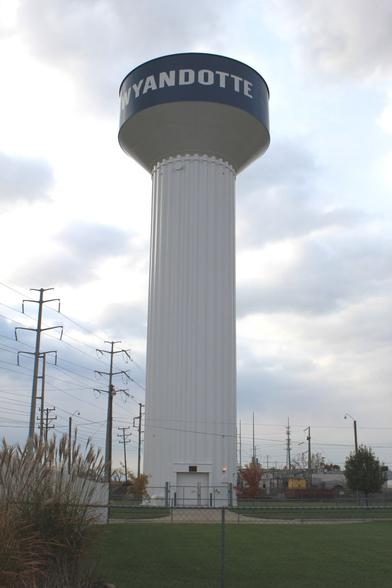
  • Wyandotte Hydropillar: Wyandotte, MI = 215 feet
  • 2. University of South Florida Hydropillar: Tampa, FL = 212 feet

    3. Kirk Road Hydropillar (2005): Austintown, OH = 209 feet

    4. Little Canada Water Tower (1997): Little Canada, MN = 192 feet

    5. Aggieland Hydropillar (1975): College Station, TX = 186 feet – added 3/3/25

    6. Eagan/Inver Grove Heights Hydropillar (1997):Eagan, MN = 183 feet

    7. PWS District #1 Arnold Hydropillar (1976): Arnold, MO = 182 feet

    8-9. Wehrle “Big Blue” Hydropillar (1987): Amherst, NY and Ripon Hydropillar: Ripon, CA = 175 feet

    10. Friendship Park Hydropillar (1960s): Yuma, AZ ~ 170 feet

    11-13. Carter Park Hydropillar (1985): Bowling Green OH; Western Hydropillar (1986): Bowling Green OH; and Alsip Water Tower #2 (1967): Alsip, IL = 165 feet

    14-15. Hibbing Public Utilities Water/Ansley Tower (2003); Hibbing, MN and Buzzards Bay Hydropillar: Bourne, MA = 162 feet

    16-18. Keokuk Hydropillar (2011): Keokuk, IA; London Road Hydropillar (1980s): Delaware, OH and Urbandale/170th Street Hydropillar (2006): Urbandale, IA = 160 feet

    19. Hibbing/Mesabi Water Tower (1982): Hibbing, MN = 157 feet

    20-22. City of Champlin Hydropillar (1984): Champlin, MN; Salisbury Township Hydropillar: Allentown, PA; and Lake Mary Hydropillar: Lake Mary, FL = 150 feet

    23-24. DeSoto Hydropillar: DeSoto, IA and North “Fluted” Water Tower: Meridian Township, MI ~ 148 feet – Meridian added 3/18/25

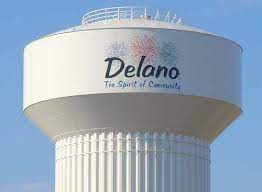
    25. Delano Water Tower (2007): Delano, MN = 146 feet

    26. Pleasant Hill Hydropillar (1977): Pleasant Hill, IA = 142 feet

    27. Le Mars Hydropillar (2015): Le Mars, IA = 140 feet

    28. 50th Avenue NW Hydropillar: Rochester, MN = 137 feet

    29. Alsip Water Tower #1 (1967): Alsip, IL ~ 134 feet

    30. Stone Harbor Water Tower: Stone Harbor, NJ = 133 feet

    31. DeKalb Hydropillar (1967): DeKalb, IL ~ 131.5 feet

    32. 16th Street Hydropillar (1998): Sedalia, MO = 131 feet

    33. Florence Y’all Water Tower (1974): Florence, KY = 130 feet

    34. Andover Hydropillar (1985): Andover, MN = 127 feet

    35. Coon Rapids Hydropillar (2003): Coon Rapids, MN = 125 feet

    36. Oak Park Avenue Hydropillar: Oak Forest, IL = 122 feet37. Millersville Road Hydropillar (ca 2018): Lancaster, PA = 113 feet

    37. Cherry Street Hydropillar (2004): Erie, PA = 110 feet

    38-39. Mitchellville Water Tower: Mitchellville, IA and North Suburban Public Utility Water Tower (1971): Glenview, IL = 100 feet

    40. Maple Avenue Water Tower (1988): Downers Grove, IL = 77.5+ feet

    41. 40th Street North Hydropillar (1990): Plymouth, MN = 72+ feet

    Source: pttg.hexagon.tools

    More information needed:

    • Wind Creek Casino Hydropillar: Atmore, AL
    • Harvest-Monrovia Water Authority: Harvest, AL
    • Troy “Trojan Territory” Hydropillar (1998): Troy, AL
    • Blackhawk Hydropillar: Pea Ridge, AR
    • Madera Valley Water Hydropillar: Madera, CA
    • Mistlin Sports Park Hydropillar: Ripon, CA
    • Pueblo Hydropillar: Pueblo, CO
    • Westminster Hydropillar: Westminster, CO
    • Bonita Springs Hydropillar: Bonita Springs, FL = 151 feet – demolished in 2019
    • Hull Hydropillar: Hull, IA
    • Northeast Hydropillar: Newton, IA
    • Southeast Hydropillar: Newton, IA
    • West Des Moines Hydropillar (2005): West Des Moines, IA
    • Addison Hydropillar: Addison, IL
    • Dolton Water Tower: Dolton, IL
    • Worth Water Tower: Worth, IL
    • 131st Street Hydropillar: Carmel, IN
    • Franklin Township Hydropillar: Indianapolis, IN
    • Shelbyville Hydropillar: Shelbyville, IN – contains a fire station
    • Hays Hydropillar: Hays, KS
    • BFWC Hydropillar: Florence, KY
    • Lawrence Hydropillar: Lawrence, MA
    • Bowie Triple Hydropillars: Bowie, MD
    • Corporate Drive Hydropillar (2004): Charles City, MD
    • Durand Hydropillar: Durand, MI
    • Andover Water Tower (1989): Andover, MN =
    • Anoka Water Tower (2001): Anoka, MN =
    • Arden Hills Water Tower (1968): Arden Hills, MN
    • Baxter Water Tower: Baxter, MN
    • Arbor Point Water Tower (2005): Inver Grove Heights, MN
    • Asher Water Tower (2014): Inver Grove Heights, MN
    • Mankato Hydropillar: Mankato, MN
    • New Hope Hydropillar: New Hope, MN
    • North Water Tower (1992): Orono, MN
    • White Bear Lake Hydropillar: White Bear Lake, MN
    • Belton Hydropillar: Belton, MO
    • Missouri American Hydropillar: Joplin, MO
    • North Hydropillar (2001): Macon, MO
    • New Melle Hydropillar: New Melle, MO
    • Hydropillar Tower: Raytown, MO
    • West Hydropillar (1985): St. Charles, MO
    • Merit Health Hydropillar: Hattiesburg, MS
    • Atlantic Beach Water Tower: Atlantic Beach, NC x 2
    • Fayetteville Hydropillar: Fayetteville, NC
    • I-74 Ward Water Tower: High Point, NC
    • All-American City Hydropillar: Lumberton, NC
    • Scottsbluff Water Tower: Scottsbluff, NE
    • Broad Street Hydropillar: Burlington City, NJ
    • Eastern Water Service Hydropillar (2018): Manchester Township, NJ
    • OCWA Hydropillar: Brewster, NY
    • Colvin Hydropillar (2005): Tonawanda, NY
    • Ashland Hydropillar: Ashland, OH
    • Centerville Hydropillar: Centerville, OH
    • Cleveland Hydropillar: Cleveland, OH
    • Dublin Water Tower: Dublin, OH – may have been removed?
    • Dublin/Washington Township Hydropillar: Dublin, OH – contains fire station
    • Five Points Hydropillars (x2): Five Points, OH
    • La Grange Hydropillar: La Grange, OH
    • Marysville Hydropillar: Marysville, OH
    • Clermont County Water Tower: Miami Township, OH =
    • Clermont County Hydropillar: Union Township, OH – contains a fire station
    • New Middletown Hydropillar: New Middletown, OH
    • Ranger Pride Hydropillar: North Ridgeville, OH
    • Downtown “R.M. Davis” Hydropillar: Piqua, OH
    • Butler County Water Tower: West Chester, OH
    • Bulldogs Caterpillar: Okmulgee, OK
    • North Wales Water Tower: Chalfont, PA
    • East Lake Hydropillar: Erie, PA
    • Pennsylvania American Water Tower:
    • Alligator Rural Water Tower: McBee, SC
    • Manitowoc Hydropillar: Manitowoc, WI
    • Oshkosh Hydropillar: Oshkosh, WI
    • Blaine Water Tower (1981): Blaine, MN
    • Water Tower #1 (1972): Bloomington, MN
    • Water Tower #4 (1973): Brooklyn Center, MN
    • Water Tower #1 (1998): Brooklyn Park, MN
    • Halthom City Hydropillar (1983): Halthom City, TX – once contained a fire station
    • Huntsville Hydropillar: Huntsville, TX
    • Rainbow Water Tower: Odessa, TX
    • Water Plant #3 Hydropillar: Shenandoah, TX
    • Bealeton Hydropillar: Bealeton, VA
    • Bellwood Tank Hydropillar (1987): Bellwood, VA
    • Water Tower #1: Cambridge, MN
    • Water Tower #1 (2010): Carver, MN
    • Water Tower #3 (1995): Chanhassen, MN
    • Industrial Water Tower (1971); Chaska, MN
    • Symphony Hills/Bavaria Water Tower (2006): Chaska, MN
    • Hundertmark Water Tower(2002): Chaska, MN
    • Chisago City Water Tower (1989): Chisago City, MN
    • Cakato Water Tower: Cakato, MN
    • Cottage Grove Water Tower (2001): Cottage Grove, MN
    • Eden Prairie Water Tower (1981): Eden Prairie, MN
    • Edina Water Tower (1989): Edina, MN
    • Elk River Water Tower #1 (1985): Elk River, MN
    • Elk River WaterTower #2 (1985): Elk River, MN
    • Fairmont Water Tower (2003): Fairmont, MN
    • Farmington Water Tower (1974): Farmington, MN
    • Fergus Falls Water Tower #1 (1997): Fergus Falls, MN
    • Fergus Falls WaterTower #2 (2007): Fergus Falls, MN
    • Fridley Water Tower (1991): Fridley, MN
    • Grand Rapids Water Tower (2001): Grand Rapids, MN
    • Hastings Water Tower (1985): Hastings, MN
    • Hastings Water Tower (1997): Hastings, MN
    • Isanti Water Tower (2003): Isanti, MN
    • Fairfield Water Tower (1984); Lakeville, MN
    • Airlake Water Tower (1968): Lakeville, MN
    • Jordan Water Tower: Jordan, MN
    • Lino Lakes Water Tower (1991): Lino Lakes, MN
    • Lino Lakes WaterTower (1997); Lino Lakes, MN

    SOURCES:

    #1 #2 #3 #4 #adaptiveResuse #cities #emergencyServices #engineering #fireStations #flutedColumns #flutedPillars #geography #history #hydopillars #landUse #mixedUses #planning #stats #towns #travel #utilities #water #waterTowers

    Only in Dublin: Station 95

    Come along with us as we take a closer look at this one-of-a-kind firehouse and meet the firefighters that make it a station you can find Only in Dublin.

    _The Evening Post_, 24 Feb 1923:
    POLICE METHODS
    JURY’S RIDER IN FERGUSON CASE
    A VERDICT OF NOT GUILTY
    “The jury is of opinion that the method of detaining the prisoner in this case for periods of four and three hours respectively, in the second instance without food, is altogether against the principles of justice.”
    This rider was introduced by the jury at the Supreme Court yesterday afternoon in returning a verdict of not guilty in the case of Donald Thomas Ferguson, who was charged with setting fire to the Lower Hutt Fire Brigade Station on the evening of 28th November.

    In summing up, Mr. Justice Hosking said that they must dismiss Mrs. Cotton’s evidence from their minds altogether. It was strange that the evidence had not been investigated by the police. The substance of the evidence for the Crown was contained in the third statement by the accused. The jury had to be quite satisfied that the confession had been made freely and voluntarily.
    After a retirement of three-quarters of an hour, the jury returned with a verdict, of not guilty, and the rider given above.
    https://paperspast.natlib.govt.nz/newspapers/EP19230224.2.89
    #OnThisDay #OTD #PapersPast #FireStations #Fires #LawCourts #Police
    Now I'm listening to "Thick Terrain" by Firestations (2023)
    #music #listening #Firestations #NewAcquisition
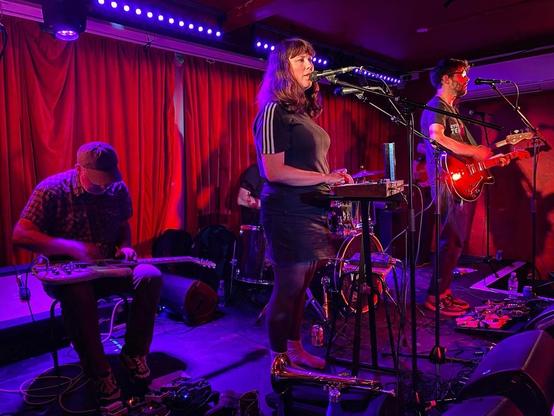
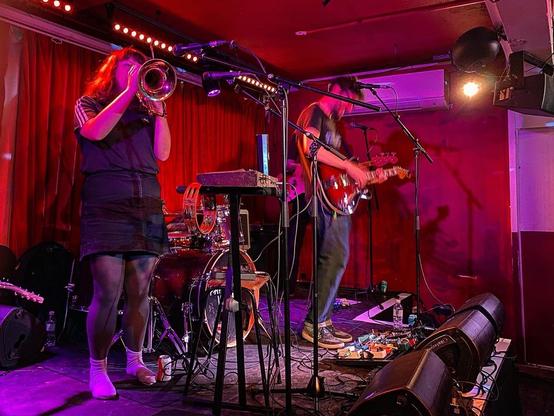
    First time I’ve seen Firestations, who have released one of my favourite albums of the year, really enjoyed their set especially the flugelhorn. A brilliant double bill #chopsgigs #firestations #paperdressvintage @firestationsband @sonictonicpromo
    Thick Terrain, by firestations

    10 track album

    firestations
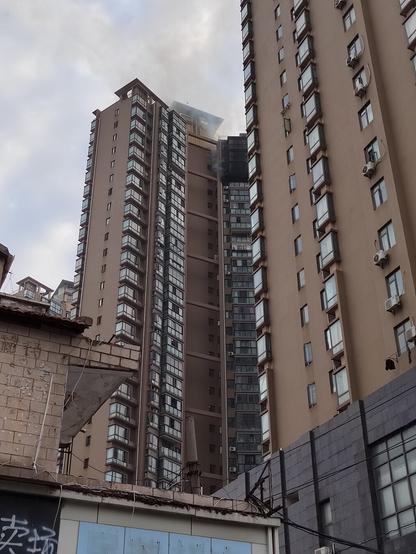
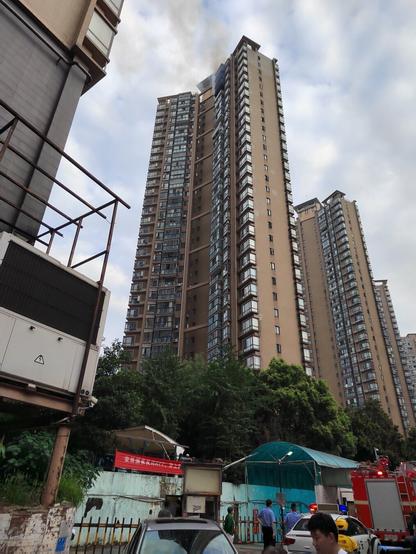
    #Fire in an #ApartmentBlock near where I live in Wuhan (and indeed in the building immediately behind the building that houses my favourite ever restaurant of any kind anywhere in the world). As I approached it two #FireTrucks were on the scene (in the part I could see: the compound is huge so there may have been others where I couldn't see them), as well as #ambulances and #police. By the time I reached the point the first picture was taken from three more had arrived. By the time I took the last picture a further three had arrived. In the end, from the side I was on, there were eight trucks from three different #FireStations there, plus a fleet of #ambulance and #police.

    Post 1 of 2. This post is behind a content warning for obvious reasons. The next won't be because it's about the emergency response and is mostly pictures of trucks.

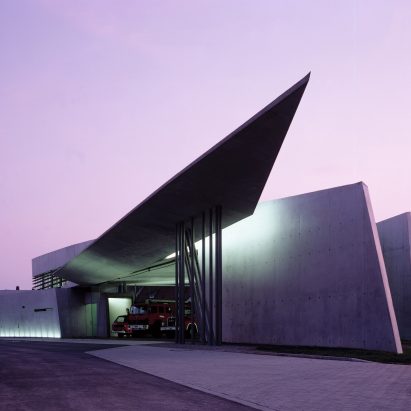
    Zaha Hadid's Vitra Fire Station is "ready to explode into action at any moment"

    We continue our series on deconstructivism by looking at Zaha Hadid's first major built work, the Vitra Fire Station in Weil am Rhein, Germany.

    Designed by Zaha Hadid Architects in 1993, the building was a key work in establishing the style of deconstructivism and now serves as an exhibitions and events space.

    Top and above: Zaha Hadid designed the Vitra Fire Station. Photos by Christian Richters

    The station's dynamic form was the built translation of Hadid's early, visionary paintings, which portrayed disordered, dynamic forms "exploding into little pieces" with a sense of movement that would become characteristic of the deconstructivist style.

    At Vitra Fire Station, this feeling of motion is captured in sweeping planes of exposed concrete that cut across the site along paths informed by the surroundings, demonstrated in a short animation produced by the practice.

    It has a dynamic form. Photo is by Ricardo Gomez Angel via Unsplash

    The unusually narrow, sloping spaces created where these planes crash together are intended to create a sense of "tension", anticipating the sudden rush of activity that could occur at any time should the station's alarm ring.

    "This building is 'movement frozen' – a vivid, lucid expression of the tensions necessary to remain 'alert', to explode into action as required," said Zaha Hadid Architects.

    [

    Read:

    Deconstructivist architecture "challenges the very values of harmony, unity and stability"

    ](https://www.dezeen.com/2022/05/03/deconstructivist-architecture-introduction/)

    Vitra director Rolf Fehlbaum commissioned the station in 1990, following a fire in 1981 that tore through over half of the Vitra Campus, necessitating a new masterplan that would include space for a dedicated fire service.

    This redevelopment saw the campus become home to a series of early works by some of the most high profile architects in the world, including another proponent of deconstructivism, Frank Gehry, who designed the nearby Vitra Design Museum.

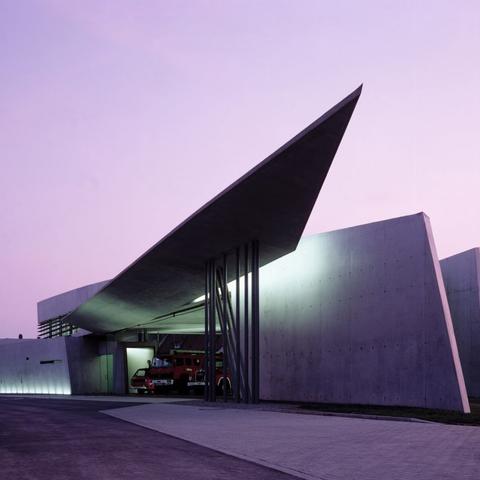
    The building is on the Vitra campus. Photo by Christian Richters

    The fire station sits at the southwestern edge of the campus, where it follows a curve in the road with two parallelogram-shaped forms that are organised according to "linear patterns in adjacent fields and landscapes."

    "Conceived as the end-note to existing factory buildings… it is designed as a connecting unit rather than an isolated object, defining rather than occupying space," explained the studio.

    It was Hadid's first major building. Photo by Christian Richters

    To the east is a cavernous garage space featuring an entirely glazed, steel frame wall.

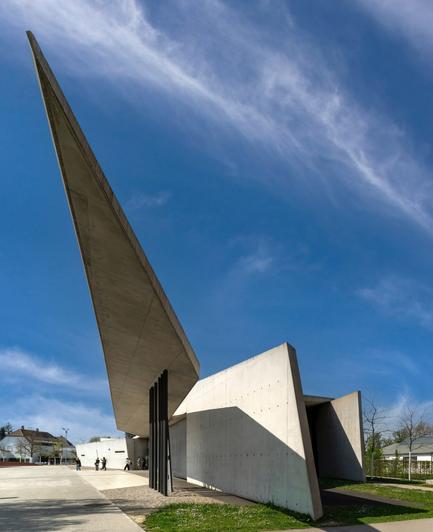
    A large section of sliding wall forms of the exit from this garage, beneath a sharp, geometric concrete canopy supported by a cluster of thin metal columns that soars upwards to reference the movement of fire engines rushing out of the building.

    "The walls appear to slide past each other, while the large sliding doors literally form a moving wall," said the studio.

    To the west, a two-storey volume contains an entrance corridor with a large ribbon window, behind which are the changing areas for the firefighters.

    The space is now a gallery. Photo is by Andreas Schwarzkopf

    Above, a break room with a kitchenette features an angular countertop and shelving that follows the geometry of the walls, looking back towards the campus through another ribbon window shaded by brise-soleil.

    Instead of being treated as separate rooms enclosed by doors, the interior is conceived as a flowing network of spaces, with the changing areas originally separated by curving metal lockers and thresholds suggested by the narrowing of spaces rather than doors.

    "The fire station - long, linear, narrow - emerges as a layered series of tilted and breaking walls," said the practice.

    "The programme inhabits the spaces between these walls, which puncture, tilt and break according to functional requirements," it continued.

    Internal walls are exposed concrete. Photo is by Andreas Schwarzkopf

    To maintain the clarity of this formal composition, details in the station have been kept to an absolute minimum, avoiding light fittings, door and window frames, floor finishes, and roof edgings.

    While certain spaces have been given a lining of insulation and white plaster to retain heat, many of the internal walls have been left as exposed concrete.

    Strips of fluorescent light embedded along the ceilings or floors again reference the concept of lines cutting across the site, and give the concrete planes the appearance of glowing.

    Even the balustrade of the staircase, which is positioned in a void where two forms intersect, is designed as four parallel handrails at different heights that ensure its upwards, angled trajectory is not broken by the landing areas.

    It has many angular spaces. Photo is by Pjt56

    "Any attachments like roof edgings or claddings were avoided as they distract from the simplicity of the prismatic form and the abstract quality of the architectural concept." said the practice

    Lines inscribed onto the pavement surrounding the building suggest the "linear patterns" that informed the design, and are intended to "choreograph" the various positions and routes of the fire engines.

    [

    Read:

    The legacy of deconstructivism "makes me want to retreat to the back of the room" says Bernard Tschumi

    ](https://www.dezeen.com/2022/05/23/legacy-deconstrucitivsim-bernard-tschumi-interview/)

    "As one passes across the spaces of the fire station, one catches glimpses of the large red fire engines," said the practice.

    "Their lines of movement are inscribed into the asphalt. Similarly, the ritualised exercises of the firemen will be inscribed into the ground' a series of choreographic notations," it continued.

    The station opened to great acclaim, praised for its ability to translate what many had merely considered "paper architecture" in Hadid's paintings into built form.

    Vitra Fire Station was a built translation of Hadid's early paintings

    In a 2016 interview filmed for Dezeen's Remembering Zaha Hadid series, the Danish architect Bjarke Ingels reflected on the impact seeing the Vitra Fire Station for the first time had on him.

    "She had somehow found a way to manifest in physical form the seemingly impossible perspectives of floating elements and skewed angles that she had captured in her fantasy [paintings]," said Ingels.

    Just a few years after the station opened, however, Vitra decided to disband its dedicated fire service, with the responsibility for protecting the campus transferred to the Weil and Basel Fire Services.

    Hadid's paintings show angular forms

    To critics of deconstructivism, reports that firefighters had allegedly found the building difficult to use served as proof that the style prioritised form over function. Today, the Vitra Design Museum continues to use the spaces for events and small exhibitions.

    The use of exposed concrete to create angular, sloping walls and jagged edges would become a hallmark of Zaha Hadid's early projects, including the MAXXI Museum in Rome and the Phaeno Science Centre in Wolfsburg.

    Illustration by Jack Bedford

    Deconstructivism is one of the 20th century's most influential architecture movements. Our series profiles the buildings and work of its leading proponents – Eisenman, Koolhaas, Gehry, Hadid, Libeskind, Tschumi and Prix.

    Read our deconstructivism series ›

    The post Zaha Hadid's Vitra Fire Station is "ready to explode into action at any moment" appeared first on Dezeen.

    #deconstructivism #all #architecture #cultural #zahahadidarchitects #germany #firestations #vitradesignmuseum

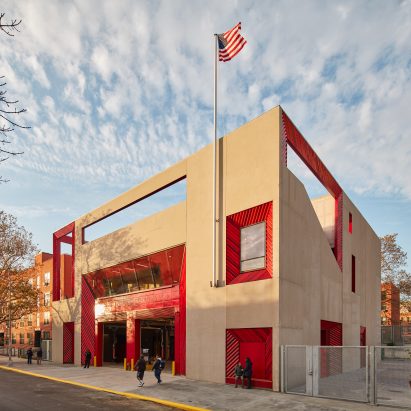
    Studio Gang designs Brooklyn fire station to train elite firefighters

    Studio Gang has completed a fire station for Brooklyn's elite force that doubles as a simulation and training facility for extreme rescue situations.

    The new headquarters for the FDNY's Rescue 2 unit is located in Brownsville, Brooklyn. Each of New York's five boroughs has a dedicated Rescue team.

    Studio Gang designed a firestation in Brooklyn

    These teams are highly specialized in extreme conditions that include rappelling down buildings, navigating collapsed structures, and even deploying for underwater rescue operations.

    The building serves as the elite unit's headquarters, where the firefighters sleep, train, and coordinate their operations.

    "The rescue company is trained to respond to various emergency scenarios, from fire and building collapses to water rescues and scuba operations," said US firm Studio Gang.

    The station hosts and trains Brooklyn's elite firefighters

    "The new Rescue Company 2 facility is designed as a tool for training, enabling FDNY’s elite force of specialized rescue workers to stage and simulate a wide range of emergency conditions in, on, and around the building," the studio added.

    The building is organized around a three-storey-tall volume that is meant to accommodate firefighters' rappelling training. On the exterior, various anchor points similarly allow the firefighters to practice using the building itself.

    The double-height interiors allow for training within the building

    "The void enables the team to practice rescue scenarios that mimic conditions common to the city, using its height and associated elements of balconies, bridge, doorways, ladders, and stairs," Studio Gang explained.

    "At the same time, it introduces natural light and fresh air, improving the quality of everyday life within the building," they added.

    The architects put in skylights for more comfortable habitation

    The ground floor contains two garage bays for fire trucks, which are flanked by the classic firefighter poles, as well as easy-access storage for a wide variety of tools and building materials that may be needed in an emergency.

    At the back, facing a courtyard, the architects included a kitchenette and conference room, where on-duty firefighters spend their time between operations.

    [

    Read:

    Studio Gang breaks ground on Populus building designed to be US' "first carbon-positive" hotel

    ](https://www.dezeen.com/2022/04/28/studio-gang-populus-denver-carbon-positive/)

    The top two floors contain a range of rooms for the normal operations of the unit, including bunk rooms, a gym, and administrative offices. On the roof, the architects included planted areas and a space for the firefighters to enjoy the outdoors.

    The concrete building is fronted with terracotta tiles that recall the red colour typically used for fire engines. These colourful accents line the surroundings of the windows, drawing attention to the building's function from the exterior.

    The red terracotta tiles recall the red firetruck

    "On the exterior, red glazed terracotta panels surround a smaller-scale series of voids (windows and doors) with highly crafted details animating these points of connection between the facility and the community it serves," the architects explained.

    Studio Gang is headquartered in Chicago and has offices in New York City, San Francisco, and Paris. Other notable projects by the American studio include an expansion to the American Museum of Natural History, and a twisting residential tower in San Francisco dubbed Mira.

    The photography is byTom Harris.

    Project credits:

    Structural engineer: Thornton Tomasetti
    MEP & Fire protection: ads
    Civil engineer: Langan, civil engineer
    Landscape architect: SCAPE
    Wayfinding and signage consultant: Once–Future Office
    Lighting consultant: Domingo Gonzalez Associates
    Cost estimator: Toscano Clements Taylor
    Expeditor: KM Associates of New York
    Construction manager: The LiRo Group
    General contractor: ZHL Group
    Precast concrete fabricator: High Concrete Group
    Terracotta rainscreen fabricator: Boston Valley Terracotta

    The post Studio Gang designs Brooklyn fire station to train elite firefighters appeared first on Dezeen.

    #all #architecture #publicandleisure #usa #terracotta #brooklyn #firestations #newyorkcity #studiogang #publicspace #newyork