https://doi.org/10.1016/j.apsoil.2025.106296
Sylvy Jo has a #BladderInfection, officially diagnosed today. It has not advanced, but it's been a shakey day of tears and miracles. Monday morning, we'll find out the whole scope and prepare war under the belly!
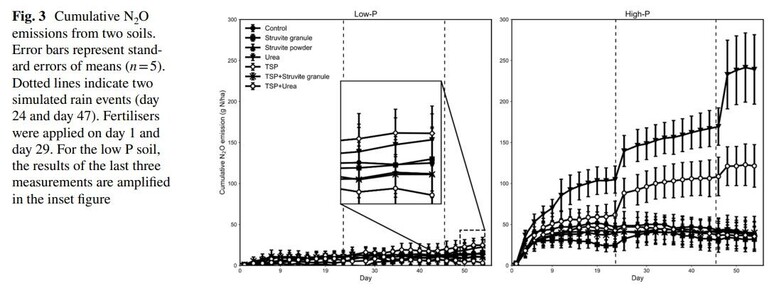
Purpose Although struvite (MgNH4PO4·6H2O) is mostly considered to be a novel phosphorus (P) fertiliser, it does contain a significant amount of nitrogen (N). Yet, relatively little is known about the soil N dynamics in struvite-amended soils. Here, we focus on how struvite application impacts emissions of the greenhouse gas nitrous oxide (N2O), in relation to soil P status. Methods We conducted a 54-day greenhouse pot experiment on two similar soils with different P status (“low-P soil”; “high-P soil”) seeded with Lolium perenne L. We applied seven fertiliser treatments (Control; Struvite granules; Struvite powder; Urea; Triple superphosphate (TSP); TSP + Struvite granule; TSP + Urea). Except for the unfertilised Control and the TSP treatments, N application rate was 150 kg N‧ha−1. Nitrous oxide (N2O) fluxes, aboveground yield, plant N and P uptake and readily plant-available soil N and P contents were measured. Results In the low-P soil, none of the fertiliser treatments induced a significant increase in N2O emission compared to the control. In the high-P soil, struvite application resulted in lower emissions than urea application, statistically not different from the control treatment. Struvite powder significantly increased both plant N and P uptake compared to granular struvite and the resulting yield was similar to conventional fertilisation (TSP and Urea). Any struvite application also resulted in lower readily plant-available soil nitrate contents than urea. Conclusion Our results suggest that struvite fertilisation can reduce the risk of gaseous N losses without compromising agronomic performance. Pulverizing struvite granules further promotes its dissolution, which could be useful for crops with early nutrient needs.