 Ionica Smeets
Yearly required poetry reading in the Nobel week.



Omdat iedereen over Omtzigt post doe ik het ook.
Pieter Omtzigt doet mee maar wil niet te groot worden. Zeg, bv. maximaal 10 of 15 zetels. Dit kan ruwweg op drie manieren, elk met z'n eigen voor-/nadelen:
1. Zichzelf impopulair maken
NSC peilt nu op tientallen zetels. Maar er zijn nog een paar maanden om daar wat aan te doen. Citeer Mao of Hitler of ren naakt over de Oude Markt in Enschede, en je keldert wel in de peilingen.
Nadeel: je moet Mao of Hitler citeren of naakt over straat.
1/n
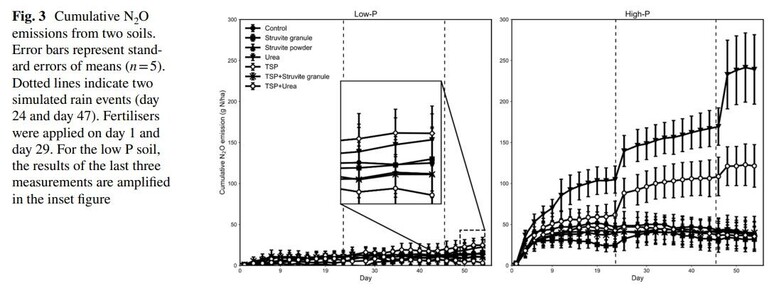

Purpose Although struvite (MgNH4PO4·6H2O) is mostly considered to be a novel phosphorus (P) fertiliser, it does contain a significant amount of nitrogen (N). Yet, relatively little is known about the soil N dynamics in struvite-amended soils. Here, we focus on how struvite application impacts emissions of the greenhouse gas nitrous oxide (N2O), in relation to soil P status. Methods We conducted a 54-day greenhouse pot experiment on two similar soils with different P status (“low-P soil”; “high-P soil”) seeded with Lolium perenne L. We applied seven fertiliser treatments (Control; Struvite granules; Struvite powder; Urea; Triple superphosphate (TSP); TSP + Struvite granule; TSP + Urea). Except for the unfertilised Control and the TSP treatments, N application rate was 150 kg N‧ha−1. Nitrous oxide (N2O) fluxes, aboveground yield, plant N and P uptake and readily plant-available soil N and P contents were measured. Results In the low-P soil, none of the fertiliser treatments induced a significant increase in N2O emission compared to the control. In the high-P soil, struvite application resulted in lower emissions than urea application, statistically not different from the control treatment. Struvite powder significantly increased both plant N and P uptake compared to granular struvite and the resulting yield was similar to conventional fertilisation (TSP and Urea). Any struvite application also resulted in lower readily plant-available soil nitrate contents than urea. Conclusion Our results suggest that struvite fertilisation can reduce the risk of gaseous N losses without compromising agronomic performance. Pulverizing struvite granules further promotes its dissolution, which could be useful for crops with early nutrient needs.




 Laura Helmuth
 Casper Albers ✅
 Resource
 Dean Burnett (that brains guy)