
Rem Koolhaas designs Taipei Performing Arts Center to "contribute to the history of the theatre"

The long-awaited Taipei Performing Arts Center in Taiwan, designed by Rem Koolhaas-led studio OMA, has completed ahead of its official opening on 7 August 2022.

Commissioned by the Taipei City Government in 2009, the 59,000-square-metre cultural landmark has a distinctive form with three auditoriums protruding from a cuboid central form.

Pritzker Architecture Prize-winner Koolhaas, who led the design alongside OMA managing partner David Gianotten, wanted the building to stand out from "standardised" contemporary theatres being built in major cities around the world.

Taipei Performing Arts Center has completed

"Theatre has a very long tradition," said Koolhaas. "We have seen contemporary performance theatres increasingly becoming standardised, with conservative internal operation principles."

"We want to contribute to the history of the theatre. Here in Taipei, we were able to combine three auditoria in a particular way," he continued. "We are interested to see how this architecture will have an impact in terms of extending what we can do in theatre."

Koolhaas took a similar approach to the design of the CCTV Headquartes in Beijing, which he designed to encourage alternative forms for high-rise buildings.

The Globe Playhouse has a spherical form

Built in the Shilin Night Market area of Taipei, the building contains three theatres that all extend from the central form.

The most prominent of these is the 800-seat Globe Playhouse, which has a spherical shape and is supported externally on two columns.

The Grand Theater extends from the central cube

Alongside the spherical auditorium, the building also contains the 1,500-seat Grand Theater and the 800-seat Blue Box theatre. These both project from opposite sides of the building.

The two venues sit opposite each other on the same level of the arts centre so that they can be combined into one venue referred to as a "Super Theater".

The Grand Theater can seat 1,500. Photo by Shephotoerd Co. Photography, courtesy of OMA

The main, central section of the building is raised above the ground to create a covered plaza.

It contains the entrances, foyers and all of the backstage areas for the three theatres.

The Public Loop is a walkway that runs through the building

A public walkway running through the building, named the Public Loop, runs through these backstage areas with windows to give views of the usually unseen spaces.

The walkway runs through the centre of the building before heading up to a public viewing point on the building's roof. A walkway across the roof of the spherical theatre leads to a set of lifts that returns people to the ground floor.

The public walkway leads to a viewing area. Photo by Shephotoerd Co. Photography, courtesy of OMA

"The configuration of three theaters plugged into a central cube has resulted in new internal workings of the performing spaces to inspire unimagined productions," said OMA's Gianotten.

"The Public Loop exposes visitors with and without tickets to these new works and their creative processes. We are excited by how the building constantly generates new relationships between artists, spectators, and the public."

The Super Theatre is formed by opening up the Grand Theater and Blue Box theatre

OMA designed the Taipei Performing Arts Center to have a wide variety of unique performance spaces, the spherical theatre and factory-like Super Theatre, but also to have numerous additional spaces that could be used for performances.

"Taipei Performing Arts Center is much more than the sum of its three theaters," said CEO of Taipei Performing Arts Center Austin Wang.

[

Read:

Rem Koolhaas is the architect who built deconstructivism's legacy

](https://www.dezeen.com/2022/05/13/rem-koolhaas-profile-deconstructivisms/)

"Every foyer, every plaza, every unexpected corner is brimming with creative potential. We believe theatre of the future will outgrow conventional theatrical spaces," he continued.

"Taipei Performing Arts Center is prepared for every form of contemporary performance art from the most adventurous artists."

The foyer to the Globe Theatre is in the main building

The Taipei Performing Arts Center has been in construction for over a decade, with building starting in 2012 after OMA won the commission in 2009.

Originally slated for completion in 2015 it topped out in August 2014 and was featured in Dezeen's most anticipated projects for both 2015 and 2016.

It is now set to open on 7 August 2022.

Led by Koolhaas, OMA is one of the world's most successful architecture studios. It has recently revealed plans for the first North American outpost for Centre Pompidou and the Qatar Auto Museum in Doha.

Koolhaas was one of a group of architects in the 1980s who developed deconstructivist architecture of architecture, which we are revisiting in our series on the style.

The photography is by Chris Stowers unless stated.

Project credits:

Design architect: OMA **
Partners-in-Charge:** Rem Koolhaas and David Gianotten **
**Executive architect: KRIS YAO | ARTECH (architect: Kris Yao; Project Principals: Willy Yu, Grace Lin)
Theater consultant: dUCKS Scéno, Creative Solution Integration Ltd
Acoustic consultant : Royal HaskoningDHV and Theo Raijmakers (level acoustics & vibration), SM&W Landscape designer, interior designer: Inside Outside
Structure, MEP, building physics, fire engineer: Arup
Structural engineer: Evergreen Consulting Engineering Inc
Services engineer: Heng Kai Inc, IS Leng and Associates Engineers
Fire engineer: Taiwan Fire Safety Consulting Ltd
Lighting consultant: Chroma 33
Facade engineer: ABT, CDC Inc
Sustainability consultant: Segreene Design and Consulting
Landscape consultant: CNHW
Geotechnical engineer: Sino Geotech
Traffic consultant: Everest Engineering Consultants Inc
Animation: Artefactory

The post Rem Koolhaas designs Taipei Performing Arts Center to "contribute to the history of the theatre" appeared first on Dezeen.

#all #architecture #cultural #oma #taiwan #theatres #taipei #taipeiperformingartscenter #sphericalarchitecture
"The red flags raised by the MSG Sphere relate to democratic failure not to aesthetics"

More important than the aesthetic shortcomings of London's planned spherical venue is the failure of democracy that is allowing it to be built, writes Anna Minton.

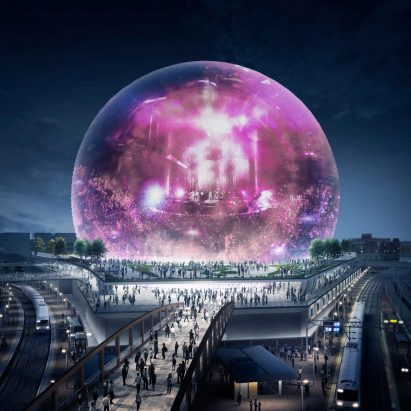
A decade on from London 2012, a gigantic sphere as tall as Big Ben and as wide as the London Eye looks set to be the latest piece of the Olympic legacy. Known as the MSG Sphere, it will be identical to a venue under construction in Las Vegas and will mirror the "Las Vegas-ification" of Stratford in east London.

Local MP Lyn Brown described the structure as a "monstrosity" and while it is not to my taste, the red flags raised by the MSG Sphere relate to democratic failure not to aesthetics.

Designed by Populous and the brainchild of Madison Square Garden (MSG), which is run by Donald Trump-donor James Dolan, the sphere has been met with vociferous opposition.

The extensive objections claim that the sphere will blight the lives of residents

Despite a vocal campaign, the London Legacy Development Corporation (LLDC) approved the giant glowing structure, which will loom over Stratford, in March. It has now been referred to the mayor of London to give final approval.

The long list of opposition groups and elected representatives unhappy with the decision included 852 objections, a 2,000 strong petition, Newham and Hackney councils and West Ham MP Brown who said that "Stratford does not want to be Las Vegas" and claimed that "the LLDC's version of the Olympic legacy has become a tyranny".

[

Read:

Populous' spherical music venue gets go ahead to be built in London

](https://www.dezeen.com/2022/03/29/msg-sphere-populous-spherical-music-venue-stratford-london/)

The extensive objections claim that the sphere will blight the lives of residents as it will be surrounded by dense residential housing on all sides, blocking natural light and pouring electronic light pollution into the east London night sky, not to mention noise.

The plans aim to bring up to 60,000 people daily to Stratford for a minimum of 300 days a year which campaigners fear will place unbearable strain on Stratford Station, which is already subject to overcrowding. And then there are the obvious aesthetic arguments.

There is no doubt that there are two sides to this argument

I agree that the objections seem compelling, but that said, supporters also put forward numerous counter arguments; MSG say the sphere will bring thousands of jobs to the area, which they've pledged to pay at the London Living Wage with 35 per cent recruited locally during the three-year construction phase, going up to 50 per cent once the sphere is open.

The venue, which has capacity for 21,500 people, will provide a state-of-the-art immersive experience for music and award ceremonies, corporate events and product launches.

There is no doubt that there are two sides to this argument, as there generally are with all contentious development struggles. But that is to miss the point, which relates to democratic representation and accountability.

The decision was opposed by local elected representatives at Newham and Hackney councils, parliamentary representatives and on the development corporation's board – where it was opposed by four elected members of the largely non-elected board.

Equally concerning is the revolving door between the Development Corporation and MSG, with Jayne McGivern, who was previously an LLDC Board member between 2012-2016, going on to work for MSG and lead the sphere project until last year.

Development Corporations are not democratically accountable and for that reason attract critique

According to a Freedom of Information request submitted by campaigners, between 2017 and 2019 there were 79 meetings and 33 unminuted meetings between MSG's team and the LLDC.

Emails obtained reveal that the Corporation and MSG discussed strategies for how to deal with "local resistance" with LLDC suggesting "wordings" for emails to local schools where complimentary tickets for baseball games and visits from coaches and players would be offered.

[

Read:

Stufish designing hexagonal arena for ABBA reunion tour

](https://www.dezeen.com/2021/09/07/stufish-arena-london-abba-reunion-tour/)

The corporation's unelected and unaccountable nature and the failure to listen to local opposition echoes the activities of the London Docklands Development Corporation a generation earlier.

At that time, plans for the development of Canary Wharf and surrounding areas were pushed through in the face of stiff opposition from local authorities, MPs and the local community who feared they would be displaced, well-founded fears as it turned out, as the demographic of the area changed beyond all recognition.

Council employees and elected representatives regularly move to work for developers

Development corporations are not democratically accountable and for that reason attract critique, while advocates claim they get things done. Local authorities on the other hand are accountable, but the same issues with the revolving door and the failure to listen to communities occur, again and again, revealing that democratic failure is increasingly the norm, regardless of the institutional structure.

Council employees and elected representatives regularly move to work for developers and lobbying firms involved in the regeneration of places.

In Southwark, the council's project manager and the communications manager both went on to work for Lendlease, the developer behind the controversial regeneration of Elephant & Castle and it was revealed that just under 20 per cent of Southwark's 63 councillors worked as lobbyists.

It may not be a planning consideration, but the other red flag is MSG itself, and the well-documented links between executive chairman Dolan and Trump. Dolan is not the only influential Trump supporter transforming UK real estate, with Blackstone, the giant US private equity firm also exponentially growing its presence in Britain.

It is worth paying attention to the growing influence of investment from less than palatable sources from other parts of the world

Blackstone, whose CEO Stephen Schwarzman, was not only a Trump donor but close advisor, recently completed what was reported to be the largest ever property deal in the UK, buying student accommodation firm iQ for £4.7 billion.

While the role of Russian oligarchs in UK real estate has been painfully highlighted it was not only entirely overlooked but much encouraged until Putin's war in Ukraine so perhaps it is worth paying attention to the growing influence of investment from less than palatable sources from other parts of the world.

If issues around democratic failure seem to define the progress of the sphere's application, it is not yet a done deal as it has now been referred to the mayor. Another highly contentious decision to approve the Hondo Tower, a 20 storey tower in Brixton in south London, was also referred to Sadiq Khan who has decided to hold a public hearing on the matter. The same may yet happen to the sphere.

Anna Minton is the author of Big Capital: Who is London For? (Penguin 2017) and is a reader in architecture at the University of East London.

The post "The red flags raised by the MSG Sphere relate to democratic failure not to aesthetics" appeared first on Dezeen.

#all #architecture #opinion #london #uk #england #populous #sphericalarchitecture

"The red flags raised by the MSG Sphere relate not to aesthetics but to democratic failure"

More important than the aesthetic shortcomings of London's planned spherical venue is the failure of democracy that is allowing it to be built, writes Anna Minton.

A decade on from London 2012, a gigantic sphere as tall as Big Ben and as wide as the London Eye looks set to be the latest piece of the Olympic legacy. Known as the MSG Sphere, it will be identical to a venue under construction in Las Vegas and will mirror the "Las Vegas-ification" of Stratford in east London.

Local MP Lyn Brown described the structure as a "monstrosity" and while it is not to my taste, the red flags raised by the MSG Sphere relate not to aesthetics but to democratic failure.

Designed by Populous and the brainchild of Madison Square Garden (MSG), which is run by Donald Trump-donor James Dolan, the sphere has been met with vociferous opposition.

The extensive objections claim that the sphere will blight the lives of residents

Despite a vocal campaign, the London Legacy Development Corporation (LLDC) approved the giant glowing structure, which will loom over Stratford, in March. It has now been referred to the mayor of London to give final approval.

The long list of opposition groups and elected representatives unhappy with the decision included 852 objections, a 2,000 strong petition, Newham and Hackney councils and West Ham MP Brown who said that "Stratford does not want to be Las Vegas" and claimed that "the LLDC's version of the Olympic legacy has become a tyranny".

[

Read:

Populous' spherical music venue gets go ahead to be built in London

](https://www.dezeen.com/2022/03/29/msg-sphere-populous-spherical-music-venue-stratford-london/)

The extensive objections claim that the sphere will blight the lives of residents as it will be surrounded by dense residential housing on all sides, blocking natural light and pouring electronic light pollution into the east London night sky, not to mention noise.

The plans aim to bring up to 60,000 people daily to Stratford for a minimum of 300 days a year which campaigners fear will place unbearable strain on Stratford Station, which is already subject to overcrowding. And then there are the obvious aesthetic arguments.

There is no doubt that there are two sides to this argument

I agree that the objections seem compelling, but that said, supporters also put forward numerous counter arguments; MSG say the sphere will bring thousands of jobs to the area, which they've pledged to pay at the London Living Wage with 35 per cent recruited locally during the three-year construction phase, going up to 50 per cent once the sphere is open.

The venue, which has capacity for 21,500 people, will provide a state-of-the-art immersive experience for music and award ceremonies, corporate events and product launches.

There is no doubt that there are two sides to this argument, as there generally are with all contentious development struggles. But that is to miss the point, which relates to democratic representation and accountability.

The decision was opposed by local elected representatives at Newham and Hackney councils, parliamentary representatives and on the development corporation's board – where it was opposed by four elected members of the largely non-elected board.

Equally concerning is the revolving door between the Development Corporation and MSG, with Jayne McGivern, who was previously an LLDC Board member between 2012-2016, going on to work for MSG and lead the sphere project until last year.

Development Corporations are not democratically accountable and for that reason attract critique

According to a Freedom of Information request submitted by campaigners, between 2017 and 2019 there were 79 meetings and 33 unminuted meetings between MSG's team and the LLDC.

Emails obtained reveal that the Corporation and MSG discussed strategies for how to deal with "local resistance" with LLDC suggesting "wordings" for emails to local schools where complimentary tickets for baseball games and visits from coaches and players would be offered.

[

Read:

Stufish designing hexagonal arena for ABBA reunion tour

](https://www.dezeen.com/2021/09/07/stufish-arena-london-abba-reunion-tour/)

The corporation's unelected and unaccountable nature and the failure to listen to local opposition echoes the activities of the London Docklands Development Corporation a generation earlier.

At that time, plans for the development of Canary Wharf and surrounding areas were pushed through in the face of stiff opposition from local authorities, MPs and the local community who feared they would be displaced, well-founded fears as it turned out, as the demographic of the area changed beyond all recognition.

Council employees and elected representatives regularly move to work for developers

Development corporations are not democratically accountable and for that reason attract critique, while advocates claim they get things done. Local authorities on the other hand are accountable, but the same issues with the revolving door and the failure to listen to communities occur, again and again, revealing that democratic failure is increasingly the norm, regardless of the institutional structure.

Council employees and elected representatives regularly move to work for developers and lobbying firms involved in the regeneration of places.

In Southwark, the council's project manager and the communications manager both went on to work for Lendlease, the developer behind the controversial regeneration of Elephant & Castle and it was revealed that just under 20 per cent of Southwark's 63 councillors worked as lobbyists.

It may not be a planning consideration, but the other red flag is MSG itself, and the well-documented links between executive chairman Dolan and Trump. Dolan is not the only influential Trump supporter transforming UK real estate, with Blackstone, the giant US private equity firm also exponentially growing its presence in Britain.

It is worth paying attention to the growing influence of investment from less than palatable sources from other parts of the world

Blackstone, whose CEO Stephen Schwarzman, was not only a Trump donor but close advisor, recently completed what was reported to be the largest ever property deal in the UK, buying student accommodation firm iQ for £4.7 billion.

While the role of Russian oligarchs in UK real estate has been painfully highlighted it was not only entirely overlooked but much encouraged until Putin's war in Ukraine so perhaps it is worth paying attention to the growing influence of investment from less than palatable sources from other parts of the world.

If issues around democratic failure seem to define the progress of the sphere's application, it is not yet a done deal as it has now been referred to the mayor. Another highly contentious decision to approve the Hondo Tower, a 20 storey tower in Brixton in south London, was also referred to Sadiq Khan who has decided to hold a public hearing on the matter. The same may yet happen to the sphere.

Anna Minton is the author of Big Capital: Who is London For? (Penguin 2017) and is a reader in architecture at the University of East London.

The post "The red flags raised by the MSG Sphere relate not to aesthetics but to democratic failure" appeared first on Dezeen.

#all #architecture #opinion #london #uk #england #populous #sphericalarchitecture

Populous' spherical music venue features in today's Dezeen Agenda newsletter

The latest edition of our weekly Dezeen Agenda newsletter features Populous' MSG Sphere arena, which is set to become London's largest indoor venue. Subscribe to Dezeen Agenda now!

Architecture studio Populous has been given the green light to build a 90-metre-high spherical music venue near the Olympic Park in east London for the organisation that runs New York's Madison Square Garden (MSG).

The London Legacy Development Corporation's planning committee voted six to four in favour of the proposal, despite 852 objections submitted in opposition to the project.

The venue will have a capacity of 21,500 with 17,566 seated.

Zaha Hadid Architects' dune-like Beeah Headquarters in Sharjah features in today's Agenda newsletter

Other stories in this week's newsletter include Zaha Hadid Architects' dune-like Beeah Headquarters in Sharjah, news of SHoP Architects' supertall Brooklyn Tower topping out in New York and an opinion piece on inclusivity in design by Priya Khanchandani.

Dezeen Agenda

Dezeen Agenda is a curated newsletter sent every Tuesday containing the most important news highlights from Dezeen. Read the latest edition of Dezeen Agenda or subscribe here.

You can also subscribe toDezeen Debate, which is sent every Thursday and contains a curated selection of highlights from the week, as well as Dezeen Daily, our daily bulletin that contains every story published in the preceding 24 hours on Dezeen.

The post Populous' spherical music venue features in today's Dezeen Agenda newsletter appeared first on Dezeen.

#all #architecture #london #performancevenues #populous #sphericalarchitecture #dezeenagenda

This week London's spherical music venue was approved

This week on Dezeen, the MSG Sphere music and esports arena moved a step closer to reality as it was approved by planners.

Designed by architecture studio Populous, the 90-metre-high spherical music venue is set to be built near the Olympic Park in east London. It was approved despite 852 objections being submitted in opposition to the project.

The world's first multi-storey skatepark opened its doors this week

In other architecture news, the world's first multi-storey skatepark opened in Kent.

Designed by Hollaway Studio, the F51 building in the seaside town of Folkestone contains three skateparks that are stacked on top of each other.

Dyson launched a set of noise-cancelling headphones with an air-purifying visor

This week saw British technology company Dyson unveil a set of noise-cancelling headphones with an air-filtering visor.

Named the Dyson Zone, the company's first wearable device caused confusion in the British press with UK newspaper the Telegraph describing it as a "bizarre air-purifying mask" and the BBC calling it an "air vacuum for mouth".

World View unveiled a balloon spacecraft

As space tourism continues to gain traction, exploration company World View unveiled a balloon-powered capsule designed by PriestmanGoode to take passengers 30,000 metres up to the edge of the Earth's atmosphere.

Set to begin flights in 2024, the hexagon-shaped pods would contain seats for eight passengers and two crew members.

Amy Kulper was named director of The Bartlett

In London, change was taking place at the top of two of the city's leading architecture schools.

The Bartlett School of Architecture appointed Amy Kulper as its director, while the Architectural Association released a shortlist of five candidates for its director role following the dismissal of Eva Franch i Gilabert in 2020.

KACH designed a Japanese house with polycarbonate screens

Popular projects this week included a house wrapped in polycarbonate screens in Japan, a bamboo welcome centre designed by Vo Trong Nghia Architects and the "invisible" restoration of Peter Womersley's High Sunderland house.

Our lookbooks this week focused on compact bedrooms that make the most of limited space and self-designed studios by architects and designers.

This week on Dezeen

This week on Dezeen is our regular roundup of the week's top news stories. Subscribe to our newsletters to be sure you don't miss anything.

The post This week London's spherical music venue was approved appeared first on Dezeen.

#all #news #thisweekondezeen #london #uk #england #sphericalarchitecture

Populous' spherical music venue gets go ahead to be built in London

Architecture studio Populous has won planning approval for the MSG Sphere music and esports arena, which will be London's largest indoor venue.

Designed for the organisation that runs New York's Madison Square Garden (MSG), the 90-metre-high spherical music venue would be built near the Olympic Park in east London.

It is set to be built after the London Legacy Development Corporation's planning committee voted six to four in favour of the proposal.

It made the decision despite 852 objections submitted in opposition to the project. In total, 355 responses were received supporting the proposal.

"The applications have been subject to robust review and a detailed officer report," said an LLDC spokesperson.

"Following careful consideration, the independent Planning Decisions Committee has approved granting full planning permission for the MSG Sphere, subject to conditions," the spokesperson added.

Following the agreement of Section 106 planning obligations, the application will be referred to the London mayor's office.

Designed by stadium-specialist Populous, the venue will have a capacity of 21,500 with 17,566 seated.

It will be built on a triangular site, which is surrounded on all sides by railway lines, alongside the Westfield Stratford City shopping centre.

The main auditorium would be placed within the 90-metre-high sphere along with restaurants, cafes and a members' club. Within the sphere, the interior surface will be covered in an "immersive LED surface" that could be utilised for esports.

[

Read:

Populous to design spherical music venues in Las Vegas and London

](https://www.dezeen.com/2018/02/14/populous-build-spherical-music-venue-las-vegas-usa-london-uk-msg-sphere-london/)

"MSG Sphere London is a natural fit for events such as esports, where audiences will be able to participate in the competition and interact with each other," said a statement from MSG when the project was first revealed.

"It represents an important milestone in the company's vision to redefine live entertainment through iconic venues that will feature game-changing technologies and pioneer the next generation of transformative, immersive experiences."

The sphere would rise from a podium building that will contain shops and a nightclub.

Externally it will be covered in LED screens that will be used for promoting upcoming events or for advertising.

The venue is one of a pair of sphere-shaped arenas designed by Populous that were first revealed in 2018. Its almost-identical sister venue is currently under construction in Las Vegas and scheduled to be complete next year.

The building will be the latest in a series of spherical buildings. We recently rounded up nine globe-shaped buildings from around the world.

The imagery is courtesy of Madison Square Garden Company.

The post Populous' spherical music venue gets go ahead to be built in London appeared first on Dezeen.

#all #architecture #news #london #uk #populous #sphericalarchitecture

AndrénFogelström installs sculptural spheres in Stockholm park

Children can play, hide and climb inside a series of sculptural spheres in a playground in Vårbergstoppen, Stockholm designed by Swedish architecture studio AndrénFogelström.

AndrénFogelström has decorated Vårbergstoppen, a park on a hill on the outskirts of Stockholm, with several colourful spheres.

The architects installed a giant orange sphere at the top of Vårbergstoppen park. Photo is by Brendan Austin

The studio worked with landscape architecture practice Land Arkitektur to update the park, in a bid to counteract some of the urbanisation occurring in the park's suburban location.

"We wanted to make something exciting and unusual to inspire kids as well as adults to explore," studio founders Moa Andrén and Tove Fogelström told Dezeen.

"The idea came from a client who was inspired by the steep hill and the thought was that great balls would roll down the slope, almost as if a giant was throwing them," they continued.

Perforated metal allows daylight to filter through the orb

A large orange sphere constructed out of perforated metal sheets sits at the top of the hill.

AndrénFogelström cut the metal into individual hexagons, before welding them together into the spherical structure.

It is meant to look as if it is about to roll down the hill

The architects spent a long time working out how to make the structure look as though it were about to roll down the hill.

"It was an immense task during construction to make them fit together, and the structural engineer had a great deal of work just managing how to mark the pieces during the construction," AndrénFogelström said.

"It is a self-bearing construction where the parts support each other in the spheric form. It appears to be rolling down but is safely anchored to the ground," the architects explained.

Adults and children can sit inside the hollow sphere

Children and adults can enter the sphere through a circular opening to rest on its stepped wooden benches. At night, the sphere is lit by several small floor lights. Cables to the lights are threaded through the legs.

In the winter, the architects imagine that people will use the sphere as a starting point for sledging down the hill.

Three smaller spheres, which are positioned inside the playground at the foot of the hill, were made for younger children to play on and climb.

One sphere has a slide, another one has a little bench. All have small holes for peeking out of while playing.

Three smaller spheres are set inside the children's playground

Each of the spheres, which the studio thinks of as "little worlds," is made from wood which has been treated with linseed oil to increase its durability.

The frames, which stand on a block of concrete underneath the ground, are all made of steel.

Each hollow sphere has little circles through which children can peep while at play

Vårbergstoppen's unique geographical history also informed the architect's design choices. Swedish city landscape architect Holger Blom created Vårbergstoppen as an artificial hill in the 1960s.

The architects drew on the circular shapes Blom used, in an effort to honour his creation.

"The landscape was clearly designed, as the landscape architect who made the park in the 60s worked with forming the masses in geometric forms; the most significant one is a circular crater with a diameter of 100 meters," the studio said.

The structures are part of a wider redevelopment of the park

Other playgrounds that make use of playful, sculptural structures include The Folds by Atelier Scale in China which encourages children to explore in a more tactile way than usual.

Architecture office Studio Dlux created a multicoloured playground for children at a school in Curitiba that features curved mounds with tunnels for schoolchildren to climb through.

Photography is byClément Morin unless stated otherwise.

The post AndrénFogelström installs sculptural spheres in Stockholm park appeared first on Dezeen.

#publicandleisure #all #architecture #design #stockholm #installations #playgrounds #park #sphericalarchitecture

AndrénFogelström installs sculptural spheres in Stockholm park

Children can play, hide and climb inside sculptural spheres in a playground in Vårbergstoppen, Stockholm designed by Swedish architecture studio AndrénFogelström.

Watershed Core is a cyclical installation that filters rainwater in New York

Artist Mary Mattingly has designed a sphere filled with native plants that filter water in a gravity-fed system to mimic New York City's water system.

Named Watershed Core, the installation in Prospect Park, Brooklyn, was designed to draw attention to issues around quality, access and privatisation of water in the city.

Watershed Core mimics the geological features of a watershed

Mattingly's sculpture mimics the workings of New York City's drainage basin, which includes aqueducts, reservoirs and tunnels.

It is part of her multiform project Public Water that includes a digital campaign and education initiatives alongside Watershed Core.

A spherical structure makes up the installation

The installation is a 10-foot (three-metre) tall open-air spherical sculpture made from metal supporting restaurant trays filled with native plants.

Rainwater is collected by the sculpture, where it is cleaned by the filtration elements of plants, soil, sand, rock and a layer of carbon through a process called phytoremediation.

Rainwater enters through holes in the sculpture

"Watershed Core is a sculpture that describes the geology of parts of New York City's drinking watershed through carbon, soils, rocks and plants," Mattingly told Dezeen.

"The installation filters rainwater for drinking," she continued.

"Water moves through the trays and into the water bottles at the bottom of the sculpture. There is a backup system inside the sculpture where water from Prospect Park can be added in case of a prolonged period without rain. This system uses a hand pump and several buckets."

The installation is in Brooklyn's Prospect Park

Mattingly completed the project with More Art, a New York-based non profit art organisation that focuses on socially-driven public art projects.

Watershed Core aims to raise awareness of how we can all become better water stewards in our understanding of where clean water comes from, and how it is governed.

The project raises awareness of water stewardship

Growing up in an agricultural town outside of New York City, Mattingly noticed how the already pesticide-polluted well that provided water to her town began to accrue more contaminates over time when it was privatised.

This experience led the artist to investigate water and its politics in America, where the country's freshwater supplies are at risk of running low due to decreasing precipitation and increasing populations.

Mattingly wanted to draw attention to issues surrounding privatisation of water systems

"I've been tracking water privatisation around the US and I began working with More Art on this research in 2018. We focused on New York City's public drinking water system" said Mattingly.

"Working together, we began focusing on highlighting public water systems that we thought were working well. They were more equitable, environmental and regenerative than the private systems, or both public and private systems."

The public sculpture invites people to engage with its message

Through Watershed Core and its various other programmes, Public Water intends to share the strengths of New York's water system that over eight million people depend on daily.

"We're eager to share what steps have been taken to begin for the system to be more equitable, and look at how we can help in stewarding these watershed areas," explained Mattingly.

Native plants grow from the structure

More Art and Mattingly have also created a self-guided walking tour that connects Watershed Core to Prospect Park's ecoWEIR, a natural water filtration system that has recently been installed to remove nutrients from the park's watercourse that lead to the development of harmful algae.

Mary Mattingly is an American artist whose work explores ecology and sustainability.

More Art is a New York-based non-profit art organisation.

Other projects that capture water and put it to use include rain-harvesting panels designed primarily for drought-stricken cities that can be fitted onto the sides of buildings for people to catch their own water.

Photography is byManuel Molina Martagon, courtesy of More Art.

The post Watershed Core is a cyclical installation that filters rainwater in New York appeared first on Dezeen.

#all #design #installations #usa #plants #brooklyn #water #newyorkcity #waterharvesting #sphericalarchitecture

Watershed Core is a cyclical installation that filters rainwater in New York

Mary Mattingly has designed Watershed Core, an installation in New York covered in plants which filter water in a gravity-fed system mimicking a watershed.