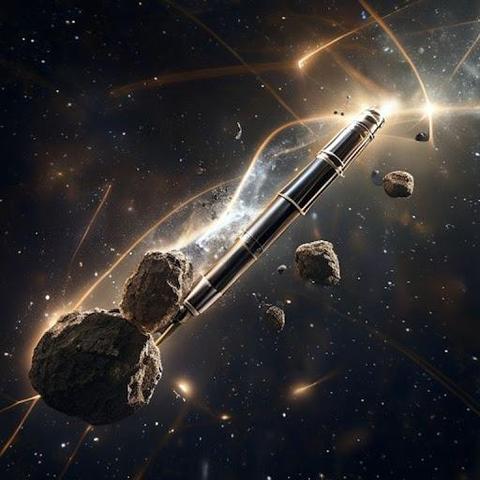
NEW METHOD PROMISES EASIER ACCESS TO NEAR-EARTH OBJECTS

How does the new asteroid trajectory method reduce energy costs for space missions? Learn how researchers are making it easier to reach near-Earth objects.

#spaceexploration, #asteroidmining, #nasa, #spacephysics, #scienceupdate

https://newsletter.tf/new-asteroid-trajectory-method-2026/

Researchers have found a new way to calculate paths to asteroids. This method uses less energy than older models used by NASA.

#spaceexploration, #asteroidmining, #nasa, #spacephysics, #scienceupdate
https://newsletter.tf/new-asteroid-trajectory-method-2026/

New Space Path Method Cuts Asteroid Mission Energy Costs in 2026

How does the new asteroid trajectory method reduce energy costs for space missions? Learn how researchers are making it easier to reach near-Earth objects.

NewsletterTF

RE: https://wisskomm.social/@GermanAstroSoc/116210846409366882

Congratulations to Heike Rauer! 🎉

I had the pleasure of experiencing her work firsthand in a colloquium at my former institute while I was still a student, and I remember her as an outstanding #planetary scientist. A very well-deserved recognition!

#PlanetaryScience #exoplanets #SpacePhysics

I seem to be in a bit of a #space mood 🪐🔭 at the moment 😅, so I remembered that I once visited the #Smithsonian National Air and Space Museum in Washington, DC and wrote a short blog post about it. I thought I would share it again here:

🌍 https://www.fabriziomusacchio.com/blog/2021-05-03-smithsonian/

#Museum #SpacePhysics #PlanetaryScience #Astronomy #Aviation #Spaceflight #WashingtonDC #Voyager #NewHorizons #Apollo #ApolloMission #Soyuz #Moon

✨🔭 If you're interested in learning more about #SpaceScience in the region, I have two older posts about a visit I made with my former institute to the #Effelsberg #RadioTelescope ( @MPIfR_Bonn) and the #Stockert radio telescope ( #Astropeiler).

Here's the link to the Effelsberg post:

🌍 https://www.fabriziomusacchio.com/blog/2021-05-01-effelsberg/

#SpacePhysics #Observatory #Telescope #RadioAstronomy #Astronomy #MPIfR

✨🔭 Interesting news from outer space: #Cassini data plus global #MHD #simulations show that #Saturn’s cusp is not noon-centered like #Earth’s, but shifted toward the post-noon and even post-dusk sector. Xu, Yao, & Arridge et al. identify 67 cusp events and argue that rapid rotation plus internal #plasma sources fundamentally reshape Saturn’s global magnetic topology:

📝 https://doi.org/10.1038/s41467-026-69666-9

#SpacePhysics #PlanetaryScience #Magnetosphere

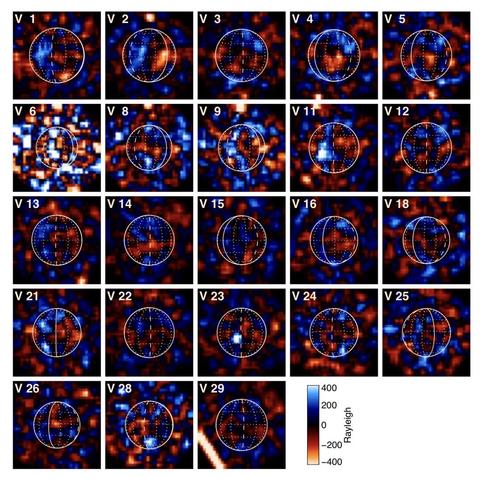
🛰️ New paper by Knowles et al.: Using the #JWST, the authors observed rapid variability in the auroral footprints of #Jupiter’s #moons in Jupiter’s #atmosphere.

IR observations show that the footprints of moons like #Io can change on short timescales, highlighting the dynamic interaction between Jupiter’s #magnetosphere and its satellites. The moon–magnetosphere coupling driving Jupiter’s #aurora is more variable than previously assumed.

📄https://doi.org/10.1029/2025GL118553

#SpacePhysics #PlanetaryScience