
#climate #volcano #VolcanicEruption #emissions #so2

Original open access article

Marshall et al. Clim. Past, 21, 161–184, 2025

Last-millennium volcanic forcing and climate response using SO2 emissions

https://doi.org/10.5194/cp-21-161-2025

Last-millennium volcanic forcing and climate response using SO2 emissions

Abstract. Climate variability in the last millennium (past 1000 years) is dominated by the effects of large-magnitude volcanic eruptions; however, a long-standing mismatch exists between model-simulated and tree-ring-derived surface cooling. Accounting for the self-limiting effects of large sulfur dioxide (SO2) injections and the limitations in tree-ring records, such as lagged responses due to biological memory, reconciles some of the discrepancy, but uncertainties remain, particularly for the largest tropical eruptions. The representation of volcanic forcing in the latest generation of climate models has improved significantly, but most models prescribe the aerosol optical properties rather than using SO2 emissions directly and including interactions between the aerosol, chemistry, and dynamics. Here, we use the UK Earth System Model (UKESM) to simulate the climate of the last millennium (1250–1850 CE) using volcanic SO2 emissions. Averaged across all large-magnitude eruptions, we find similar Northern Hemisphere (NH) summer cooling compared with other last-millennium climate simulations from the Paleoclimate Modelling Intercomparison Project Phase 4 (PMIP4), run with both SO2 emissions and prescribed forcing, and a continued overestimation of surface cooling compared with tree-ring reconstructions. However, for the largest-magnitude tropical eruptions in 1257 (Mt. Samalas) and 1815 (Mt. Tambora), some models, including UKESM1, suggest a smaller NH summer cooling that is in better agreement with tree-ring records. In UKESM1, we find that the simulated volcanic forcing differs considerably from the PMIP4 dataset used in models without interactive aerosol schemes, with marked differences in the hemispheric spread of the aerosol, resulting in lower forcing in the NH when SO2 emissions are used. Our results suggest that, for the largest tropical eruptions, the spatial distribution of aerosol can account for some of the discrepancies between model-simulated and tree-ring-derived cooling. Further work should therefore focus on better resolving the spatial distribution of aerosol forcing for past eruptions.

Daniel Swain patiently explains SO2 unmasking, what was known, what was expected, and what's now on the research agenda. Here as sub-thread:
https://bsky.app/profile/weatherwest.bsky.social/post/3m4oagza3vc22
What I now understand:

Heating from less shipping 🚢SO2
of all GHG that were already in the atmo
has now been accomplished. ✅

Loss of clouds also adds more heating power to all further added GHG in the atmo (more than modelled for today's stage of our path to CO2-Zero).

But that's a tiny amount:
add heat ONCE to 3350 Gt vs add heat🌡️to new 40 Gt per year !

Not even 40Gt/yr because half of that annual CO2 emission amount still gets sucked up by ocean and land sink. Only 20Gt CO2 end up permanently the atmosphere for now.
So really not a lot of additional CO2 to "get heated" by the loss of SO2-clouds.
Compared to the one-time only heating of a hundred times more CO2, 3350 Gt = 430ppm.

Now I understand that there is NO reason why the sudden warming jump should become a new feature for the next decades as well.

Daniel amplifies that it is unfounded to extend the increased warming rate decades into the future
(like it's being done by Hansen, and very prominent on Social Media: by Leon Simons, see attached table.)

Daniel "admits" that the asynchronous reduction appears to have caused a greater forcing increase in some specific regions than the synchronous model calculations would suggest. https://bsky.app/profile/weatherwest.bsky.social/post/3m4oagzejin22

Urgent research is ongoing why that might be the case.

#climateChange #climateimpact #SO2 #atmosphere #IMO2020 #WarmingRate

Or maybe not forever?

But as long as fossil forcers are added to the atmosphere?

They used to have a warming potential of x degrees.
And that calculation was spot on when you compare Exxon's own warming projections with reality today.

But it was spot on without considering the added cooling from SO2 [over land and ocean].
So now, with SO2 going away, the fossil forcers get more power than they used to have.

Add yet more fossil forcers, and the warming rate increases compared to Exxon's calculations.

What happens when the adding of fossil forcers finally stops?

Hm. Until then, it gets hotter than Exxon predicted.
But then?
Is the lack of SO2-clouds then still an active warm-er compared to Exxon's calculations?

The oceans then still continue to take up more heat than Exxon knew.
For 2 reasons: 1) because Exxon didn't know about the SO2-clouds and the air is simply hotter than they had calculated.
2) oceans continue increased heat uptake and subsequent release for lack of clouds – increased when compared to calculations.

Grmpf. But not increasing over time anymore? NO. NOT increasing over time anymore because adding fossil forcers has stopped.

Ah, I don't know. All I know is that I doubt my old belief was true.

#climateChange
#climatefeedbacks
#atmosphere
#ocean
#cloud
#SO2

I have a broken logic board when it comes to lost cloud cooling from SO2 reduction.

I used to think:
you take SO2 away, and the atmosphere heats up by 0.x degrees, and afterwards, the forcings from GHG pile on that new level of achieved heat. But SO2-reduction from x Mt per year to zero is more like an event, and when zero is reached, it stops adding heat.

Now I think different and I really need help getting my head around it.

A stretch of ocean from now on is exposed to direct🌞and takes up more heat.
Every day its >layers< heat more, ie faster than before. Forever.
To me, it sounds like the recent growth rate must continue. Eg, 2023: +0.01*, 2024: +0.011, 2025: 0.012, 2026: 0.013 forever?

*dunno what the real cloud effect is. +0.01 in 2023 is only a guess for sake of the illustration.

Important with the ocean's exposure to direct sun is that it has layers. Yesterday's additional °C gets mixed down by wind and waves. But it also comes up again and re-interacts with the atmo= warms it today.

How is it with land?
When SO2 stops over hard land surface, lost cooling is a one-off and won't add °C beyond its local potential.
??? No, that can't be right.

( Over land, SO2 reduction also lets forests recover from acid rain – which increases cloud formation around "VOC", or call them tree pheromones. Over land, this new cloud formation mechanism counters the lost clouds from reduced SO2 pollution to some extent. Seen a paper somewhere saying by 40%. )

Now I think, in both environments, lost SO2 cloud-cooling is a gift that keeps on giving MORE. Not a single warming potential, but a forever growing heat addition.

Help?

#climateChange #climatefeedbacks #atmosphere #ocean #cloud #SO2

Wat tonen de satellietbeelden van vandaag? #cams #fijnstof #so2 #zwaveldioxide #O3 #ozon #no2 #stikstofdioxide

A new study connects recent regionally confined warming in China 2010ff to their strive for healthy air by scrubbing SO2 from their coal chimneys. *

In other news, India is lambasted by a politician for excluding most of their coal chimneys from SO2 scrubbing regulation. **

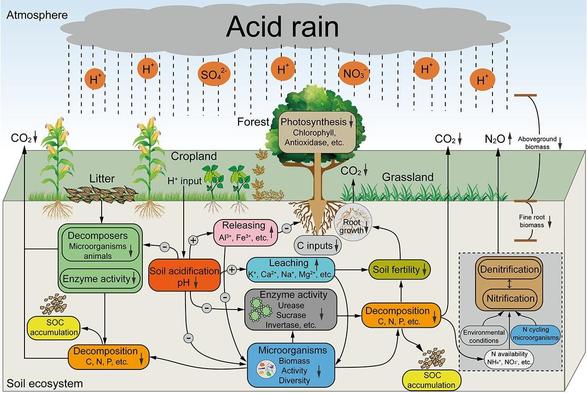
And here's a curious side effect of acid rain from SO2:
it reduces CO2 emissions from soil 💡
https://www.sciencedirect.com/science/article/abs/pii/S0341816221005725 "Acid rain reduces soil CO2 emission and promotes soil organic carbon accumulation in association with decreasing the biomass and biological activity of ecosystems: A meta-analysis" by Ziqiang Liu et al 2022

So when large areas simultaneously get rid of SO2 pollution
, CO2 emissions start to rise noticeably? Europe's SO2 reduction was fastest, USA is her typical laggard, and China began 2010ff and is now already on par with a mid-1990s Europe, much faster than USA.

My musings:
I guess, it means, once the soil removes the acid, CO2 emissions start to rise.
AFAIK, acid removal is no automatism in forest soil but I can imagine, removal from agricultural land happens automatically bit by bit during subsequent harvests? (Yum!)

Germany distributed chalk or something to her forest soils to counter the acidification and to rescue dying forests.

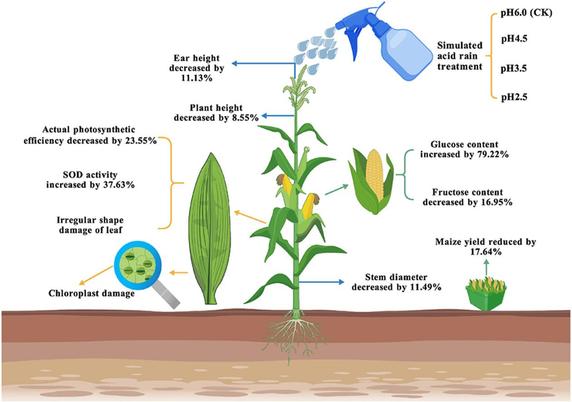
But. Plants and other beings suffer during acidification. And when forests recover they raise their carbon uptake. Crop yields also recover when the soil does, I reckon. (Indeed! see *** and pic 2, and also ****. Now I wonder whether the elsewhere celebrated yield gains are more due to cleaner air than genetical engineering and pesticides!)

Maybe, CO2 emissions from soil are balanced out by increased carbon uptake from healthier beings.
Does the paper say anything about all these musings?

"Overall, the responses of soil GHGs emissions to acid rain vary across different ecosystems, climates, soil types and experimental duration, and thus no consensus has emerged yet" 😁

* "East Asian aerosol cleanup has likely contributed to the recent acceleration in global warming" by Samset et al https://www.nature.com/articles/s43247-025-02527-3
A Conversation piece by the authors: https://theconversation.com/cleaner-air-in-east-asia-may-have-driven-recent-acceleration-in-global-warming-our-new-study-indicates-260601

** "‘Faulty premises’: Jairam Ramesh slams govt after it eases SO2 emission norms" https://theprint.in/india/faulty-premises-jairam-ramesh-slams-govt-after-it-eases-so2-emission-norms/2688855/

*** "The negative effects of simulated acid rain on maize physiology, grain quality and yield in a field trial" by Jidong Liao et al, 2025 https://www.sciencedirect.com/science/article/abs/pii/S1309104224003477

**** "More Power Generation, More Wheat Losses? Evidence from Wheat Productivity in North China" by Fujin Yi et al 2024 .
https://link.springer.com/article/10.1007/s10640-024-00841-6

#SO2 #AcidRain #SoilBiodiversity #soil #carbonUptake #CO2 #greenhousegases #agriculture #forest #cropyield #ClimateChange

@rmounce However Ross. I'm believing that #SO2 might be one of the Most sustainable routes to #OpenAccess.

I'm really critical of Diamond Open Access as "The Route" for what I've seen in #Latinamerica

SciTech Chronicles. . . . . . . . .Mar 19th, 2025

  Those who read history know EXACTLY how to repeat it. Vol II No 71 509 links Curated Mount Spurr activity will 'most likely end in an expl...

【SO2 レオン生誕祭】今日始めて誕生日が終わるまでにクロ×レオ カップルEDクリア【スターオーシャン2】

原作版ーーーーーーーーーーーーーーーーーーーーリクエストはマシュマロに投げてねhttps://marshmallow-qa.com/9ezo18chl9kfk7aSO2Rの検証依頼やネタの提供は質問箱までお願いします。https://peing.net/ja/nekomimi_maid当チャンネルではスターオーシャンの動画を投稿しています。よろしければチャンネル登録をお願いします。ーーーーーーーーーーーーーーーーーーーー他投稿動画●【#SO2R】別キャラの必殺技が使える!衝撃のバグ技を紹介します。【スターオーシャン2 リメイク】https://youtu.be/TbBAL3yzQgAーーーーーーーーーーーーーーーーーーーー#スターオーシャン #スターオーシャン2 #SO2 #so2r © 1998, 2023 SQUARE ENIX Original version developed by tri-Ace Inc記載されている会社名・製品名・システム名などは、各社の商標、または登録商標です。

WACOCA GAMES

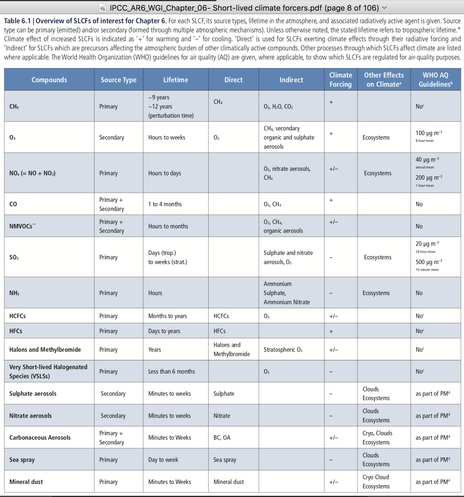
Due to acid rain, countries lowered SO2 emissions from industry and power plants. But SO2 is also a coolant via cloud-seeding aerosols. See Glen Peters' tweet: globally -0.5°C from 2010-2019. A very short lifetime of mere days means, SO2 molecules cool only locally, while methane and CO2 heat all.

SO2 is emitted by burning coal and ship fuel, & in #volcanism.
The other major coolant NOx, also short-lived with regional not global direct forcing, is emitted by burning fossil fuels eg in cars, and lightening storms & biomass burning.
So when our emissions drop, local heating goes up: " #TerminationShock".

When I say "local heating goes up", I should add that via wind and land-atmosphere and ocean-atmosphere interaction, this local heating also has global repercussions. Eg., wind drives the warm-er air parcel across the globe. So a warmer China and Japan who ditched SO2 and NOx, also heat the #Pacific.

Lowering SO2 and NOx while N2O (fertilizer), CH4 and CO2 emissions still rise is rather stupid.
#climate #climateChange #methane #SO2 #NOx #atmosphere #ocean