 anlomedad
A new study connects recent regionally confined warming in China 2010ff to their strive for healthy air by scrubbing SO2 from their coal chimneys. *
In other news, India is lambasted by a politician for excluding most of their coal chimneys from SO2 scrubbing regulation. **
And here's a curious side effect of acid rain from SO2:
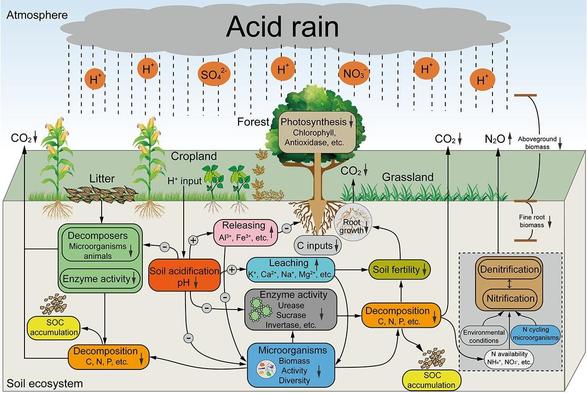
it reduces CO2 emissions from soil 💡
https://www.sciencedirect.com/science/article/abs/pii/S0341816221005725 "Acid rain reduces soil CO2 emission and promotes soil organic carbon accumulation in association with decreasing the biomass and biological activity of ecosystems: A meta-analysis" by Ziqiang Liu et al 2022
So when large areas simultaneously get rid of SO2 pollution
, CO2 emissions start to rise noticeably? Europe's SO2 reduction was fastest, USA is her typical laggard, and China began 2010ff and is now already on par with a mid-1990s Europe, much faster than USA.
My musings:
I guess, it means, once the soil removes the acid, CO2 emissions start to rise.
AFAIK, acid removal is no automatism in forest soil but I can imagine, removal from agricultural land happens automatically bit by bit during subsequent harvests? (Yum!)
Germany distributed chalk or something to her forest soils to counter the acidification and to rescue dying forests.
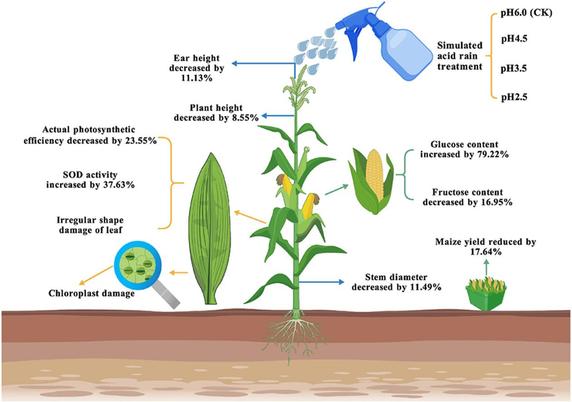
But. Plants and other beings suffer during acidification. And when forests recover they raise their carbon uptake. Crop yields also recover when the soil does, I reckon. (Indeed! see *** and pic 2, and also ****. Now I wonder whether the elsewhere celebrated yield gains are more due to cleaner air than genetical engineering and pesticides!)
Maybe, CO2 emissions from soil are balanced out by increased carbon uptake from healthier beings.
Does the paper say anything about all these musings?
"Overall, the responses of soil GHGs emissions to acid rain vary across different ecosystems, climates, soil types and experimental duration, and thus no consensus has emerged yet" 😁
* "East Asian aerosol cleanup has likely contributed to the recent acceleration in global warming" by Samset et al https://www.nature.com/articles/s43247-025-02527-3
A Conversation piece by the authors: https://theconversation.com/cleaner-air-in-east-asia-may-have-driven-recent-acceleration-in-global-warming-our-new-study-indicates-260601
** "‘Faulty premises’: Jairam Ramesh slams govt after it eases SO2 emission norms" https://theprint.in/india/faulty-premises-jairam-ramesh-slams-govt-after-it-eases-so2-emission-norms/2688855/
*** "The negative effects of simulated acid rain on maize physiology, grain quality and yield in a field trial" by Jidong Liao et al, 2025 https://www.sciencedirect.com/science/article/abs/pii/S1309104224003477
**** "More Power Generation, More Wheat Losses? Evidence from Wheat Productivity in North China" by Fujin Yi et al 2024 .
https://link.springer.com/article/10.1007/s10640-024-00841-6
#SO2 #AcidRain #SoilBiodiversity #soil #carbonUptake #CO2 #greenhousegases #agriculture #forest #cropyield #ClimateChange
 SWARM
SWARM Journal of Plant Ecology
 PUPUWEB Blog
 Josh
Josh
 JIPB
JIPB
 CelloMom On Cars
 CellBioNews