Memory Is Not a Folder

이 글은 AI 에이전트의 장기 기억 구축에서 기존 벡터 저장소가 사용하는 '폴더' 메타포가 개념적으로 한계가 있음을 지적한다. 기억은 단순 저장이 아니라 인지 경로에 따른 인식과 연상 작용이며, 이를 위해서는 프레게의 의미와 지시 구분, 헤브의 신경 연결 강화 원리, 콜린스-로프터스의 확산 활성화 이론을 기반으로 한 그래프 구조가 필요하다. 또한, 기억은 단순한 데이터 축적이 아니라 적절한 시점에 적절한 연상을 활성화하는 능력이며, 공유 가능한 개념 ID를 가진 그래프 형태가 여러 AI 에이전트 간 협업을 가능하게 한다. 이 글은 AI 기억 설계에 있어 저장소가 아닌 활성화 기반의 그래프 메커니즘을 제안한다.

https://everdreamsoft.com/blog/memory-is-not-a-folder

#aimemory #knowledgegraph #semanticmemory #llmagents #graphdatabase

Memory is not a folder — EverdreamSoft Blog

Why the storage metaphor breaks AI memory — and what Frege, Hebb, Borges and Halbwachs tell us to build instead. Notes on spreading activation, identity under variation, and the case for a shared cortex.

EverdreamSoft

Graft – semantic memory for AI agents, without the LLM

Graft는 AI 에이전트와 마이크로서비스를 위한 로컬 우선의 영구적 의미 기억 그래프 메모리 시스템입니다. SQLite 기반 단일 바이너리로 동작하며, 세션 간, 기기 간, 에이전트 간 기억을 빠르게 저장하고 검색할 수 있어 LLM의 맥락 창 한계를 극복합니다. 의미적 및 키워드 연결 그래프를 활용해 정확하고 검증된 캐시 조회를 제공하며, Claude, Codex, ChatGPT 등 다양한 AI 도구와 쉽게 통합됩니다. 또한, GPU 가속 옵션과 REST API, 3D 뷰어를 지원하며, 마이크로서비스 아키텍처 내에서 LLM 호출 비용과 지연을 크게 줄이는 계층형 캐시 역할을 수행합니다.

https://github.com/AEndrix03/Graft

#semanticmemory #aiagents #sqlite #microservices #llmintegration

MotionOS addresses a core AI limitation: agent context loss. Their new OS layer provides persistent semantic memory—storing & recalling information based on meaning, recency, and importance. Built on pgvector and Go, it achieves sub-100ms retrieval. Features include versioned memories and causal relationship tracking, aiming for more reliable, timeline-aware AI agents. A significant step for agent architecture resilience and reasoning. What do others think? #AIagents #SemanticMemory #AIethics
Teaching AI to Remember: Inside a Java-Based Semantic Memory System
How Quarkus, LangChain4j, and pgvector power long-term memory for intelligent, context-aware conversations
https://myfear.substack.com/p/java-ai-semantic-memory-quarkus-langchain4j
#Java #Quarkus #LangChain4j #AiMemory #LongTerm #SemanticMemory
Explore the future of AI and NLP with "Semantic Memory" 🧠! Discover how it's revolutionizing data indexing and natural language querying. Don't miss out, AI enthusiasts 🚀! #SemanticMemory #AI #NLP
https://neotools.io/jkBVg
Semantic Kernal Memory Giving AI Unlimited Memory AGI IS NEAR

WorldofAI

Semantic Kernal Memory Giving AI Unlimited Memory AGI IS NEAR
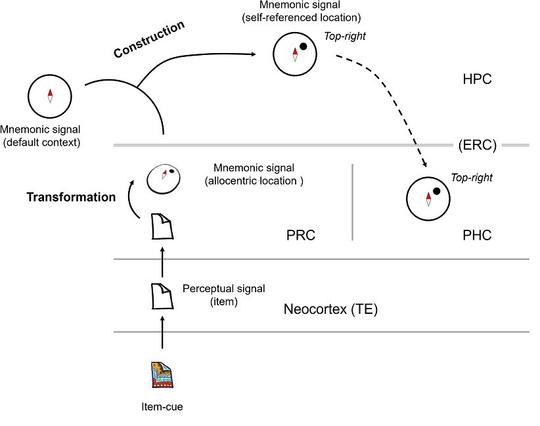
#ephys study of monkeys reveals a 2-stage mechanism for recalling #SemanticMemory: 1. retrieve its allocentric representation in #PerirhinalCortex, 2. represent the retrieved information in the 1st-person perspective by #hippocampal neurons #PLOSBiology https://plos.io/3qB4Olx
Sequential involvements of the perirhinal cortex and hippocampus in the recall of item-location associative memory in macaques

The standard consolidation theory suggests that the hippocampus (HPC) is critically involved in acquiring new memory, while storage and recall gradually become independent of it. Converging studies have shown separate involvements of the perirhinal cortex (PRC) and parahippocampal cortex (PHC) in item and spatial processes, whereas HPC relates the item to a spatial context. These 2 strands of literature raise the following question; which brain region is involved in the recall process of item-location associative memory? To solve this question, this study applied an item-location associative (ILA) paradigm in a single-unit study of nonhuman primates. We trained 2 macaques to associate 4 visual item pairs with 4 locations on a background map in an allocentric manner before the recording sessions. In each trial, 1 visual item and the map image at a tilt (−90° to 90°) were sequentially presented as the item-cue and the context-cue, respectively. The macaques chose the item-cue location relative to the context-cue by positioning their gaze. Neurons in the PRC, PHC, and HPC, but not area TE, exhibited item-cue responses which signaled retrieval of item-location associative memory. This retrieval signal first appeared in the PRC, followed by the HPC and PHC. We examined whether neural representations of the retrieved locations were related to the external space that the macaques viewed. A positive representation similarity was found in the HPC and PHC, but not in the PRC, thus suggesting a contribution of the HPC to relate the retrieved location from the PRC with a first-person perspective of the subjects and provide the self-referenced retrieved location to the PHC. These results imply distinct but complementary contributions of the PRC and HPC to recall of item-location associative memory that can be used across multiple spatial contexts.

I am a #CognitiveNeuroscience researcher working on #ConceptRepresentation, #Language comprehension, and #SemanticMemory. I have used event-related potentials, TMS, and MEG, but my primary tools are #fMRI and behavioral performance measures of #cognition.

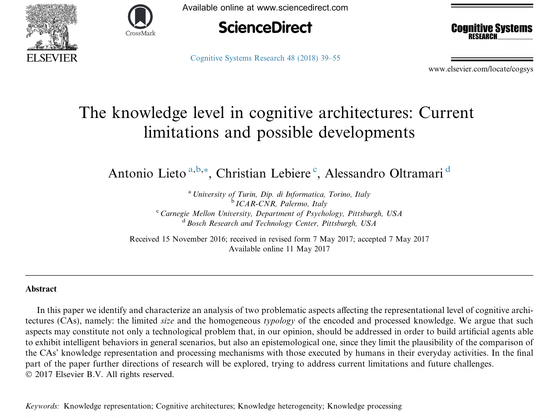
Lieto, Antonio, Lebiere, Christian, & Oltramari, Alessandro (2018). The knowledge level in cognitive architectures: Current limitations and possible developments. Cognitive Systems Research, 48, 39-55.

https://doi.org/10.1016/j.cogsys.2017.05.001

#knowledgerepresentation #knowledgeprocessing #semanticmemory #cognitivearchitectures #cognitivesystems #ArtificialIntelligence #cognitivemodelling #computationalcognitivescience #AI