MotionOS addresses a core AI limitation: agent context loss. Their new OS layer provides persistent semantic memory—storing & recalling information based on meaning, recency, and importance. Built on pgvector and Go, it achieves sub-100ms retrieval. Features include versioned memories and causal relationship tracking, aiming for more reliable, timeline-aware AI agents. A significant step for agent architecture resilience and reasoning. What do others think? #AIagents #SemanticMemory #AIethics
Teaching AI to Remember: Inside a Java-Based Semantic Memory System
How Quarkus, LangChain4j, and pgvector power long-term memory for intelligent, context-aware conversations
https://myfear.substack.com/p/java-ai-semantic-memory-quarkus-langchain4j
#Java #Quarkus #LangChain4j #AiMemory #LongTerm #SemanticMemory
Explore the future of AI and NLP with "Semantic Memory" 🧠! Discover how it's revolutionizing data indexing and natural language querying. Don't miss out, AI enthusiasts 🚀! #SemanticMemory #AI #NLP
https://neotools.io/jkBVg
Semantic Kernal Memory Giving AI Unlimited Memory AGI IS NEAR

WorldofAI

Semantic Kernal Memory Giving AI Unlimited Memory AGI IS NEAR
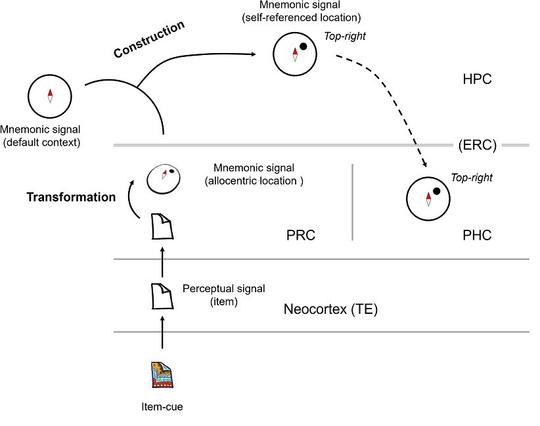
#ephys study of monkeys reveals a 2-stage mechanism for recalling #SemanticMemory: 1. retrieve its allocentric representation in #PerirhinalCortex, 2. represent the retrieved information in the 1st-person perspective by #hippocampal neurons #PLOSBiology https://plos.io/3qB4Olx
Sequential involvements of the perirhinal cortex and hippocampus in the recall of item-location associative memory in macaques

The standard consolidation theory suggests that the hippocampus (HPC) is critically involved in acquiring new memory, while storage and recall gradually become independent of it. Converging studies have shown separate involvements of the perirhinal cortex (PRC) and parahippocampal cortex (PHC) in item and spatial processes, whereas HPC relates the item to a spatial context. These 2 strands of literature raise the following question; which brain region is involved in the recall process of item-location associative memory? To solve this question, this study applied an item-location associative (ILA) paradigm in a single-unit study of nonhuman primates. We trained 2 macaques to associate 4 visual item pairs with 4 locations on a background map in an allocentric manner before the recording sessions. In each trial, 1 visual item and the map image at a tilt (−90° to 90°) were sequentially presented as the item-cue and the context-cue, respectively. The macaques chose the item-cue location relative to the context-cue by positioning their gaze. Neurons in the PRC, PHC, and HPC, but not area TE, exhibited item-cue responses which signaled retrieval of item-location associative memory. This retrieval signal first appeared in the PRC, followed by the HPC and PHC. We examined whether neural representations of the retrieved locations were related to the external space that the macaques viewed. A positive representation similarity was found in the HPC and PHC, but not in the PRC, thus suggesting a contribution of the HPC to relate the retrieved location from the PRC with a first-person perspective of the subjects and provide the self-referenced retrieved location to the PHC. These results imply distinct but complementary contributions of the PRC and HPC to recall of item-location associative memory that can be used across multiple spatial contexts.

I am a #CognitiveNeuroscience researcher working on #ConceptRepresentation, #Language comprehension, and #SemanticMemory. I have used event-related potentials, TMS, and MEG, but my primary tools are #fMRI and behavioral performance measures of #cognition.

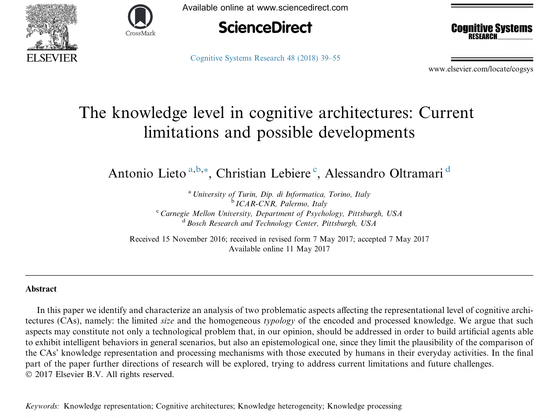
Lieto, Antonio, Lebiere, Christian, & Oltramari, Alessandro (2018). The knowledge level in cognitive architectures: Current limitations and possible developments. Cognitive Systems Research, 48, 39-55.

https://doi.org/10.1016/j.cogsys.2017.05.001

#knowledgerepresentation #knowledgeprocessing #semanticmemory #cognitivearchitectures #cognitivesystems #ArtificialIntelligence #cognitivemodelling #computationalcognitivescience #AI