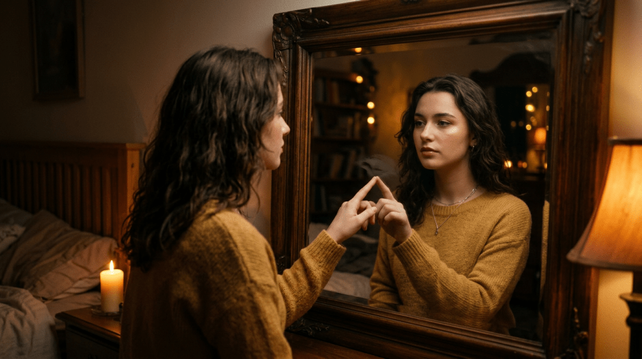
Your Social Media Behavior Is Saying Things You Haven't Said Out Loud - Zsolt Zsemba

From hiding your partner online to monitoring their likes, here's what your social media behavior is really saying about your relationship.

Zsolt Zsemba

Your Social Media Behavior Is Saying Things You Haven’t Said Out Loud

Your Social Media Behavior Is Saying Things You Haven’t Said Out Loud

At some point, social media stopped being a place where people shared their lives and became a place where people managed their image. That’s fine in general. In a relationship, it gets complicated fast.

How you behave online with and around your partner tells a story. The question is whether that story matches what you’re telling them in person.

The Hidden Relationship

If you’re with someone and you’re actively making sure nobody can tell, that’s worth examining. Not liking their posts. Not commenting. Never being seen together online even though you see each other constantly in real life. Keeping your relationship status blank or set to something vague.

Sometimes there are legitimate reasons for keeping things private. Not everyone needs to broadcast their relationship to the internet, and that’s a completely valid choice. The issue is when one partner is fine with privacy and the other is using privacy as a cover for something else entirely. There’s a difference between being a private person and being someone who doesn’t want certain people to know they’re taken.

If your partner is hidden online but you’re both active on social media, ask yourself who exactly you’re hiding from and why.

The Jealousy That Lives in the Comments Section

Then there’s the other side. The partner who monitors every like. Who notices that you commented a fire emoji on someone’s photo. Who wants a full explanation for why a specific person follows you. Who checks your tagged photos like they’re reviewing evidence.

This is not love. This is surveillance dressed up as concern. And it tends to escalate. What starts as a comment about one like becomes a pattern of checking, questioning, and low-level interrogation that makes the other person feel like a suspect in their own relationship.

Jealousy on social media is almost always about the person feeling it, not the person being accused. It points to something unresolved that has nothing to do with your follower count.

What’s Actually Acceptable in the DMs

This one comes up constantly and the honest answer is that there is no universal rule. What’s acceptable depends entirely on what you and your partner have actually agreed to, not what you assume is obvious.

Some couples are fine with friendly DMs to anyone. Some draw a line at ex-partners. Some are uncomfortable with anything that feels flirtatious even if nothing explicit was said. All of these positions are reasonable as long as both people know what the expectation is.

The problem is that most couples never have this conversation. They just assume the other person operates by the same invisible rulebook they do. Then someone feels betrayed over something that was never discussed, and the other person feels accused of something they didn’t think was wrong. Both of them are right from inside their own heads. Neither of them actually talked about it.

Posting About Your Relationship

Some people want their relationship visible. Photos together, the occasional tag, being acknowledged in someone’s feed. For them, being absent from their partner’s social media feels like being hidden. It stings in a specific way that’s hard to explain to someone who doesn’t care about it.

Other people keep their personal life completely offline and mean nothing by it. Their feed is food, travel, and gym content. Their relationship is real and serious and just not part of their public profile.

Neither approach is wrong. But when two people with opposite instincts end up together and never talk about it, one person ends up feeling erased and the other ends up feeling pressured. That tension doesn’t go away on its own.

Have the Actual Conversation

Social media preferences in a relationship are not a small thing anymore. They intersect with trust, visibility, boundaries, and how each person defines respect. Assuming you’re on the same page without checking is how small irritations turn into genuine fractures.

Figure out what you actually want. Figure out what your partner actually wants. See if those things are compatible. That conversation takes maybe twenty minutes and it saves months of low-grade tension that neither of you can quite name.

What you do online is not separate from who you are in the relationship. It’s just another place where your behavior either builds trust or quietly chips away at it.

#communication #DMBoundaries #jealousyInRelationships #onlineRelationshipBehavior #relationshipExpectations #socialMediaAndRelationships #ZsoltZsemba
What Your Texting Habits Say About You - Zsolt Zsemba

From five-hour silences to anxious rapid-fire messages, here's what your texting habits actually say about your relationship expectations.

Zsolt Zsemba

If You Don’t Know Who You Are Alone, Relationships Will Confuse the Hell Out of You

Nobody tells you this when you’re young. You spend your whole adolescence being shaped by what other people think of you, what your parents wanted you to become, and what the culture tells you success looks like. You absorb all of it. You build a personality around it. And then one day you find yourself in a relationship, wondering why you feel so lost, why you keep reacting in ways you don’t fully understand, why the person across from you seems to trigger something you can’t quite name.

The answer is usually the same. You never figured out who you are when nobody is watching.

Most men walk into relationships as a work in progress; they haven’t started yet. They know their job title, their taste in music, and their football team. They don’t know their patterns. They don’t know what they actually need versus what they think they’re supposed to want. They don’t know where they end, and other people begin. So when a relationship puts pressure on all of that, the confusion is total.

The Mirror Problem

Relationships have a way of reflecting things back at you. A partner who pulls away makes you realize you have an abandonment wound you never addressed. A partner who criticizes you activates something from childhood you thought you’d outgrown. A partner who needs too much space makes you question your own worth in ways that have nothing to do with them.

None of this is their fault. The mirror doesn’t create what it shows you. It just shows you.

The problem is that most men haven’t done the work to understand what they’re looking at when it appears. So instead of recognizing the reflection, they blame the mirror. They blame her for being distant, critical, or suffocating. They end the relationship. They find a new one. The same patterns show up again within six months, wearing a different face.

This is not bad luck. This is what happens when you enter a relationship without knowing yourself.

What You Think You Want vs. What You Actually Need

Here’s where it gets complicated. A man who doesn’t know himself doesn’t know the difference between what he wants and what he needs. He thinks he wants a woman who doesn’t challenge him. What he needs is someone who makes him feel safe enough to be honest. He thinks he wants constant closeness. What he needs is to learn that he can be alone without falling apart. He thinks he wants someone to fix the emptiness. What he needs is to stop outsourcing that job.

This gap between want and need is where most relationships quietly die. Two people who both don’t know themselves, trying to fill in the blanks with each other, eventually realizing the blanks are still there and blaming each other for it.

You cannot bridge that gap from inside a relationship. You can do some of the work there, if you’re lucky and both people are willing. But the foundation has to be laid before you walk in.

Alone Is the Practice Ground

Being alone is not a waiting room. It’s not the unpleasant gap between relationships that you have to survive until the next one starts. It’s the only place where you can actually hear yourself think without someone else’s needs, expectations, or projections filling up the space.

When you’re alone, and you sit with that discomfort instead of immediately solving it, you learn something. You learn what actually bothers you versus what you can let go. You learn how you talk to yourself when nobody is listening. You learn whether you actually like your own company, and if you don’t, that tells you something important.

The men who figure out who they are when they’re alone tend to show up differently in relationships. Not perfectly. Not without issues. But with enough self-knowledge to stop reacting blindly, to take some responsibility for their patterns, to ask for what they need instead of punishing a partner for not reading their mind.

The Real Cost of Skipping This

Skipping the work of knowing yourself doesn’t just hurt you. It hurts whoever you’re with. You become unpredictable to them because you’re unpredictable to yourself. You make them responsible for your emotional stability. You confuse love with need and then resent them when they can’t meet all of it.

The relationships that actually work, the ones that hold up under pressure and still feel like something good years later, are almost always built by people who came in with some degree of self-knowledge. Not perfect self-knowledge. Just enough to know where they were standing.

You can start a relationship without knowing yourself. Plenty of people do. But at some point, the confusion becomes impossible to ignore. The question is whether you address it before it costs you something you actually care about.

#FriendsAndFriendship #Loneliness #NeedsAndWants #partners #relationship #relationshipExpectations #ZsoltZsemba

REALITY SHOWS PROFFER FAILED LOVE STORIES FOR MASS CONSUMPTION

Reality dating shows like Love Island are being questioned for their production methods and declining viewer numbers. Find out how they affect real relationships.

#RealityTV, #DatingShows, #LoveIsland, #TVAudience, #RelationshipExpectations

https://newsletter.tf/reality-dating-shows-real-love-viewer-interest/

Viewer numbers for some dating reality shows are falling, with one show failing to get many viewers even on a quiet night. This is lower than expected.

#RealityTV, #DatingShows, #LoveIsland, #TVAudience, #RelationshipExpectations
https://newsletter.tf/reality-dating-shows-real-love-viewer-interest/

Reality Dating Shows Face Questions About Real Love Stories and Viewer Interest

Reality dating shows like Love Island are being questioned for their production methods and declining viewer numbers. Find out how they affect real relationships.

NewsletterTF
Before you continue to YouTube