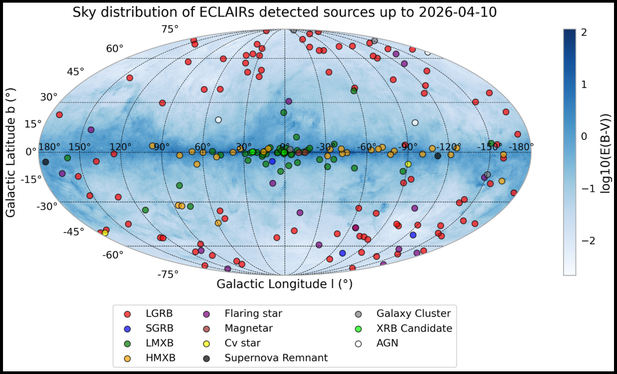
Fully operational since April 2025, the Franco-Chinese #SVOM mission has detected numerous gamma-ray bursts with a wide range of #redshifts, some of which were emitted just 730 million years after the #BigBang!

In addition, the #ECLAIRs instrument has detected more than 150 bursts from galactic sources as well as a few stellar bursts from M-K type stars, terrestrial gamma-ray flashes, auroras observed in X-rays, and solar flares reflected off the Moon!

More info: https://www.irap.omp.eu/en/2026/05/svom-an-update-on-the-mission/
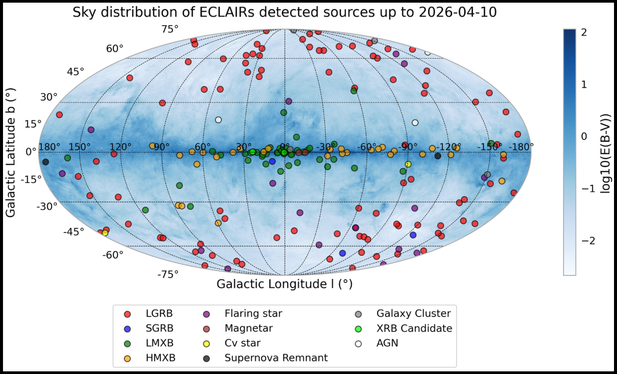
Pleinement opérationnelle depuis avril 2025, la mission franco-chinoise #SVOM a détecté de nombreux sursauts gamma de #redshifts variés, émis pour certains 730 millions d'années seulement après le #BigBang !

En outre, l'instrument #ECLAIRs a détecté plus de 150 éruptions issues de sources galactiques ainsi que quelques sursauts stellaires d’étoiles de type M-K, des terrestrial gamma-ray flashes, des aurores vues en X et des sursauts solaires réfléchis sur la Lune !

https://www.irap.omp.eu/2026/05/svom-une-mission-au-top/

A tale of many $H_0$

The Hubble parameter $H_0$, is not a univocally-defined quantity: it relates redshifts to distances in the near Universe, but is also a key parameter of the $Λ$CDM standard cosmological model. As such, $H_0$ affects several physical processes at different cosmic epochs, and multiple observables. We have counted more than a dozen $H_0$'s which are expected to agree if a) there are no significant systematics in the data and their interpretation and b) the adopted cosmological model is correct. With few exceptions (proverbially confirming the rule) these determinations do not agree at high statistical significance; their values cluster around two camps: the low (68 km/s/Mpc) and high (73 km/s/Mpc) camp. It appears to be a matter of anchors: the shape of the Universe expansion history agrees with the model, it is the normalizations that disagree. Beyond systematics in the data/analysis, if the model is incorrect there are only two viable ways to "fix" it: by changing the early time ($z\gtrsim 1100$) physics and thus the early time normalization, or by a global modification, possibly touching the model's fundamental assumptions (e.g., homogeneity, isotropy, gravity). None of these three options has the consensus of the community. The research community has been actively looking for deviations from $Λ$CDM for two decades; the one we might have found makes us wish we could put the genie back in the bottle.

arXiv.org