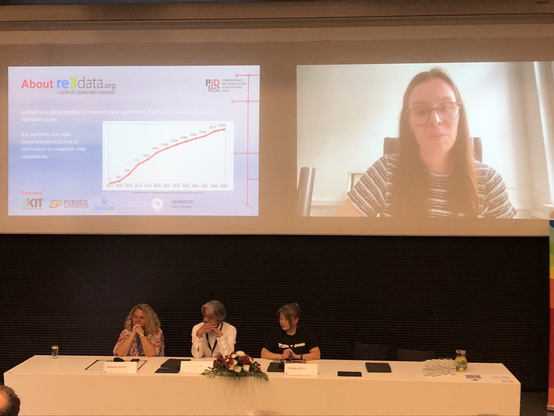
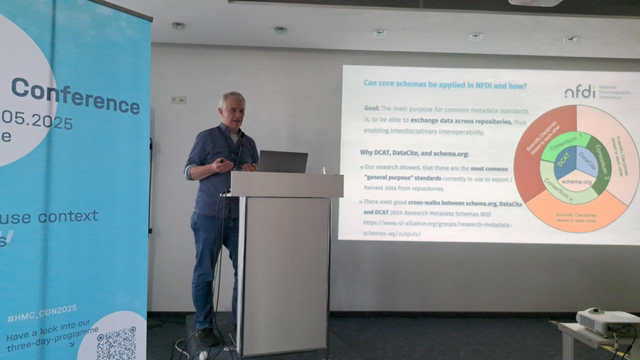
At #HMC_con2025, Emanuel Söding presented the results of the 1st NFDI Metadata Workshop: All 26 NFDI consortia participated and agreed to
1. promote the three cross-disciplinary standards: #DCAT, #DataCite Metadata Schema, #schemaorg
2. work towards an NFDI core metadata profile that identifies mandatory fields of these three
3. recommend registration and at least annual curation in #re3data
Report of the workshop: https://doi.org/10.5281/zenodo.15227236
Contact: https://www.nfdi.de/section-meta/task-force-metadata/?lang=en
#rdm #NFDI #metadata

Report on the first NFDI Metadata Workshop

Metadata is a topic of significant interest across all consortia, serving as a crucial link between them. When properly addressed, it enables consortia to share their specific needs and experiences, fostering collaboration and knowledge exchange.This report summarizes the outcomes of the first NFDI Metadata Workshop, which took place on January 14-15, 2025, in Dresden, and was organized by the Taskforce Metadata. The workshop marked the beginning of a series of NFDI-wide metadata discussions aimed at developing joint recommendations for metadata schemas for datasets and the use of re3data as a central registry for repositories.

Zenodo
KIT - PSE - Für Bewerbende - Stellenangebote - Joboffer-Details

KIT-Bibliothek | 2025-03-20 Stellenausschreibung Data Scientist

Website der KIT-Bibliothek, Karlsruhe

La newsletter #ScienceOuverte de l'#InstitutPasteur a compilé cette semaine une sélection d'articles autour des #EntrepôtsDeDonnées
­👉 #OnVousExplique : Les entrepôts de données
👉 Comment trouver un entrepôt de données dans le domaine biomédical ?
👉 Le répertoire d’entrepôts de données #re3data
👉 Les différences entre plusieurs entrepôts de données généralistes : #RechercheDataGouv, #Zenodo, #Dryad et #Figshare
👉 Déposer des données dans un entrepôt, que doit-on anticiper ? L’exemple de #GEO
👉 Disparition de certains entrepôts de données : quel impact sur l’accès aux #DonnéesDeRecherche ?

➡️ https://4682g.r.sp1-brevo.net/mk/mr/sh/OycXxko2a8zXNsWQVbhniEew/_eAVoGIw0pDv

Lettre d'information Science Ouverte

New study: "We found that nine Latin American countries carry out #OpenScience actions; eight develop research #data #repositories; eight implement technological infrastructure to develop repositories; seven collaborate with #libraries in open science actions; and seven have their repositories recorded in the Registry of Research Data Repositories [#re3data] and Dataverse, resulting in 62 research #DataRepositories in #LatinAmerica."
https://unisapressjournals.co.za/index.php/LIS/article/view/15112

#OpenData
@openscience

Research Data Repositories from Latin America: Analysis and Proposal of Library Functions to Implement Open Science | Mousaion: South African Journal of Information Studies

Jibran K. Paul and Dorothea Strecker @dorothearrr presented the development of research data repositories in India at #PIDfest. Including the perspective of @re3data and potential improvements for PID usage.

Jibran also talks about to design a roadmap for building a national PID strategy.

#re3data #PIDs #DOI @HelmholtzOpenScienceOffice @KIT_Karlsruhe

💚 Noch nicht das richtige Repositorium gefunden? Gleich stellt Dorothea Strecker vom @IBI_HU im Rahmen der #LoveDataWeek das Verzeichnis #re3data vor.
hu.berlin/lovedataweek24
#LoveData24 #Repos

New insightful publication from @unesco on the state and trends of #OpenScience around the world.

#re3data metadata is used to demonstrate the global distribution of #DataRepositories on pages 42-43: 📊

https://doi.org/10.54677/GIIC6829

@fsan Conrad et al. "Making Mathematical Research Data FAIR: A Technology Overview" https://arxiv.org/abs/2309.11829 suggest "no".

It might be easier to look for practices/standards within a smaller research community, as seen in the wild on some open repository or some #OpenAccess journal focused on reproducibility (like the venerable https://www.ipol.im/ ).

A starting point for other fields might be #re3data.

#FAIRdata

Making Mathematical Research Data FAIR: A Technology Overview

The sharing and citation of research data is becoming increasingly recognized as an essential building block in scientific research across various fields and disciplines. Sharing research data allows other researchers to reproduce results, replicate findings, and build on them. Ultimately, this will foster faster cycles in knowledge generation. Some disciplines, such as astronomy or bioinformatics, already have a long history of sharing data; many others do not. The current landscape of so-called research data repositories is diverse. This review aims to perform a technology review on existing data repositories/portals with a focus on mathematical research data.

arXiv.org

🤔 Is it possible to reliably and unambiguously cite a research data repository?

🙌 Yes, of course!

👉 Here's a great example of using #re3data DOI's to reference repositories:

https://doi.org/10.1038/s41597-023-02269-x