 cytgen
Activation of Autophagy During Microsporogenesis and Tapetogenesis in Angiosperms - Cytology and Genetics
Activation of Autophagy During Microsporogenesis and... ##microsporogenesis ##tapetogenesis ##autophagy ##secretorytapetum ##plasmodialtapetum ##programmedcelldeath ##capsellabursapastoris ##hostasieboldiana ##tradescantiavirginiana ##celldeath ##capsella ##tradescantia ##hosta
 Cytology and Genetics
Activation of Autophagy During Microsporogenesis and Tapetogenesis in Angiosperms - #microsporogenesis #tapetogenesis #autophagy #secretorytapetum #plasmodialtapetum #programmedcelldeath #Capsellabursapastoris #Hostasieboldiana #Tradescantiavirginiana #celldeath #Capsella #Tradescantia #Hosta - https://link.springer.com/article/10.3103/S0095452725030041

Activation of Autophagy During Microsporogenesis and Tapetogenesis in Angiosperms - Cytology and Genetics
Abstract In this research the involvement of autophagy in the development of microsporogenesis in shepherd’s purse (Capsella bursa-pastoris) as a representative of dicotyledons and in Siebold’s plantain lily (Hosta sieboldiana) and Virginia spiderwort (Tradescantia virginiana) as representatives of monocotyledons was investigated. It was shown that microsporogenesis in the studied species is accompanied by the activation of autophagy, which is associated with both the onset and completion of meiosis and corresponds to the accumulation and degradation of regulators involved in meiotic division and tapetogenesis. The presence of cytomixis in meiosis prophase may serve as additional confirmation of the regulatory role of autophagy in meiosis. It was confirmed that autophagy is involved in the functioning and degradation of the tapetum. The activation of autophagy may accompany the formation of tetrads of microspores (C. bursa-pastoris), the functioning and degradation of the tapetum (H. sieboldiana), as well as the formation of tetrads and the final degradation of the tapetum (T. virginiana). This may be because the studied species differ in the type of tapetum (secretory and plasmodial). This difference between tapetum types is not clearly diagnosed, and varieties are differentiated in terms of reorganization, intensity of autophagy, and time of degradation of the tapetum tissue within the secretory type. The obtained results allow for the conclusion that, in general, the functioning and degradation of the tapetum in the studied monocots are accompanied by more intense autophagy than in the representative of dicot.
 ChemistryViews
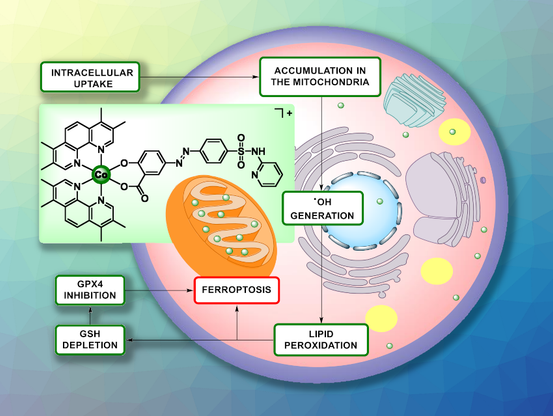
Cobalt Complex Induces Programmed Cell Death against Cancer
Co(III) polypyridine sulfasalazine complex can act as a ferroptosis inducer to kill cancer cells
https://www.chemistryviews.org/cobalt-complex-induces-programmed-cell-death-against-cancer/
#ferroptosis #cancertreatment #programmedcelldeath #chemistry

 Yasha Hartberg (he/him)
“Third, PCD can co-ordinate the cooperative functions between compartments in the eukaryote cell and by synchronizing the behavior of phytoplankton groups.”
Durand et al. (2019)
“Second, PCD is a mechanism for the evolution of the division of labor.”
Durand et al. (2019)
“First, PCD facilitates the formation of cooperative groups by cells sharing resources or communicating information about the environment – prokaryote cells in the case of eukaryogenesis, and eukaryote cells in the case of multicellularity.”
Durand et al. (2019)
“In the eukaryote cell, PCD may be a way of ensuring that the evolutionary interests of all the organellar genomes (three, in the case of photosynthetic organisms) remain aligned [41,46,47]. The stable evolution of the eukaryote cell depended on this alignment.”
Durand et al. (2019)
“PCD is a mechanism for cooperation and overcoming some of the stresses of social living by sharing resources between members of the group.”
Durand et al. (2019)
“In addition, and as many authors have demonstrated, it is helpful to think about [[PCD]] as a “system that is probabilistic (the same input does not universally produce the same output), branching (some stages in the execution of the program can lead to a range of future states) and non-discrete (loss of viability can be transient or graded)”
Durand et al. (2019)
“For the evolution of cooperation and division of labor, individuals need to be able to communicate with each other. They need to “know” where they fit functionally, structurally, or temporally in the group.”
Durand et al. (2019)