 Daniel Pomarède
in the #arXiv
The Heterogeneous Surface of Asteroid (16) Psyche
by Saverio Cambioni and co-authors
https://arxiv.org/abs/2402.03422
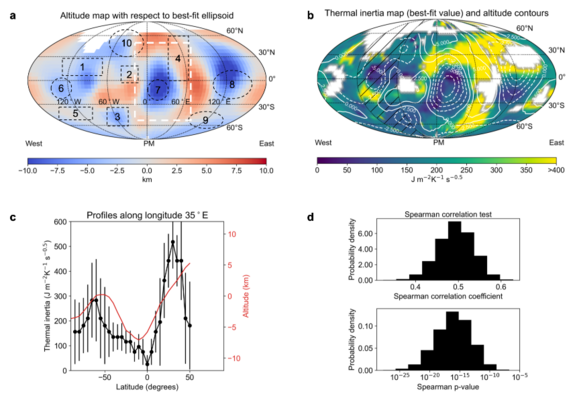
📷 Fig. 5: The lowlands in the Bravo-Golf region (longitudes 15◦W to 60◦E) have a lower thermal inertia than the surrounding highlands.
#asteroid #Psyche #map #mapping #cartography #ALMA #remotesensing #preplanet #planetesimal #metal #metals #astronomy #astrophysics #astrodon #space #science #research

The Heterogeneous Surface of Asteroid (16) Psyche
Main-belt asteroid (16) Psyche is the largest M-type asteroid, a class of object classically thought to be the metal cores of differentiated planetesimals and the parent bodies of the iron meteorites. de Kleer, Cambioni, and Shepard (2021, https://doi.org/10.3847/psj/ac01ec) presented new data from the Atacama Large Millimeter Array (ALMA), from which they derived a global best-fit thermal inertia and dielectric constant for Psyche, proxies for regolith particle size, porosity, and/or metal content, and observed thermal anomalies that could not be explained by surface albedo variations only. Motivated by this, here we fit a model to the same ALMA data set that allows dielectric constant and thermal inertia to vary across the surface. We find that Psyche has a heterogeneous surface in both dielectric constant and thermal inertia but, intriguingly, we do not observe a direct correlation between these two properties over the surface. We explain the heterogeneity in dielectric constant as being due to variations in the relative abundance of metal and silicates. Furthermore, we observe that the lowlands of a large depression in Psyche's shape have distinctly lower thermal inertia than the surrounding highlands. We propose that the latter could be explained by a thin mantle of fine regolith, fractured bedrock, and/or implanted silicate-rich materials covering an otherwise metal-rich surface. All these scenarios are indicative of a collisionally evolved world.