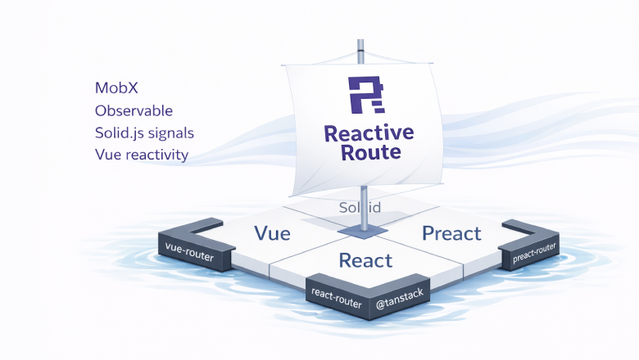
Reactive Route — новый роутер для разных фреймворков и реактивных систем в 2 КБ

Я не OpenSource разработчик, но за пару десятков лет написал под сотню enterprise-level библиотек, которые остаются в рабочем контуре, дорабатываются под каждый проект и адаптируются к новым технологиям. Большого смысла выходить в OSS не было, кроме как для упрощения обучения коллег и единого места хранения документации. Но и желание помогать другим и делиться выстраданными подходами, экспертизой и конкретным кодом мне не чуждо - сегодня поможешь ты, завтра - тебе. Через полгода подготовки и адаптации к OpenSource (сам использую и дорабатываю около 8 лет) в свет выходит одна из библиотек моего рабочего контура - Reactive Route . Так как я работаю с проектами на разных стеках, стараюсь писать код максимально framework-agnostic - независимыми слоями, которые можно заменить или переписать, не трогая остальной код проекта. А к фреймворкам и библиотекам для работы с состоянием они подключаются с помощью легковесных адаптеров, сохраняя синтаксис работы. Конкретно для Reactive Route выложил набор готовых адаптеров в комбинациях, которые сейчас чаще всего использую: - React + MobX / Observable - Preact (no compat) + MobX / Observable - Solid.js + нативная реактивность / MobX / Observable - Vue + нативная реактивность В одном npm-пакете - строгая TS-типизация, SSR / MPA / no-JS / Widget режимы и тщательно протестированная отказоустойчивость. В статье не буду пересказывать документацию на русском и английском , а поговорю скорее про общие принципы качества, использование ИИ в разработке и почему многие библиотеки раздуваются, не успев даже стабилизировать ядро. Читать

https://habr.com/ru/articles/1010012/

#react #vue #solid #preact #router #routing

Reactive Route — новый роутер для разных фреймворков и реактивных систем в 2 КБ

Я не OpenSource разработчик, но за пару десятков лет написал под сотню enterprise-level библиотек, которые остаются в рабочем контуре, дорабатываются под каждый проект и адаптируются к новым...

Хабр

bing! And that's what using #preact gets you*

*conditions apply

Okay #frontend folks:

I wrote UIs before React. I leaned into React hard early on, because it matched my mental model for UIs. I don't want to do React anymore.

**In your opinion what's the next best direction for building UIs?**

My goal is to simplify the process of writing and managing accessible interactive components with as little overhead as possible.

Boosts and wildly unpopular opinions welcome.

#react #vue #preact #webcomponents #svelte

Vibing with the Agent Control Protocol

Although most of my actual work happens inside a terminal, I have been wanting an easy way to talk to the newfangled crop of AI agents from my iPhone.(...)

#acp #agents #ai #iphone #mcp #preact #sqlite #sse

https://taoofmac.com/space/notes/2026/02/01/2100?utm_content=atom&utm_source=mastodon&utm_medium=social

The high freshmen highschool kiddo's took the #PreACT last semester and received their scores this week.

One of them, who thinks he's not as intelligent as he actually is (compares himself to his twin....) did better then average and had some surprising strengths.

The other one scored the second highest in the school.

We are proud of them both! 🤘

Preact 11 Beta Introduces Hydration 2.0, Default Ref Forwarding, and Modernized Bundling, by @infoq.com:

https://www.infoq.com/news/2025/09/preact-11-beta/

#preact

Preact 11 Beta Introduces Hydration 2.0, Default Ref Forwarding, and Modernized Bundling

Preact 11 Beta is here! This lightweight React-compatible library modernizes hydration and API ergonomics with key updates like Hydration 2.0, default ref forwarding, and streamlined bundling. It ditc

InfoQ
Preact 11 Beta Introduces Hydration 2.0, Default Ref Forwarding, and Modernized Bundling

Preact 11 Beta is here! This lightweight React-compatible library modernizes hydration and API ergonomics with key updates like Hydration 2.0, default ref forwarding, and streamlined bundling. It ditc

InfoQ
Web development for beginners: Frontend frameworks

In this chapter, we’ll take a look at frontend frameworks – libraries that help with programming web user interfaces (“frontend” means “browser”, “backend” means “server”). We’ll use the frontend framework Preact to implement the frontend part of a todo list app – whose backend part we’ll implement in a future chapter.

@rauschma it's been a while since I wrote about it, but I've used buildless #preact for quite a bunch of cool things over the years (and still do) 😎

Feel free to have a look at https://ttntm.me/blog/buildless-preact-starter/ and https://ttntm.me/blog/building-a-data-viewer-with-preact/ if you're curious

My Buildless Preact Starter

A template/starter intended to showcase how I'm using Preact for SPAs in buildless environments.

Tom's Homepage

Refactored a Build Pipeline and used esbuild instead of webpack and replaced #react with #preact.

As a result of all the refactoring, the codebase is modernised and just 38% of the bundle size what it was previously. Even the non-minified bundle is smaller than before.