EVENING PRIMROSE, THE LUNAR FLOWER OF SUMMER SOLSTICE
By Veronica Smith
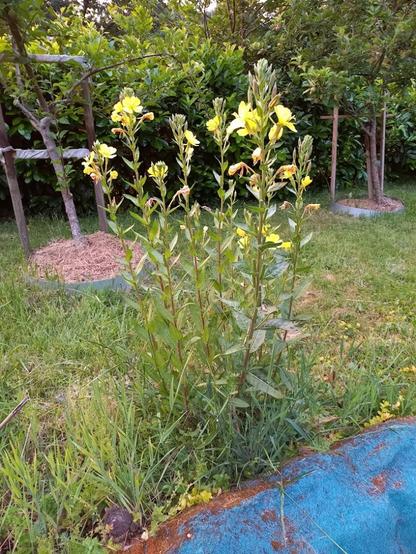
Evening Primrose (Oenothera biennis) is not part of our traditional European plant lore because it was introduced from North America during colonial times. That said, I believe that this lady deserves a place in our modern Shamanic practices, not just because of her many medicinal (and culinary) uses, but because she is an evening star, flowering after sundown, when the solar-powered plants have closed up their petals! Evidently, the flowers have ultraviolet markings, to help night-flying bugs find the nectar! As her secondary name “biennis” suggests, she flowers in her second year, from June until September (mid-summer to autumn equinox).
Evening Primrose Flower, taken at 22H30 at Summer Solstice
There are several varieties of Oenothera in North America but it is Oenothera biennis, which is best known in Europe. In French, it is known as “Onagre”; in German it is called “Echte Nachtkerze” and in Italian “Stella di Sera”.
I love how Lesley Bremness describes Oenothera biennis in her book The Complete Book of Herbs: “the clear yellow flowers of Evening Primrose unclasp their hooked cover at twilight and open their blossoms to the moon, welcoming the night with their delicate sweet fragrance and mysterious emissions of phosphorescent light. As the season progresses, the flowers often stay open all day as well.”
Despite the poetry, Oenothera biennis (family Onagraceae) has practical uses, both medicinal and culinary. The medicinal qualities have always been highlighted here in Europe, the culinary less so because it was only used as a food by native North Americans. Let us take a look at both qualities!
First, here is the science bit! According to Bartram’s Encyclopedia of Herbal Medicine, the unrefined oil, which is expressed from the seeds of Oenothera biennis, yield Gamma Linolenic Acid (GLA). It is a precursor of Prostaglandin E1, which inhibits abnormal cell proliferation and reduces blood pressure, as well as reducing serum cholesterol levels. Externally, it protects the moisture balance of the skin.
According to Anne McIntyre, in her book The Complete Herbal Tutor, the oil expressed from the seeds contains Omega-6 essential fatty acids, including Linoleic, Oleic, Palmitic and Stearic acid. These are essential for the healthy functioning of the immune, nervous and hormonal systems. For instance, Linoleic Acid helps to reduce pain caused by inflammation, by releasing endorphins and enkephalins in the brain, chemicals that make us feel good and less painful.
Evening Primrose Seed Oil has an impressive list of actions, including:-
anti-allergenic, anticoagulant; anti-eczema, antioxidant, antispasmodic, anti-thrombotic, demulcent, hormone regulation, hypotensive, nervine, nutritive, mildly sedative.
There is an even longer list of uses!
DIGESTION: it counteracts the effects of alcoholic poisoning; encourages the regeneration of a damaged liver; helps withdrawal from alcohol and alcoholic depression; alleviates hangovers.
CIRCULATION: it reduces high blood-pressure and harmful cholesterol levels; it helps to prevent blood-clotting; dilates coronary arteries and removes obstructions.
MENTAL AND EMOTIONAL: being mildly sedative, it is helpful in nervous indigestion, colic, hyperactivity in children and relieves mental depression.
RESPIRATORY: Its anti-spasmodic effects help to relieve asthma and paroxysmal coughing (as in whooping-cough).
IMMUNE SYSTEM: Fatty acids help in the treatment of allergies such as eczema, hyperactivity, ADHD, asthma, migraine, metabolic disorders, diabetes, high cholesterol, viral infections and arthritis. GLA reduces inflammation by reducing Prostaglandin E. Studies suggest that it may inhibit the production of free radicals and slow tumour growth.
REPRODUCTIVE SYSTEM: Amongst other things, Fatty acids help to maintain hormone balance and work with pre-menstrual tension, menstrual irregularities, breast problems and menopausal problems. It increases the fat content of breast milk in lactating women.
SKIN: Evening Primrose Oil contains Vitamins A, D and F. Vitamin A, which is derived from Lutein, is an antioxidant that helps prevent UV damage. The body cannot produce Vitamin A itself, so we must get it through our diet. Vitamins D and F keep the skin healthy by replacing lost oils and are essential for the production of cell membranes. A lack of these vitamins results in skin disorders, such as Eczema and Acne. GLA eases these scaly skin disorders. particularly when combined with zinc. It relieves pruritus (itching); dandruff; strengthens soft brittle finger nails and counteracts abnormal tear production.
But wait! There’s more! According to trials, Evening Primrose Oil significantly improves sensory functions, such as muscle weakness, arm tendon reflex and numbness. It works with Raynaud’s disease, lessens diabetic retinitis and may slow down the progress of Multiple Sclerosis. Research continues into treatments for Rheumatoid Arthritis, Anorexia-nervosa, Parkinson’s disease, and certain forms of infertility.
WARNING! WHEN NOT TO USE EVENING PRIMROSE OIL:
Do not give to those suffering from Epilepsy.
People with hormone-sensitive Cancers should avoid it.
Do not take it if you have a bleeding disorder!
If you are planning surgery, stop taking it at least 2 weeks before the operation!
That is the “Science” bit. Now for the “How To” bit!
As Lesley Bremness says in her book The Complete Book of Herbs, Oenthera biennis is easy to grow from its tiny, round, beige-coloured oily seeds. In fact, in some areas, it is regarded as an invasive pest! Unfortunately, extracting the precious oil from the seeds is complex, especially as the oil has a short shelf-life of six months or less.
Commercially produced Evening Primrose oil is manufactured on a large scale by factories, which have specialised equipment to process the tiny seeds. The oil is then put into gelatine capsules and measured into plastic containers, ready for sale in the stores.
We at home do not have the equipment to process the oily seeds in such a way. So I did some research over the internet and found this recipe, which uses the flowers instead of the seeds, to make an infused oil that has similar properties to the seed oil. It is no more fiddly than making St. John’s Wort Oil!
Grind about half a cup of Evening Primrose Blossoms, using either a mortar and pestle or some kind of electric food processor, until you have a teaspoon of the powdered substance. Add half a cup of olive oil (or similar) to the flower powder. Mix the two ingredients with your hands, until the oil becomes completely cloudy, which shows that the Evening Primrose flowers have been dissolved.Pour the mixture into a clean glass jar, cover with a cloth to keep out debris, and place on a sunny windowsill. Stir every few hours the first day. Then let the mixture sit for a minimum of one week, preferably longer. When ready, strain the oil through two layers of cheesecloth or pantyhose, to remove any residual plant material that has settled to the bottom. Leaving in such material would encourage mould growth. What you should have is an amber-coloured oil that is ready for use. Remember to keep it in the fridge, to stop it from growing rancid!MORE THAN JUST THE OIL:
Although Evening Primrose OIL is used in a wide range of cosmetic products as a moisturiser, you can make a poultice from the leaves and flowers, to relieve abscesses and boils and other skin ailments.
You can infuse the leaf and stem to make an astringent facial steam; or add the infusion to hand-cream as a softening agent.
You can also infuse the leaves and peeled “bark” of the tough, flowering stalk, and drink the tea to soothe cough spasms.
Evening Primrose leaves were used traditionally for minor wounds, gastro-intestinal complaints, and sore throats.
Native Americans made a hot poultice from the pounded Roots and applied it externally to treat bruises, piles and boils. The roots were also chewed and rubbed onto muscles to improve strength.
THE WHOLE PLANT IS EDIBLE!
Here in Europe, we have concentrated almost exclusively on the medicinal uses of Oenothera biennis, and even more specifically, on the seed oil. So it may come as a surprise to learn that Evening Primrose has culinary uses too! I found a great website called www.eattheweeds.com and an interesting article by Green Dean about foraging Evening Primrose. The article is full of good advice. He says: “Try all parts carefully and sparingly. They can bother the throat of some people, even when cooked, and the taste may be acquired.” Another site adds: “It may cause headaches or upset stomachs in some people. So it should not be taken on an empty stomach.”
Now that I have put you off experimenting with Oenothera biennis, here are some recipe ideas to try! First, make sure to IDENTIFY the plant correctly! I recommend Green Dean’s website mentioned above.
ROOTS: Evening Primrose has been cultivated in North America for its nutritious edible roots. It forms a long, reddish taproot, which can be hard to dig up! Only the root of the first-year plant should be harvested, late in the season, when they have stored up a year’s growth of nutrients. Do not try eating it raw as it will irritate the throat. Instead, peel it and boil it for 20 – 30 minutes, as you would potatoes. The flavour is said to be sweet and peppery, a bit like parsnip, or black salsify. You can also pickle the root and toss into salads!
YOUNG SECOND-YEAR SHOOTS: can be peeled and eaten, either raw or cooked. Green Dean describes them as mucilaginous and peppery!
YOUNG LEAVES FROM SECOND-YEAR STALKS: these were cooked as greens by the Cherokee Indians. Green Dean advises that the leaves need to be boiled more than once but even so, they are usually tough and gritty! An alternative is to infuse the leaves as a medicinal tea.
FLOWER BUDS (ON SECOND-YEAR STALK): these can be eaten raw or cooked.
OPEN FLOWERS taste sweet and can be used in salads or as a garnish.
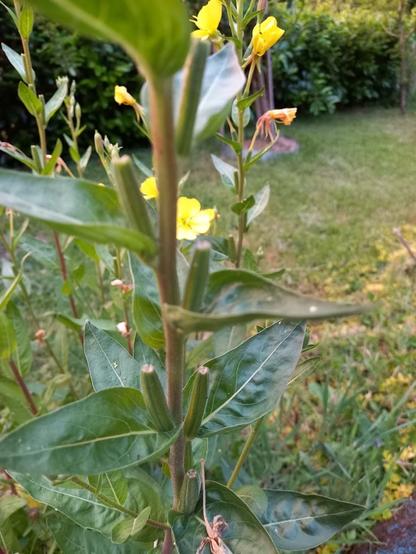
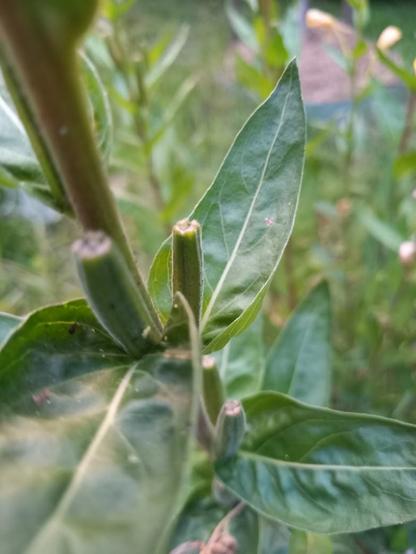
YOUNG SEED PODS (WHILE STILL GREEN): steamed. Perhaps a bit like Okra?
MATURE SEEDS: can be used as a substitute for poppy seeds on baked goods. To extract the seeds, rotate and press the dry seed capsules, catching the falling seeds on a clean piece of cloth or paper. Then roast them in a moderate-temperature oven for 15 to 20 minutes. Use them on bread or in a salad or sprinkle them over any dish as you would pepper.
I hope this post has shown you that there is more to Evening Primrose, Oenthera biennis, than the oil capsules you buy in the stores. It is an attractive plant, one of my favourite eye-catchers in the herbaceous border. The whole plant is edible and has many medicinal qualities. From a Shamanic perspective, those beautiful mysterious primrose-yellow flowers are ideal for working with Lunar Goddess Energy and make a delightful flower essence and lustral waters. Why not give it a try?
ENDS Author: Veronica Smith first published 26th July 2025
BIBLIOGRAPHY
Bartram’s Encyclopedia of Herbal Medicine by Thomas Bartram. Published by Constable and Robinson Ltd Publishers, London in 1998. ISBN: 978-1-85487-586-0
The Herb Society’s Complete Medicinal Herbal by Penelope Ody. Published by Darling Kindersley, London in 1993. ISBN: 07513-0025-X
Simple Healing with Herbs by Penelope Ody. Published by Hamlyn UK in 1999.
ISBN: 07537-05230
The Complete Herbal Tutor by Anne McIntyre. Published by Gaia, an Octopus Publishing Group Ltd, in 2010. ISBN: 978-1-85675-318-0
The Complete Book of Herbs by Lesley Bremness. Published in association with the National Trust Colour Library Books, Surrey UK in 1991. ISBN: 0-86283-893-2
www.eattheweeds.com, Green Dean’s notes on Evening Primrose.
#food #foraging #gardening #herbalMedicine #PlantLore #recipes
 The Swamp Wytch
 Nina Zina
 Brighid's Ogham Grove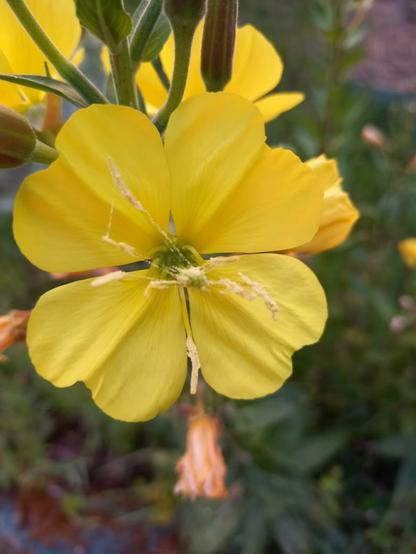
 Hypnogoria

 SiltiCrafts creatrix Kristine
 Icy Sedgwick