The thread about a Christmas-themed A to Z of Edinburgh and Leith place names

For no particular reason other than the time of year, let’s take an A to Z look into some of the street and place names of Edinburgh and Leith and see what festive or seasonal connections we might find.

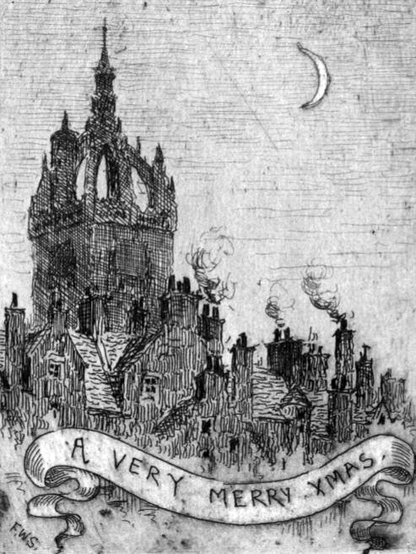
A Very Merry Xmas, a Christmas card featuring the spire of St. Giles High Kirk and a stylised Old Town roofscape c. 1900 © Edinburgh City Libraries

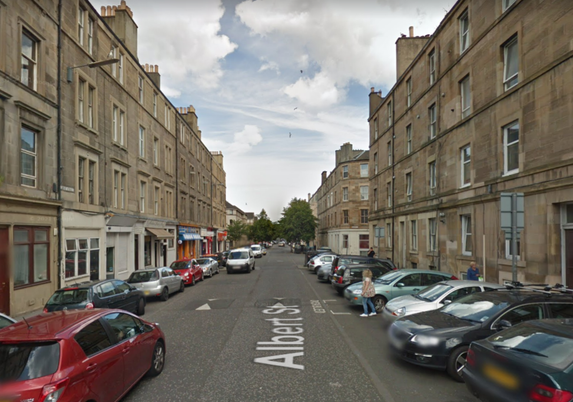
A is for Albert Street. This street in Leith was named for the Prince Consort, Albert of Saxe-Coburg and Gotha, around 1870 to commemorate his death in 1861. Albert is credited with introducing the first Christmas trees to Britain (he didn’t apparently it was Queen Charlotte – of Mecklenburg-Strelitz – in 1800)

Albert Street, off Leith Walk

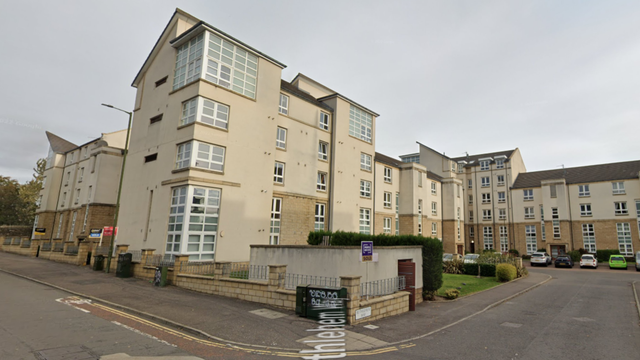
B is for Bethlehem Way. This is a rather insipid development of modern flats in the Lochend area of the city, built on the site of the old Hawkhill Quarry. I’m afraid I cannot offer an explanation as to why this name was picked – this area has no biblical or Middle Eastern connection that I know of.

Bethlehem Way

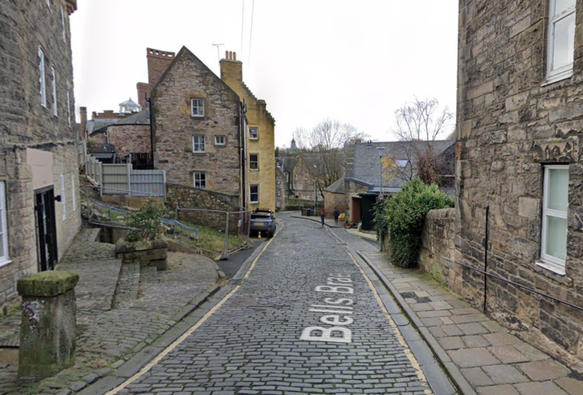
B is for Bell’s. There are a number of Bell place names in the city, but I have picked Bell’s Brae, that charmingly steep street that connects Queensferry Street to the Water of Leith Village (which you might call Dean Village). At one time this was in the parish of the West Kirk so had to be climbed each week to attend church, so this was known as the Kirk Brae. It was named Bell’s after the millers of that name further upstream at Bell’s Mill.

Bell’s Brae

C is for Chestnut Street. This is named for a rock just off of Granton’s western breakwater and for a street name is rather odd as it was first named as late as 1985, before disappearing again when the industrial area of Granton docks was cleared. It was then being re-used in a street nearby within the last few years for new build housing. It is named for the rock of that name in the Forth.

Chestnut rock marked on a coastal chart. Reproduced with the permission of the National Library of Scotland

D is for Drum. As any parent knows, the worst gift you can ever receive for your small child is a drum. From the Gaelic Druim meaning literally “back”; it describes a ridge or raised ground. See also The Drum in Gilmerton, Drumbrae in Corstorphine, etc. The Drum in Leith is not that obvious now that it has been built on, but is the higher ground above Lochend Loch and was once a house and market garden of that name here, it was once the district name and is what the Hibernian F.C. ground was called before it was named Easter Road.

OS 1893 Town Plan, Reproduced with the permission of the National Library of Scotland

E is for Elf Loch. One of the sometimes overlooked bodies of water in the city boundary. Also called the Diedman’s Pool, this more festive name is possibly from the Gaelic ailbhinn or British elfin, meaning a rocky precipice, of which there are many nearby . An ancient, natural water feature it’s easily mistaken for a water obstacle on the golf course which surrounds it.

Elf Loch, cc-by-SA Richard Webb

F is for Fir Hill. The suburb of Firrhill or Firr Hill is a mid-19th century mapmaker’s corruption of Fir Hill, in reference to the festive trees that grew there once upon a time. The school of this name features a fir tree on its badge and has the Gaelic motto Air Carraig, or “on the rock”.

“Fir Hill”. OS 6 inch survey, 1855. Reproduced with the permission of the National Library of Scotland

G is For Guse Dub. Guse is the old Scots word for a Goose, and the Dub referred to a pond and spring where geese were once raised. This has long been the name of a little corner of Causewayside, where it meets the Crosscauseway.

Guse Dub and Buccleuch Street. CC-by-NC Leo Reynolds

H is for Holly and I is for Ivy, two streets in the Merchiston and Shandon “colonies” houses built by the Edinburgh Co-operative Building Company, who often used the names of trees and flowers for their terraces of high-quality model workers houses.

OS 1893 Town Plan, Reproduced with the permission of the National Library of Scotland

J is for St. Joseph’s, the name of a Catholic Church and Primary school in the Broomhouse area of the city. It was one of the last R.C. parishes in Edinburgh to be formed, to serve the expanding post-war population in the council housing estates in the west of the city.

St. Joseph’s RC Church, CC-by-SA 4.0 Walker287

K is for the King’s Stables. Now the name of the road which connects Lothian Road to the Grassmarket, it was here in 1335 that Edward III of England’s occupying garrison built a royal stables for the King’s cavalry horses. As the centre of Royal power in the city migrated to Holyrood in the 16th century, the stables fell out of use and were sold in 1527. The name stuck though, and it has been as such ever since.

Castle from the King’s Stables Roads, unknown photographer and date. Cc-by-NC National Galleries Scotland

L is for Lamb’s House. OK, perhaps a bit contrived but I was struggling on this one and I’m pretty sure the shepherds brought at least one lamb with them to the stable in Bethlehem. Lamb’s House, named for the merchant and shipowner Andrew Lamb, is a 17th century house in Leith and one of that Port’s oldest buildings. It was sold by the National Trust for Scotland and restored in 2012.

The restored Lamb’s House, CC-by-SA 2.0 Stephen Craven

M is for Mary. There are lots of Mary- place names in Edinburgh and more than a few churches and cathedral’s dedicated to her as a Saint. There are two Maryfields in Edinburgh. One was an old 1840s house at the head of Easter Road, giving its name to the area, and a current street and colony row in Abbeyhill. These fancy -field names after female relatives, were common. e.g. Annfield, Elizafield. Jessfield.

OS 1893 Town Plan, Reproduced with the permission of the National Library of Scotland

N is for St. Nicholas. If we go back to pre-reformation times, St. Nicholas was the chapel and burial ground of North Leith (although not its parish church). It was occupied by Cromwell’s Protectorate army after the Scottish Covenanters’ defeat at Dunbar in 1650, later being swept away when his Citadel was built in 1655. The only image I know if it is in the corner of the “Petworth House Map” of the Siege of Leith, when it was fortified as a strong point (note the trench around it and the cannons).

St Nicholas’ Chapel, from the 1560 “Petworth House Map” of the Siege of Leith. PHA 4640, Reproduced by the kind permission of Lord Egremont and with acknowledgements to the County Archivist, West Sussex Record Office

O is for Oxford Street, both London’s centre of festive shopping and a short street in Newington. Named for Oxford Park which was here beforehand, the reason behind that is long lost to memory and time.

Oxford Street

P is for Perdrixknowe. The house of this name was built as Waverley House by the fountain pen magnate Duncan Cameron, but reverted to its old area name of Perdrixknowe (Partridge Hill) when converted into sheltered housing in the 1980s.

Perdrixknowe, once Waverley House

Q is for Quality Street. Chocolates anyone? There were once two Quality Streets; one in Leith and one in Blackhall. Usually the duplicate streets in Leith and Edinburgh had one renamed to avoid postal confusion, in this case it was Leith that changed, to Maritime Street, which was ironic as the one in Blackhall was most likely named after it about 150 years later! It was possibly named after a fashionable property in London at the time.

OS Town Plan, 1849, Reproduced with the permission of the National Library of Scotland

R is for Red (as in Rudolph the Reindeer). There’s lots of Edinburgh place names with “Red” in them. Redford, Redbraes, Redheughs, etc. Redhall is one of the longest established, being recorded in the 13th century and referring to a hall house built out of the local reddish sandstone from the Redhall quarry. It was later fortified and eventually referred to as a castle. It was reduced by Oliver Cromwell’s New Model Army before the Battle of Dunbar in 1650 and fell into disrepair. George Inglis of Auchendinny later built a mansion house on the estate.

Redhall House. CC-BY-SA Anne Burgess

S is for Sleigh Drive, named – along with a number of other streets in the Lochend council housing estate – after Sir William Lowrie Sleigh, DL, LLD, JP, Lord Provost of Edinburgh (1923–1926). The Corporation had a bit of a habit of naming their new housing schemes after recent Lord Provosts at this time (see also Chesser, Hutchison, Stevenson and Whitson). Sleigh made his name and money in the bicycle trade with a partner – Ross – trading under the name Rossleigh. they later moved into the motor and chauffeuring trade and are still going in the latter business.

Sir W. L. Sleigh by Cowan Dobson, © Edinburgh Museums and Galleries

T is for The East Way. How else did the Three Wise Men get where they were going? The East Way is a named footpath in the pioneering 1919 council housing development of Northfield which was laid out on Garden City principles with concentric rings of streets connected by footpaths. The others are named The North Way and The High Way.

The East Way, Northfield

U is for Upper Bow. Bow (pronounced Bough, traditionally, but Bow these days) was an old Scots term for an arched gateway, and before the construction of the West Port the West Bow was the western entrance into the city. The street was an awkward, steep dog-leg, the upper part of which was the Upper Bow, the top being the Bowhead where in antiquity there was a tron or public weigh house in the centre of the Lawnmarket. When George IV Bridge was built in the 1830s, the West Bow was redirected to connect to it, leaving the Upper Bow as a little stub, connected to it by a public stairway.

V is for Victoria Street. It is the Victorians who are credited with popularising the celebration of Christmas in the UK after all, and instituting many of the British traditions associated with it. Conveniently, this is what the West Bow was renamed to when it was diverted to connect to George IV bridge, to commemorate the recent accession of Queen Victoria. It is one of Edinburgh’s most picture postcard little streets, but is usually covered in cars despite recent attempts to make it pedestrianised.

Victoria Street. CC-by-SA 3.0 Daniel Kraft

W is for Whisky Row. Now renamed Elbe Street to reflect Leith’s North Sea trade with Hamburg on that river, it was once an address of numerous wine and spirits merchants in the Port. Cheers! Slàinte is Nollaig Cridheil!

Ainslie’s Town Plan of 1804. Reproduced with the permission of the National Library of Scotland

X is for Nothing. What naughty children get in their stockings – but mainly as there are no X- placenames in Edinburgh or Leith.

Y is for Yool. Yool’s place was an old street in Portobello. Thomas Yool or Yoole set up the pottery on the site with his nephew, Thomas Rathbone and a business partner John Thomas, and gave his name to a short street. Pottery was the once prosperous industry of the town, built as it was by claypits to house the workers of the brick and later pottery industries. After Yool’s death the business continued as T. Rathbone & Co., by Rathbone’s son – John – before being bought in 1839 by new owners.

OS 1944 Town Plan. Reproduced with the permission of the National Library of Scotland

Z is for Nothing, there’s only one Z- placename in Edinburgh and that’s named after Zetland, the traditional county name for the Shetland Islands.

Note to readers: unfortunately in April 2026, a third-party plug-in more than exceeded its authority and broke many of the image links on this site. No images were lost but I will have to restore them page-by-page, which may take some time. In the meantime please bear with me while I go about rectifying this issue.

If you have found this site useful, informative or amusing then you can help contribute towards its running costs by supporting me on ko-fi. This includes my commitment to keeping it 100% advert and AI free for all time coming, and in helping to find further unusual stories to bring you by acquiring books and paying for research.
Or please do just share this post on social media or amongst friends and like-minded people, sites like this thrive on being shared.

Explore Threadinburgh by map:

Travelers' Map is loading...
If you see this after your page is loaded completely, leafletJS files are missing.

These threads © 2017-2026, Andy Arthur.

NO AI TRAINING: Any use of the contents of this website to “train” generative artificial intelligence (AI) technologies to generate text is expressly prohibited. The author reserves all rights to license uses of this work for generative AI training and development of machine learning language models.

#Lochend #Logan #Restalrig #StMargaret
The thread about Sciennes; how you pronounce it, where the name comes from and its important moment in Scottish literary history

This thread was originally written and published in February 2020.

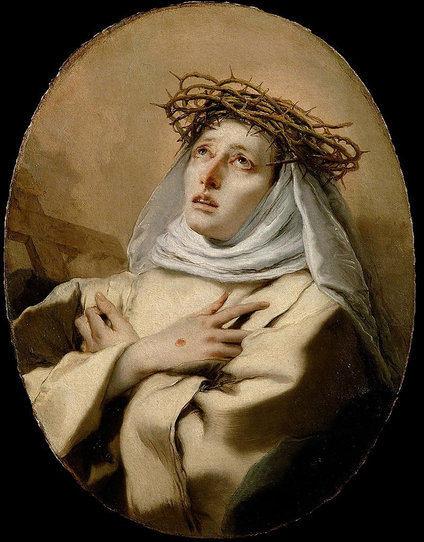
There was some chat the other week about place names that were so unapparent in their pronunciation that they were the shibboleth of the real local. One which kept coming up for Edinburgh was Sciennes. First things first, it is Sciennes; as in Sheens; as in Machine; as in Rise of the Machines. The name comes directly from St. Catherine of Siena, a convent in her honour being established in the locality in 1517. In Scots, Siena was Seynis or Schiennes. From there it’s a short leap to the modern Sciennes, but the pronunciation has remained true to the original local form.

St. Catherine of Siena, by Giovanni Battista Tiepolo

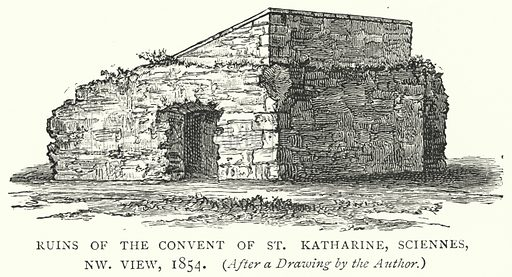
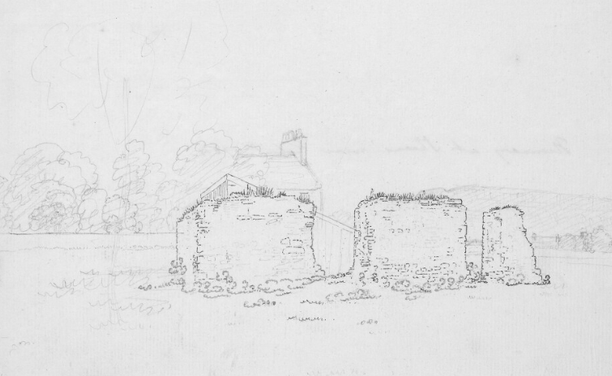
The convent occupied a 2 acre site and was surrounded by an enormous wall, some 13 feet high. The land had been fued off the Burgh Muir (common moor land owned by the city) to the Canon of St. Giles in 1513, who founded a chapel and hermitage to St. John before giving it to the Sisters.

The ruins of Sciennes convent, from Old & New Edinburgh by James Grant. Probably in use as a barn at this time.Another view of the same ruins, looking north east towards Salisbury Crags in the distance. From the Hutton Drawings, vol. 2, CC-BY-SA 4.0 National Library of Scotland

Given the location of the convent some 1,000m outside of the city walls (hence the big defensive enclosure) it is consistently missed off of all the older town plans and it’s not until Kirkwood’s plan of 1817 that it makes an appearance. We can see an old rendition of Scienes and the reference to Siena. The designation as a monastery is a mistake.

Kirkwood’s 1817 Town Plan. Reproduced with the permission of the National Library of Scotland

Notice the 2 arrows in the above map and notice that they correspond to two obvious kinks in the modern street layouts. These mark the turn of the boundary wall of the convent – I have found a good rule of thumbs when looking at old streets in Edinburgh which is that if there is a bend or kink in an otherwise straight road that seems to serve no apparent purpose, there’s a very good chance that it respects the alignment of an even older property boundary. See this thread for instance. Or this one!

Kirkwood’s 1817 Town Plan. Reproduced with the permission of the National Library of Scotland

The presence of the convent also explains why Sciennes Street (marked in green below and now known as just Sciennes) splits off at a very shallow angle from Causewayside (red arrow) . Until the early 19th century one of the two main road south east out of the city – leaving that odd gushet formed by Lord Russell Place; it was the alignment of the original footpath to the convent from St. Giles to the north.

Ainslie’s 1804 Town Plan. Reproduced with the permission of the National Library of Scotland

After the quagmire of the Boroughloch began to be drained in the 18th century and the Meadows began to be laid out as a pleasant, formal park, some of the rich of the city built large villas along the southern edge. A roadway formed at the back of the plots to give coach access, meeting the old route to the convent at its eastern extremity.

Ainslie’s own Plan of 1804, showing the villa plots along the south of the Meadows. Reproduced with the permission of the National Library of Scotland

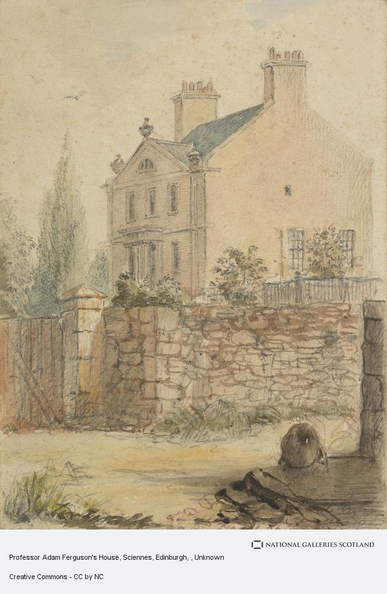
And at this junction stood a place called Sciennes Hill House. This building isn’t actually on a hill as such, but when entering the city from Causewayside it is at the top of the ascending grade from the south. The Scottish philosopher and historian of the Enlightenment, Professor Adam Ferguson of Raith, lived here at the end of the 18th century. His property was ¾ miles from the city walls at the Bristo Port and so his friends took to jokingly calling it Kamchatka on account of its perceived remoteness.

Adam Ferguson in 1781, by Sir Joshua Reynolds.

The National Gallery has the below sketch of the house and notes a soiree which took place there in 1786 that was attended by a young Walter Scott, Robert Burns, Dugald Stewart, Joseph Black, James Hutton and John Home! One can only imagine how inadequate you’d feel, staring into your tea, sitting round a table while that lot had a debate! This was both the first and last time that the young Scott met Burns and it was a formative experience for the former, then just 15 years old.

Sciennes Hill House. CC-by-NC National Galleries Scotland

By this time Sciennes was a well-established place name and had given its name to that lane along the back of the big villas, as Sciennes Road, to Sciennes Hill House, to Sciennes House Place and Sciennes Hill Place. And what became of the house itself? Well, believe it or not, it’s actually still there, hiding in plain sight, even if you look straight at it. Its clever disguise is that the back of the house is now the street façade, and the house has been subdivided and reconstructed into what looks from the street to be an unremarkable tenement.

But when you look at it again when armed with the facts, suddenly things begin to look incongruous. That rubble finish doesn’t quite look Victorian, that stair door is out of alignment, and the vertical spacing of the windows is well out with its neighbours.

The rear of Sciennes Hill House is now the front.

Oh and those plaques are a bit of a give away too…

Plaque on Sciennes Hill House. CC-BY-SA 3.0 Kim Traynor

And if you can get around the back, this ain’t your usual finish for a tenement back green! It’s quite obviously the (restored) façade of an altogether different and grander Georgian house.

The original (restored) facade of Sciennes Hill House. CC-BY-SA 2.0 Kim Traynor

The rear of the building was restored in 1989 (there are pictures of it here just prior to this) and given the much quite regular appearance above. In the old engraving below it can be clearly seen where the original doorway and portico was, at 1st floor level, by the gap in the horizontal bands of masonry and window spacing.

Sciennes Hill House in 1891, from “The Literary Landmarks of Edinburgh”in Harper’s New Monthly Magazine.

St. Catherine of Siena lent her name to one other street in the neighbourhood, that of St. Catherine Place, a street of grand Victorian semi-detached villas on the boundary with The Grange. For some reason though, when Bertrams Ltd. built a large factory in Sciennes, they went for a different spelling and we got the St. Katherine’s Works. Bertrams were ironfounders and engineers, specialising in roller machines for papermaking and printing.

Bertram’s St. Katherine’s Works. Note the malt kiln cupola to the right of the large chimney, from the West Sciennes Distillery. © Edinburgh City Libraries

Bertram’s were a very successful company in their time, with a foundry in Gorgie at Westfield and also one in London – another St. Katherine’s Works – to serve the newspaper industry. Sadly the Sciennes works burned down in 1983 at what was a difficult time for the company, with the Scottish print and papermaking industries in terminal decline. The whole company was gone by 1985 and when new housing was built on the site later it was appropriately named Siena Gardens.

https://www.flickr.com/photos/maleny_steve/42942242202

Sciennes of course also gives its name to the local school (I am typing to you from an old teacher’s desk of that establishment, recovered from a skip). I recall the first time I saw the name, written on an Edinburgh schools football league fixtures sheet about 30-odd years ago and yes I too did imagine it was pronounced Scy-ens.

There’s one more “place” in Sciennes that’s been lost to time, which is the romantic sounding Glen Sciennes. Indeed it’s a place that never even existed anywhere but on paper as a faux-Highland brand name for the spirit from a distillery in the district belonging to Thomas Duncanson & Co. It was being advertised in the London papers in 1854 but the firm went bankrupt in 1859, so Glen Sciennes had a life span of only five years. After this the distillery ran through a number of other names; the Newington Distillery, the West Sciennes Distillery; the Edinburgh Distillery before closing in 1925 by which time it was the last malt distillery in the city. The buildings were incorporated into Bertram’s works.

1850s Post Office Directory entry for the Glen Sciennes distillery.

I don’t know of any contemporary illustrations of the Sciennes distillery, but a William Channing sketch of 1852 of Sciennes Court – where the Sienna Gardens student flats are these days – shows its chimney in the background.

Sciennes Court, 1852 by William Channing © Edinburgh City Libraries

Always be on the lookout for unexplained kinks in old streets or buildings that feel a bit out of place; if you dig into them a little bit you might find out more local history than you bargained for!

Note to readers: unfortunately in April 2026, a third-party plug-in more than exceeded its authority and broke many of the image links on this site. No images were lost but I will have to restore them page-by-page, which may take some time. In the meantime please bear with me while I go about rectifying this issue.

If you have found this site useful, informative or amusing then you can help contribute towards its running costs by supporting me on ko-fi. This includes my commitment to keeping it 100% advert and AI free for all time coming, and in helping to find further unusual stories to bring you by acquiring books and paying for research.
Or please do just share this post on social media or amongst friends and like-minded people, sites like this thrive on being shared.

Explore Threadinburgh by map:

Travelers' Map is loading...
If you see this after your page is loaded completely, leafletJS files are missing.

These threads © 2017-2026, Andy Arthur.

NO AI TRAINING: Any use of the contents of this website to “train” generative artificial intelligence (AI) technologies to generate text is expressly prohibited. The author reserves all rights to license uses of this work for generative AI training and development of machine learning language models.

#Lochend #Logan #Restalrig #StMargaret
Ocksters, Oxscares and Oxcars: the thread about the islands of the Forth and what some of their names mean

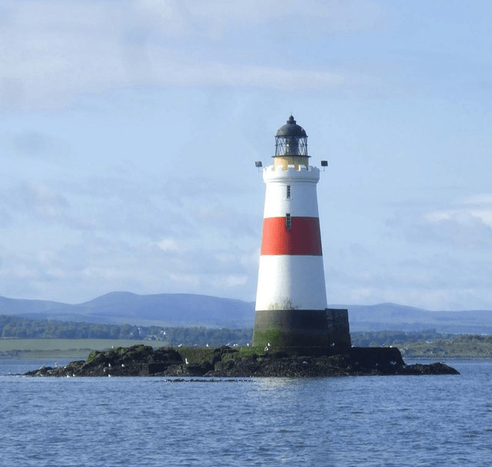
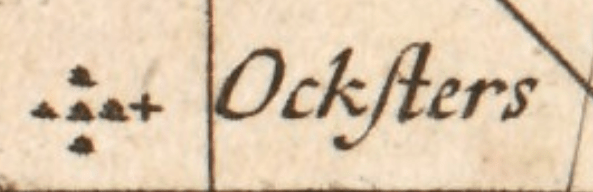
Oxcars. A lump of rock crowned by a lighthouse in the Firth of Forth. I was interested to see that a 17th century variation of the name was Ocksters – the Scots word for armpit!

Ocksters – Excerpt from Greenville Collins’ map of the Firth of Forth, 1693. Reproduced with the permission of the National Library of Scotland

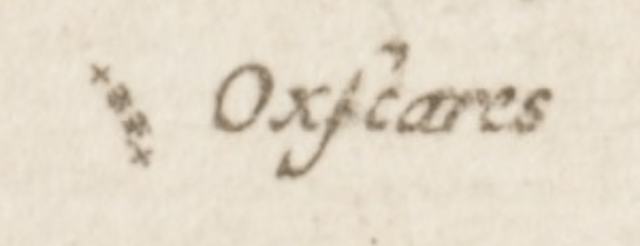
A few years previously it’s down as Ockstairs on the original sketches for John Adair’s map of the Forth, but then in a 1703 imprint it has been amended to Oxscares. The oldest variation is recorded in 1621 as Oixtaris in the Register of the Privy Council on the subject of the need for a beacon on these rocks, which are submerged at high tides.

Oxscares – Adair’s map of 1703. Reproduced with the permission of the National Library of Scotland

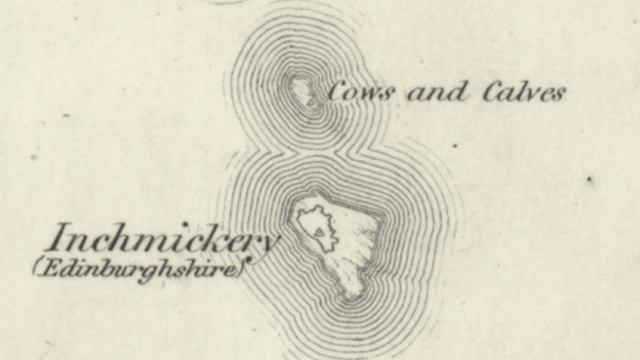
If you are wondering where these variations come from, then wonder no more. The root is Ox Scaris, as in ox skerries; ox being the animal and skerries being intertidal rocks. Ocksters etc. are simply phonetic variations. It’s likely this animal theme lent its name to the neighbouring rock of Cow(s) & Calves, which was traditionally Muckriestone as it lies off the north on Admiralty coastal charts.

Cows and Calves off of Inchmickery, OS 1 inch map of 1895. Reproduced with the permission of the National Library of Scotland

Working our way down the Forth from it’s outer reaches, we can explore the toponymy of the islands; the meanings of their place names. The Isle of May, at the eastern extreme, is likely from the old Norse, Má ey or gull island. Stands to obvious reason. The Gaelic Magh, an open field, is less likely.

Isle of May – Excerpt from Adair’s map of the Firth of Forth, 1703. Excerpt from Greenville Collins’ map of the Firth of Forth, 1693. Reproduced with the permission of the National Library of Scotland

About 8 miles south, and a little west, of the May is the Bass Rock, whose unmistakable outline is prominent along the East Lothian coast. The origin of its name has been lost to history, John Milne suggests a relation to death, from the Gaelic bàs, as it was long a place of banishment and execution, but that’s just conjecture and some of Milne’s use of Gaelic is often a little bit too convenient. But we do know that the Bass gives the scientific species name to the Northern Gannet – Morus bassanus – for which it is the largest colony. These animals were scientifically described as far back as the 16th century as Anser bassanus, and later in the 18th by Linnaeus as Sula bassana. The Scots word for them was however the solendguse or solen goose. In the spring and summer, the Bass takes on a white appearance, caked in the birds and their droppings.

The Bass Rock, John Gabriel Stedman, 1780. Collection of the National Galleries of Scotland

Moving west, the next island is Craigleith. Milne suggests the Gaelic Creag Liath – the grey rock. (In Gaelic, Liath – is the colour of a blue sky, but when used in reference to the landscape it refers to something being greyish. This is a feature of the Gaelic language when dealing with place names; the colour use is subjective and descriptive, not literal). However Craigleith is actually comprised of very dark, volcanic rocks – it needs to be squinted at in combination with the stains of guano to take on a greyish hue. It should also be noted that in Gaelic the word liath does not have the soft “th” ending that Leith does in English. Notice on the 18th century map below that the earliest spelling is Lieth, with the I before the E, which was also the case at this time for maps showing the port and town of Leith along the coast.

Craig Lieth. Excerpt from Adair’s map of the Firth of Forth, 1703. Reproduced with the permission of the National Library of Scotland

Next up is The Lamb. Milne goes for the easy Gaelic Làmh for an arm or handle, one assumes for the shape, but in that language the –mh sounds like an English –v. As I said before, sometimes Milne’s use of Gaelic for the roots of place names seems to be just too convenient. There might also be a Norse origin for the name, or it may simply be named after the animal (see already Oxcars, Cows & Calves). It is after all flanked by the North andSouth Dog rocks. This island was bought by Uri Geller (yes, that Uri Geller) in 2009 so he could dowse for Egyptian treasure on it. Yes, I’m being serious, he described that it’s an analogue for the layout of the Egyptian pyramids and holds the buried treasure of Princess Scota. He recently told the BBC that he has spent a single night on his island and didn’t enjoy it one bit and was declaring the island a micronation, the Republic of Lamb. In January 2026 Mr Geller again made the headlines when he declared Donald Trump an honorary citizen and president of the island.

Lamb, North Dog and South Dog, from OS 6 inch map, 1853. Reproduced with the permission of the National Library of Scotland

Moving west is Fidra, for which Milne once again gives a fanciful Gaelic derivation, but it’s now believed to be Old Norse, from Fiðrey or Feather Island as a result of all the seabirds. Eider feathers would have been gathered here in yore for use in bedding. Robert Louis Stevenson based his plan for Treasure Island on Fidra (amongst other islands). Like its eastern neighbour, Fidra too is guarded by North and South Dogs.

Fidra as shown on the OS 6-inch map, 1854. Reproduced with the permission of the National Library of Scotland

Next along is Eyebroughy, the fourth and final of the basalt islands between North Berwick and Aberlady. It is shown as Ibris in Adair’s 18th century chart and the 1850s Ordnance Survey place name book for East Lothian also gives Eyebrochy. The Old Norse Ey for island seems an obvious start for the word, but I cannot find a reference explaning the second part.

Ibris. Excerpt from Adair’s map of the Firth of Forth, 1703. Reproduced with the permission of the National Library of Scotland

There is now something of a gap until the next major island; it is 12.5 miles from Eyebroughy to Inchkeith, which looms large in the centre of the Firth. Its etymology gets a whole chapter on its Wikipedia page, but the logical explanation may be Innse Coit, a hybrid of old Gaelic (Island) and Welsh (wooded); a wooded island. The oldest recorded form is Ked in the 13th century, but as the Place Names of Fife points out, its an unlikely candidate to be known for being wooded, so once again we probably just don’t know. It was used to quarantine victims of syphilis from Leith and Edinburgh in the 15th century, of that we do know. The Grandgore (syphilis) Act of 1497, saw the island made a place of “Compulsory Retirement” for sufferers, obliged to board a ship at Leith and to remain on their island “till God provide for their health“.

“Inchkeith on the Forth in a Fresh Gale”, John Gabriel Stedman, 1781. Collection of the National Galleries of Scotland

Interestingly, the Georgian mapmaker extraordinaire of Scotland, William Roy, left Inchkeith off his Great Maps of both the Lowlands and Highlands, with the Forth forming the boundary between these two geographical divisions in the east of the country. But there is a square that looks like a repair where it should be…

Here be… nothing? The position of Inchkeith on Roy’s map. Reproduced with the permission of the National Library of Scotland

Next up is Oxcars, 5.5 miles west of Inchkeith, where we started this thread. If we move south from there we get to Inchmickery and Mickrystone (now Cows & Calves, as previously mentioned also). The derivation of Mickery may be from the Gaelic Innis nam Bhiocaire, island of vicars, as like most of the islands of the Forth it has been a Christian retreat at one time or another. The island was fortified during both World Wars, and it’s not without good reason that there’s a legend that its outline was deliberately made to look like an anchored battleship. The logic is that any U-boat commander who made it into the Forth would pop up his periscope, be taken in by the cunningly disguised island and would have fired his torpedoes and disappeared before realising he’d wasted them on a rock. If you know your Royal Navy ships, the fortifications are a reasonably good likeness to HMS Nelson and Rodney, but I have it on expert authority that the legend is precisely that, a legend.

Inchmickery. CC-BY-SA 2.0, Anne Burgess and HMS Nelson. Move the slider to compare the outlines.

North of Cows & Calves is Inchcolm; probably the best known of the Forth Islands and certainly the most visited. It is named for Saint Columba (Colum Cille in Gaelic) who reputedly visited it in the 6th century. The modern name is from the Gaelic Innis Choluim orColumba’s Island. The old joke goes “how many inches are there in the Forth?” and you’re meant to count the islands. In The Scottish Play, Shakespeare refers to the place as Saint Colmes Ynch.

“Inchcolm on the Forth in a Summer Shower”, John Gabriel Stedman, 1781. Collection of the National Galleries Scotland

Just off Inchcolm lies Inchgnome, but the jury of the best minds in Scottish placenames is still out on where that one might come from. Probably from some obscure Gaelic saint.

https://www.flickr.com/photos/wwshack/26451815521

South and west lies Cramond Island, which obviously takes its name from the village off which it lies. That in turn comes from Caer Amond, Caer being old British for a fortification (referring to Roman fort on the site), and Amond or Almond is the river of that name. Like the rivers Esk and Avon (and others), River Almond is a tautology as the latter word simply means river.

Cramond Island

Another tautological place name is the island of Carcraig , just northwest of Inchcolm. The Car element is an Scots word for rock (from the Old English Carr) and the Craig bit is the Scots word for the same, from the Gaelic Creag.

Carcraig, from OS 6 inch map, 1853. Reproduced with the permission of the National Library of Scotland

The other principal islet off of Inchcolm is Meadulse. This rock is entirely covered by the tide which makes it an excellent growing place for seaweed and the name likely comes from the edible dulse which grows there and is known to have been a medieval food source.

The final, and westernmost, of the Inches of the Forth is Inchgarvie, that convenient supporting foothold for the Forth Bridge. Its name is likely from the Gaelic Innse Garbh, or rough island, the –bh sound in Gaelic sounding like a –v in English. This is on account of its rugged appearance (and perhaps its legendary population of giant rats!).

Inchgarvie, OS 25 inch map of 1892. Reproduced with the permission of the National Library of Scotland

Upstream of the Forth Bridge there are fewer islands. The Beamer Rock‘s name is quite literal, and refers to an early beacon that was there from time immemorial to guard ships from it. The older form was Bimar or Bymerskyrr, the –skyrr from the Scots skerry, for a low islet or sea rock. This islet suffered the indignity of having the very beacon it was named for demolished (the base was blown up with explosives) in 2011 to make way for a tower of the Queensferry Crossing.

Beamer Rock in 2010. CC-BY-SA 2.0 Simon Johnston.

I won’t move any further west than this, as this site is principally concerned with the geography of Edinburgh, Leith and the Lothians. However there are of course countless other islets and named rocks in the Forth. Many of these are simply a variation on Craig, Carr and Bush, all words referring to rocks. Selected others in the Edinburgh area include:

  • Birnies, a collection of tidal rocks at Granton. I cannot find a description of the name, but the –birnie in the placename Kilbirnie comes from the Gaelic Cill Bhraonaigh, or Saint Brendan.
  • Another rock near the Birnies, Chestnut logically takes its name from its similarity of appearance to the fruit of that tree
  • General’s Rock on the Granton Foreshore, allegedly where English forces under Lord Hertford (Edward Seymour, 1st Duke of Somerset) landed in 1544 before the burning of Edinburgh and Leith.
  • Gunnet Ledge, a navigational hazard directly north of the entrance to the Port of Leith and west of Inchkeith, marked by a pair of bouys called the East and West Gunnet since at least the start of the 19th century. Probably a variation of Gannet, alternative older spellings include Dunnet and Guneet.
  • Martello Rocks, sitting at the old tidal entrance to the Port of Leith and named retrospectively for the Martello Tower that was constructed upon them to defend the approaches
  • Megmillar another intertidal rock off of the Granton foreshore, whose name I can find no explanation for.

The names of many of these islands were given to Council housing tower blocks built in the north of the city in the 1950s and 60s. There re are of course many more, but I hope this whistle stop tour has been of some interest.

Note to readers: unfortunately in April 2026, a third-party plug-in more than exceeded its authority and broke many of the image links on this site. No images were lost but I will have to restore them page-by-page, which may take some time. In the meantime please bear with me while I go about rectifying this issue.

If you have found this site useful, informative or amusing then you can help contribute towards its running costs by supporting me on ko-fi. This includes my commitment to keeping it 100% advert and AI free for all time coming, and in helping to find further unusual stories to bring you by acquiring books and paying for research.
Or please do just share this post on social media or amongst friends and like-minded people, sites like this thrive on being shared.

Explore Threadinburgh by map:

Travelers' Map is loading...
If you see this after your page is loaded completely, leafletJS files are missing.

These threads © 2017-2026, Andy Arthur.

NO AI TRAINING: Any use of the contents of this website to “train” generative artificial intelligence (AI) technologies to generate text is expressly prohibited. The author reserves all rights to license uses of this work for generative AI training and development of machine learning language models.

#FirthOfForth #Granton #Islands #Leith #Lighthouse #Placenames #Toponymy

Which is it? The thread about the name of Wardie Bay; or the thread about the name of Granton Beach?

This thread was originally written and published in July 2023.

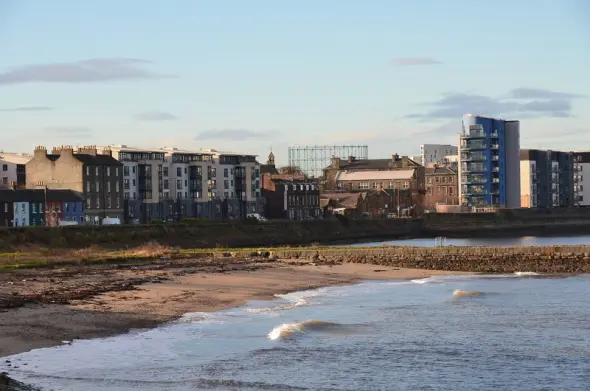
Wardie Bay; an increasingly popular little spot of accessible coastline in the north of Edinburgh, where you can dip your toes – or your whole body – in the “bracing” waters of the Forth, and watch the seals and seabirds. Or is it Granton Beach? Let’s see if we can’t find out.

“Beach at Wardie Bay and Granton Harbour”, cc-by-SA 2.0 Jim Barton via Geograph

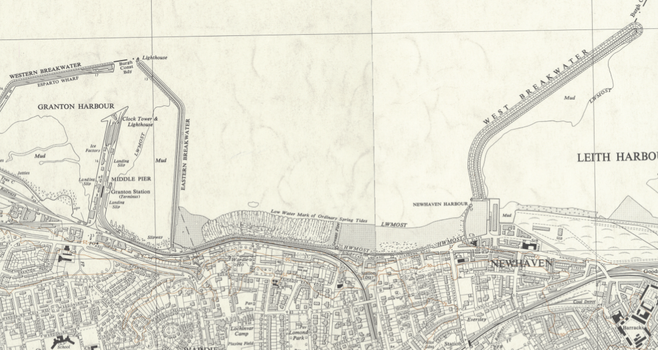
First we must get something straight, whatever this bay and beach is called, it is not a natural bay, it is man made. The sandy beach itself extends all of 150m eastwards from the Granton Eastern Breakwater (construction of which was not completed until about 1860) and the wider bay itself is bookended to the east by the Western Breakwater of Leith Docks, some 1,350m distant (constructed between 1938 and 1942).

OS 1:10,000 sheet for Edinburgh, published 1955, with Granton Harbour to the left and Newhaven / Leith Docks to the right. Reproduced with the permission of the National Library of Scotland

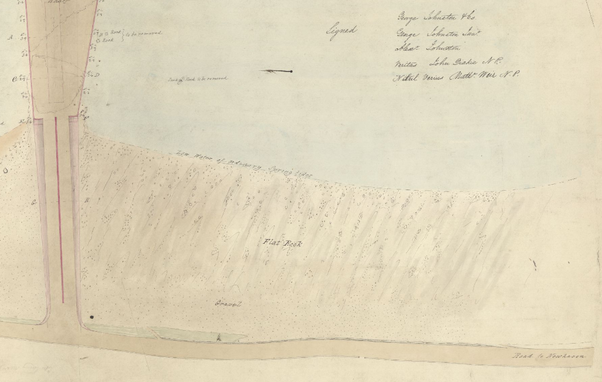
Surveying undertaken by the eminent engineers Robert and Alan (his son) Stevenson in the 1830s when planning Granton Harbour shows that at this time, there was no sandy beach at Wardie, it was only rock and gravel (there was, however, sand to the west of where the pier is marked below).

“Granton – Plan and section of a wharf on the Ox Craig” by Robert and Alan Stevenson, 1835. Reproduced with the permission of the National Library of Scotland

Once we accept this, it means we don’t need to look for a name for this bay that is older than that, because it didn’t exist, it was just the shoreline of the Firth of Forth.

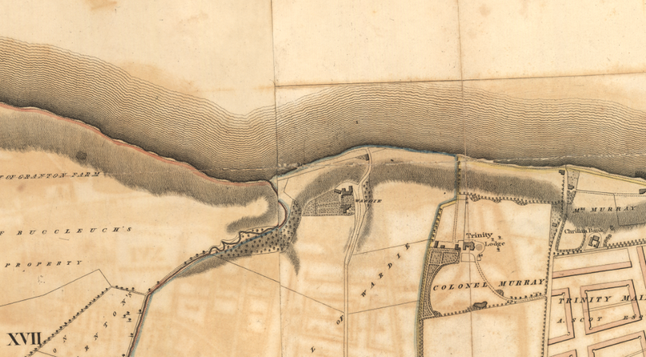
Robert Kirkwood’s 1817 Town Plan of Edinburgh and Leith, centred on Wardie. Reproduced with the permission of the National Library of Scotland

Our two competing names for the bay come from the estates and big houses of Granton and Wardie.

  • Granton as a placename goes back to 1478 and a “castle” or tower house existed here. The estate was later split into two farmsteads (Easter Granton (or Royston) and Wester Granton). Under the ownership of Andrew Logan, the castle was replaced by a mansion house, which was called Royston House. This was rebuilt at the end of the 17th centurty by George Mackenzie and in 1739 was purchased by John Campbell, Duke of Argyll, who renamed it Carolina Park after his daughter and had it extended by William Adam. At the end of the 18th century the house was inherited by the Duke of Buccleuch.
  • Wardie as a placename is first recorded over 100 years earlier than Granton, in 1336, with various spellings over time such as Warda and Weirdie. The flat plane of land in this area above the shoreline of the Forth back to the Water of Leith was known as Wardie Muir (moor). A castle of this name was built in the 15th or 16th century, which over time evolved into Wardie House. At the end of the 18th century, Wardie House was in the possession of Alexander Boswell (or Boswall) of Blackadder, in Berwickshire. When he died in 1812, he left Wardie to a distant relative, Captain John Donaldson, RN, whose inheritance required he take up the Boswall name.

Granton and Wardie also gave (and still give) their name to the two most prominent intertidal rocks on their respective foreshores, Granton Bush and Wardie Bush.

“Chart of the Firth of Forth from Queensferry to Inchkeith” by Robert and Alan Stevenson, 1835. Reproduced with the permission of the National Library of Scotland

The boundary between the estates of Granton and Wardie was the rivulet of the Wardie Burn; west of the burn lies Granton, east of it lies Wardie. This also formed the old parish boundary between St. Cuthberts and Cramond. To the east of Wardie, on a boundary defined by what is now Netherby Road, lay the ancient lands of Trinity – part of North Leith parish and so-called because they belonged to Trinity House in Leith. The land ownership plan below was drawn up by Robert Stevenson on behalf of the Duke of Buccleuch in 1836 as part of the harbour scheme, which included a significant new access road to and from Edinburgh (marked red below) that spanned the Wardie Burn and crossed the land of Captain Boswall of Wardie. Interestingly, Stevenson’s first plans for Granton had a much grander pier, wet docks and this roadway was proposed as a railway.

Robert & Alan Stevenson’s “Plan & Section of the road from Granton Pier”, 1836. Reproduced with the permission of the National Library of Scotland

The below map overlays the boundaries of the old Granton, Wardie and Barnton estates on a modern aerial photo. We can see that the boundary between Granton and Wardie, the old line of the Wardie Burn, is approximately in the middle of the current beach, with probably the lion’s share in Granton.

Modern aerial mapping with the boundaries of Granton, Barnton and Wardie overlaid

From an administrative point of view, when the Great Reform Act passed in 1832, it defined new parliamentary constituencies. One was created for the Burgh of Leith, which cut through the middle of the Wardie estate, in a straight line between where the Wardie Burn entered the sea and Ferry Road, 400 yards west of Golden Acre. To the west of this, Granton was in Edinburghshire, and to the south of this was the constituency the Burgh of Edinburgh.

1832 Map of Edinburgh and Leith, to accompany the definition of the constituency boundaries as part of the Reform Act. To the left of the red line is Edinburghshire, to the east of it, the northern part is Leith Burgh and the southern part is Edinburgh Burgh. Reproduced with the permission of the National Library of Scotland

The following year, Leith was made a municipal Burgh, and the boundary was pushed 100 feet further west from Granton Road than the parliamentary boundary. Although it still ran through the middle of the old Wardie estate (which was progressively being parcelled up and built on), this now meant that almost the entirety of the foreshore at what would later become Wardie Bay beach was then in Leith’s jurisdiction.

Bartholomew Post Office map, 1865, showing the municipal boundary (red) between Leith’s 5th Ward (green) and Edinburgh’s 2nd and 3rd Wards (pink and yellow). Granton at this time was in neither burgh, but was in the shire of Midlothian for administrative purposes. Reproduced with the permission of the National Library of Scotland

The Edinburgh Municipal Act of 1900 incorporated Granton into Edinburgh (into the No. 8 St. Bernard’s Ward), with the boundary remaining 100 feet west of Granton Road. When the Edinburgh Extension Act of 1920 passed and Edinburgh consumed Leith, the ward boundaries remained the same in Leith, and the old No. 5 North Leith Ward became Edinburgh’s new No. 19 West Leith Ward. Wardie Bay may now have formally been within Edinburgh, but it was still in a Leith ward (as it remained until incorporated into a new shoreline ward called Forth in 2007 when the city moved to a smaller number of larger, multi-member wards).

In news print, Granton Beach appears over a decade before Wardie Bay, but it’s not easy to tell what part of the foreshore this was referring to. Granton Bay never has been used, and Wardie Beach is used earlier on (1837) but only as a one off, and not in a local publication. Wardie Bay is cetainly the name used by the author Joyce Wallace, who wrote a number of excellent books on Edinburgh and Leith local history in the 1990s, including Traditions of Leith and Trinity and Further Traditions of Leith and Trinity.

Place NameEarliest Newspaper MentionMentions 1900-1999Granton Beach1887, The Scotsman, with reference to Duck Shooting on the beach12Granton BayNo mention–Granton Shore1848, Caledonian Mercury, with reference to a storm19Wardie Beach1837, The Globe (London), with reference to the geology on the beach–Wardie Bay1901, Dundee Evening Telegraph, with reference to a storm136Wardie Shore1824, Caledonian Mercury, with reference to the feuing of building lots at Wardie1The first appearance of different place names for “Wardie Bay” in searches for the above terms on the British Newspaper Archive

In 1901 there was a great tragedy at Wardie Bay when the Revenue Cutter Active was driven against the Granton Breakwater in a storm with the loss of 20 of the 23 souls on board. This was widely reported in newspapers across Scotland and the UK, and Wardie Bay was the name used.

In 1987, there was a scheme put forward by Forth Ports, the harbour and navigation authority for the Firth of Forth, to infill the shoreline between the Granton and Leith harbour breakwaters, and the name Wardie Bay was used. You can read more about this ridiculous proposal over on its own thread.

This has all been a very long-winded way to say that I think, on the balance of probabilites, if I was asked to adjudicate on whether it is Wardie Bay or Granton Beach, I would say it is Wardie Bay.

  • It is an accepted term in print by local authors, and the most commonly used term in local newspapers
  • The most prominent intertidal feature on the beach is Wardie BushGranton Bush is a mile to the west
  • While the older estate boundaries put much of what is now the beach on the Granton side, the beach and bay have only come into existence as we known them since 1860, by which time the estates were being broken up by feuing, and a new municipal boundary had been set which put almost all of the beach east of the breakwater on the Wardie side.

However, there is really no right or wrong answer here. No authority has ever decreed an official name. The bay itself is a local feature, it’s not defined or recognised on Ordnance Survey maps or marine charts. So you go ahead and call it what you think is best, and don’t let anyone (especially me) tell you otherwise.

Note to readers: unfortunately in April 2026, a third-party plug-in more than exceeded its authority and broke many of the image links on this site. No images were lost but I will have to restore them page-by-page, which may take some time. In the meantime please bear with me while I go about rectifying this issue.

If you have found this site useful, informative or amusing then you can help contribute towards its running costs by supporting me on ko-fi. This includes my commitment to keeping it 100% advert and AI free for all time coming, and in helping to find further unusual stories to bring you by acquiring books and paying for research.
Or please do just share this post on social media or amongst friends and like-minded people, sites like this thrive on being shared.

Explore Threadinburgh by map:

Travelers' Map is loading...
If you see this after your page is loaded completely, leafletJS files are missing.

These threads © 2017-2026, Andy Arthur.

NO AI TRAINING: Any use of the contents of this website to “train” generative artificial intelligence (AI) technologies to generate text is expressly prohibited. The author reserves all rights to license uses of this work for generative AI training and development of machine learning language models.

#Lochend #Logan #Restalrig #StMargaret
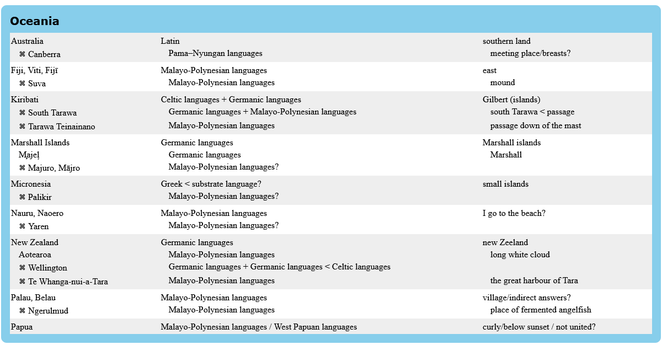
Two months ago my brain decided that I needed to find out what the name of each country means. As the work progressed, along came capital cities and some administrative divisions. On some days I didn’t do anything else but this and on some other days I barely even looked at the list. A bit surprisingly I actually managed to finish the project, so here I present to you the meaning and language group of origin of quite many placenames.

https://yura.radulfr.net/countries.html

#etymology #placenames

Origin of country names

Meaning and original language of the names of countries and capitals.

radulfr.net
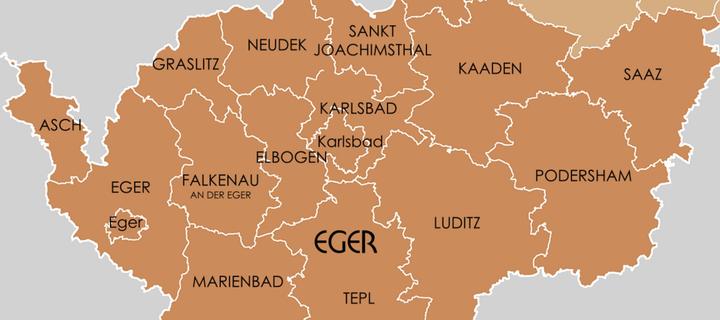
We all know 'New York, New York' but what about 'Eger, Eger, Eger' (Sudetenland).
Are there any places with higher levels of self-nesting?
#maps #PlaceNames #geography #Germany #CzechRepublic #Czech
You think you know Canada? Let’s find out.

YouTube

This is rather nice, newly on the National Library of Scotland Maps website: East Lothian Field Names Recording Project. I'm having fun already looking up field names for some ancestral farms around Gifford, Garvald and Saltoun. A project still in progress. https://maps.nls.uk/projects/field-names/project/

#History #Geography #Scotland #EastLothian #Farming #Agriculture #PlaceNames #Maps

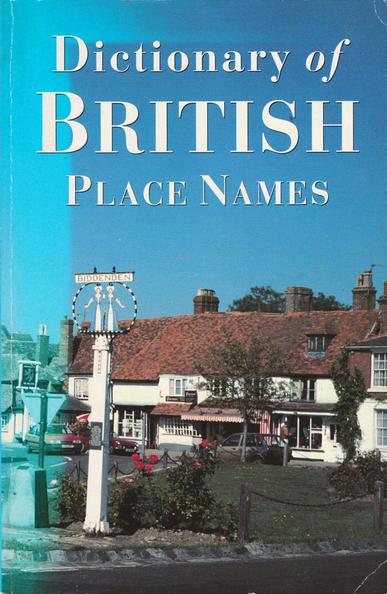
#1225 Adrian Room - Dictionary of British Place Names. Bookmart Limited, 1995, 1st paperback edition.

#AdrianRoom #BookmartLimited #PlaceNames #Toponymy #BookOfTheDay