“The clearest way into the Universe is through a forest”*…
Robert Beauchamp, owner of Sierra Cone, one of the largest cone collection contractors in the West, reaches for a red fir cone outside of Dorrington, California. Nina Riggio Dillon Osleger explains that, while the future of Western forests depends on professional pinecone collectors, they’re slowly being starved out of existence…
High in the crown of a giant sequoia, the world becomes a cathedral of green and amber, hushed but for the creak of ancient wood and the sharp, rhythmic snap of cones being pulled from boughs. Dan Keeley, 31, moved around with a practiced, fluid economy, suspended by thin lines of high-tensile rope 200 feet above the ground on the western edge of California’s Sequoia National Park. To his left, the sequoia’s cinnamon-colored bark provided a steady presence as he leaned out over the negative space between branches.
“There is a lot of trust that goes into this work,” Keeley said, speaking over the wind. He eyed a cluster of green, egg-sized cones. “Trust in the trees, predominantly, but also trust in the system — that I’m being sent to the right trees, at the right time, and for the right reason, not all of which are always the case.”
Keeley, a lean, tanned former rock climber and arborist, is what some in the forestry industry call a pinecone cowboy, a freelance contractor hired to harvest the genetic future of Western forests. He climbs trees of important or threatened species to collect ripe cones for seeds intended to be used for reforestation.
Keeley is part of a specialized workforce that’s become the primary resistance against the rapid erasure of a Western landscape. As megafires — fueled by climate change and a century of heavy-handed forest management and fire suppression — incinerate millions of acres in the West, natural regeneration is failing. Cones from serotinous species, which open their scales and drop their seeds in response to low-intensity wildfires on the forest floor, are now incinerated in increasingly common crown fires — high-intensity blazes that leap into the canopy. Meanwhile, other species’ seeds, dropped into the soil by wind and animals like squirrels and birds, are choked underneath layers of ash or outcompeted by invasive shrubs. The future of a relationship between trees and wildfires that has existed for 350 million years now rests on the shoulders of rope-suspended climbers who collect the trees’ cones one 45-liter bag at a time…
[The work, which dates back to the 1930s, is both arduous and precise; the workers, dedicated. But, as Osleger explains, a number of forces– main among them, Federal budget cuts, have taken a huge toll on the effort…]
… The result is an annual reforestation shortfall that is compounding and transforming entire ecosystems. The Forest Service produces 30 million to 50 million seedlings a year, according to American Forests, a mere fraction of the 120-million annual seedling goal the REPLANT Act established. Roughly 80% of those seedlings will survive, while it takes about 220 trees to reforest each burned acre. Altogether, the agency meets just 6% of its post-wildfire planting needs annually, according to its 2022 Reforestation Strategy Report.
And that’s just on Forest Service land: Wildfires on both public and private lands have affected, on average, 7.8 million acres a year over the last decade, according to the National Interagency Fire Center. In California alone, current seedling production and planting rates mean that it would take 15 to 20 years to reforest what has already been lost, while each additional fire “puts us further behind,” said Kuldeep Singh, operations manager of seed production for CAL FIRE. While the Forest Service considers a tract reforested after seedlings survive their first five years, research says that a functioning ecosystem like the one the fire destroyed won’t return for several decades.
When a forest fails to regenerate, either because it wasn’t replanted or because new seedlings didn’t survive, it often becomes scrub-land, in a permanent ecological shift known as type conversion. The new brush-based ecosystem creates a more flammable fuel bed that resists the forest’s return, effectively locking the land into a cycle of fire and scrub. In areas like South Lake Tahoe, California, for example, fields of 8-foot-tall manzanita and buckbrush now dominate hundreds of acres where conifers once stood. In Oregon, Washington, Idaho, Wyoming and throughout the Southwest, Forest Service research says that high-severity burn areas — which are difficult to regenerate regardless of human intervention — are increasingly repopulated by invasive grasses or the flowering plants called Brassicaceae, which store less carbon and prevent conifers from taking root. This process is permanently altering the hydrology, fire cycle and carbon-sequestration capacity of the West…
More– and more photos– at: “The plight of the pinecone cowboy,” from @highcountrynews.org.
Pair with: “Make Your Own Micro Forest” (“The Miyawaki method of reforestation inserts small, densely packed wild acreage into urban environs. It’s proving wildly successful.”)
* John Muir
###
As we treasure trees, we might recall that it was on this date in 1910 that Glacier National Park in northwestern Montana was established. The park encompasses more than 1 million acres and includes parts of two mountain ranges (sub-ranges of the Rocky Mountains), more than 130 named lakes, more than 1,000 different species of trees and plants, and hundreds of species of animals. Its pristine ecosystem is the centerpiece of what has been referred to as the “Crown of the Continent Ecosystem,” a region of protected land encompassing 16,000 square miles.
The park’s predominantly coniferous forest is home to various species of trees such as the Engelmann spruce, Douglas fir, subalpine fir, limber pine and western larch, which is a deciduous conifer, producing cones but losing its needles each fall.
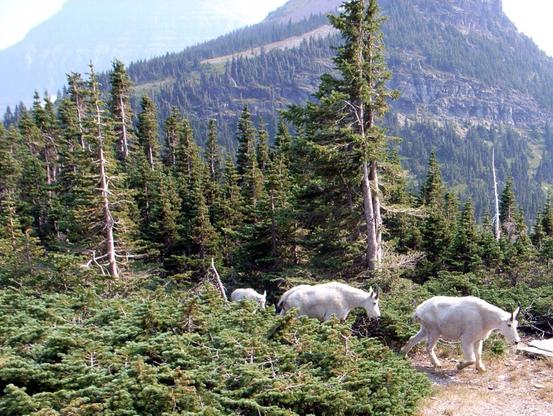
Mountain goats (the official park symbol) at Logan Pass (
source)
#culture #forest #forestManagement #forestry #forests #GlacierNationalPark #history #MiyawakiForests #pineconeCowboy #pineconeCowboys #pinecones #politics #Science #trees Jared
Jared
 Norm
Norm (Roughly) Daily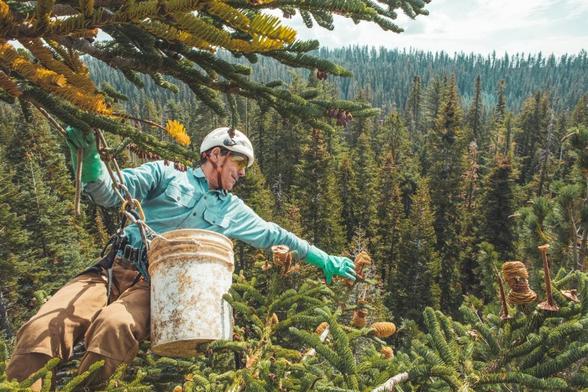
 Kellyfornia

 Paul Houle
 @Om
@Om @Om*
@Om* @Om*
@Om* beklicks