 Michael Nimmo
Arriving in my postbox this week from creator Matt Garvey, with art by Martin Hrastić and colours by Jim Clarke, is The Skim - Part One, and it’s my pick of the week!.
https://comics.3millionyears.co.uk/p/pick-of-the-week-the-skim-part-one

Arriving in my postbox this week from creator Matt Garvey, with art by Martin Hrastić and colours by Jim Clarke, is The Skim - Part One, and it’s my pick of the week!.
https://comics.3millionyears.co.uk/p/pick-of-the-week-the-skim-part-one
#TheMetalDogArticleList
#MetalInjection
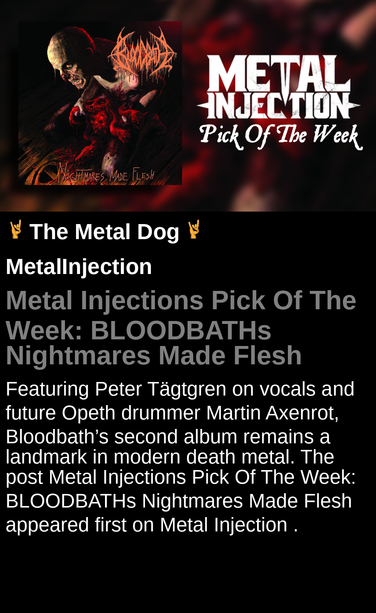
Metal Injection's Pick Of The Week: BLOODBATH's Nightmares Made Flesh
#BLOODBATH #MetalInjection #PickOfTheWeek #deathmetal #album #drummer #metal #music
#TheMetalDogArticleList
#MetalInjection
Metal Injection's Pick Of The Week: AMORPHIS' Tales From The Thousand Lakes
#AMORPHIS #MetalInjection #PickOfTheWeek #album #metal #music

Somehow have been a Mac user since the early 2000s, but had never used @flyingmeat’s Acorn image editor before yesterday. Bought it on a whim, no trial testing, and within *moments* of using knew it was the right choice to finally get on board. 🫡
Our pick of the week by @apierg: "Robust Pronoun Use Fidelity with English LLMs: Are they Reasoning, Repeating, or Just Biased?" by @dippedrusk, @lauscher, et al., 2024.
Here is my review of the intriguing new album by avant-pop artist Jane Weaver, published today in #PopMatters
https://www.popmatters.com/jane-weaver-love-constant-spectacle
Here is my review of Ride's Interplay, the latest album by the reunited British shoegaze band. Published today in PopMatters:
https://www.popmatters.com/ride-interplay-music-review
#RideBand #Shoegaze #Music #PickOfTheWeek
#PopMatters #CurrentSpins
Here is my review of Audio Vertigo, the new album by the British band Elbow. Published today in PopMatters.
Strong contender for my list of the year's best.
https://www.popmatters.com/elbow-audio-vertigo-review
#Elbow #GuyGarvey #Music #PickOfTheWeek #PopMatters #CurrentSpins
Here is my review of Bruce Dickinson's new solo album, The Mandrake Project, published today in PopMatters: https://www.popmatters.com/bruce-dickinson-mandrake-project-review
 🤘 The Metal Dog 🤘
 Richard the Brave 🇨🇦
 Ctrl-OA-Reset
 MT Group at FBK
 Great_Albums


