#Biochemistry #Biology #sflorg
https://www.sflorg.com/2025/02/bchm02102501.html
Microalgae with unusual cell biology could lead to improved understanding of harmful algal blooms https://phys.org/news/2024-03-microalgae-unusual-cell-biology-algal.html
Conspicuous #chloroplast with light harvesting-#photosystem I/II megacomplex in marine #Prorocentrum cordatum https://academic.oup.com/plphys/advance-article/doi/10.1093/plphys/kiae052/7603414
"the #photosynthesis process in these #microorganisms is organized in an unusual configuration which may help them to better adapt to the changing light conditions in the #oceans."
What are the molecular processes in a unicellular marine algae species that can cause harmful algal blooms? A research team led by microbiologist Prof. Dr. Ralf Rabus from the University of Oldenburg (Germany) has conducted the first detailed analyses of the unusual cell biology of Prorocentrum cordatum, a globally widespread species of the dinoflagellates group, using both advanced microscopic and proteomics approaches.
Structure of #diatom #photosystem supercomplex reveals its #energy transfer, #photoprotective pathways.
#fucaxanthin #FCP #photosystem_II #Lhcx
https://phys.org/news/2023-10-diatom-photosystem-supercomplex-reveals-energy.html
Diatoms are an important group of red lineage species in the oceans that produce about 20% of the Earth's primary productivity. Unlike green algae and higher plants, diatom photosystems bind fucoxanthin-chlorophyll a/c binding proteins (FCPs) as peripheral antennas to harvest more blue-green light underwater.
Light-driven CO2 assimilation by #photosystem II and its relation to #photosynthesis.
#electrontransport #chloroplasts
https://phys.org/news/2023-01-light-driven-co2-assimilation-photosystem-ii.html
Photosynthesis is the greatest natural process on Earth, converting sunlight into chemical energy on a massive scale and maintaining life. There are basically two successive stages of oxygenic photosynthesis, of which the light-dependent reactions in photosystem II (PSII), and in photosystem I (PSI), enable the oxidation of H2O into molecular oxygen, and production of reducing power (NADPH and ATP), while CO2 assimilation is generally known to take place long after oxygen evolution and NADP+ reduction, via light-independent reactions in the stroma.
Thanks! :) Really appreciate that!
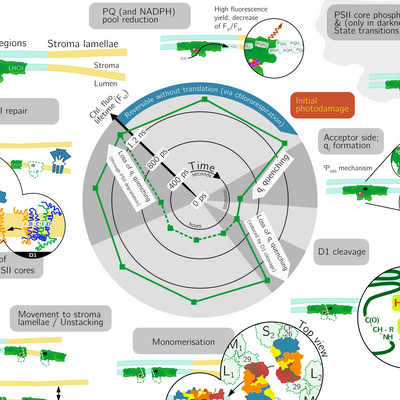
Indeed low #Photosystem II activity in some conditions (high light / nutrient stress etc) is due to faster damage than repair rate.
But what *is* damage? Because D1 degradation is an active proteolytic process that takes place *after* the initial damage, the latter immediately blocking PSII from functioning.
I find it quite fascinating that we still don't understand this very first step responsible for #photosynthesis limitation!
To generate #hydrogen with light energy, a research team @[email protected] & @[email protected] has now developed a compact and sustainable molecular #photosystem. Since it is based on iron, it does not require expensive noble metals or toxic heavy metals.