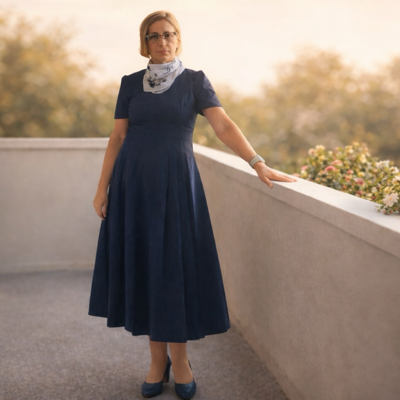
I'm waiting to get on the plane back to Nantes. I'm really so excited. As with all times away, I'm thinking about what I want to bring back with me from here. It's a bit too long to write here. Figuring that out was the subject of many cafe journal entries in Athens. And the answer is less definitive but it can all be summed up by saying I'm finally deciding to have the courage to be for the first time in a while
#Athens #Greece #traveling #Tillich #paulTillich #journaling #introspection #life

On the Question of Self-Confidence: Whether to Build a Tower or to Become the Ground

Seorang pria berdiri di depan laut untuk pertama kalinya setelah berjalan tiga hari dari desanya. Ia membawa pertanyaan-pertanyaan yang tak terucapkan. Dalam pencarian makna kepercayaan diri, penulis menjelaskan pentingnya memahami diri sendiri dan bertumbuh melalui proses yang jujur, bukan membangun pelindung untuk menyembunyikan ketakutan.

https://legawa.com/2026/06/08/on-the-question-of-self-confidence-whether-to-build-a-tower-or-to-become-the-ground/

The awareness of the ambiguity of one's highest achievements (as well as one's deepest failures) is a definite symptom of maturity.
-- Paul Tillich

#Wisdom #Quotes #PaulTillich #Ambiguity

#Photography #Panorama #Sunrise #LakeSantaFe #Florida

What is trust?

I’m aware that yesterday’s post perhaps raised more questions that it answered. That’s not a bad thing in itself, perhaps, but it’s not always kind to one’s readers. Richard Rohr reminds us:

Unfortunately, the notion of faith that emerged in the West was much more a rational assent to the truth of certain mental beliefs, rather than a calm and hopeful trust that God is inherent in all things, and that this whole thing is going somewhere good. Predictably, we soon separated intellectual belief (which tends to differentiate and limit) from love and hope (which unite and thus eternalize). As Paul says in his great hymn to love, “There are only three things that last, faith, hope and love” (1 Corinthians 13:13). All else passes. Faith, hope, and love are the very nature of God, and thus the nature of all Being. Such goodness cannot die. (Which is what we mean when we say “heaven.”) … Christ is a good and simple metaphor for absolute wholeness, complete incarnation, and the integrity of creation.

The Universal Christ, p.22

Now I know that using the word “Christ” in this context may bring some readers up short, but bear with me here: there is more to New Testament Christology than often meets the eye. The apostle Paul says of Christ (Colossians 1:16-17 NIV):  “For in him all things were created: things in heaven and on earth, visible and invisible, whether thrones or powers or rulers or authorities; all things have been created through him and for him. He is before all things, and in him all things hold together.” (This of course is the source of the concept of coinherence so beloved of Charles Williams.)

Using the word Christ in this context is far closer to Meister Eckhart’s Istigkeit, Spinoza’s Deus sive Natura, the Original Ground of Dzogchen, or the Ground of Being in Paul Tillich’s writings, than it is to the “Jesus’ surname” usage common to some thoughtless conventional Christian preaching.

One difficulty we often run into on the far side of deconstruction, it seems to me, is finding words adequate to just this deeply experiential aspect of the contemplative life. It is all very well scraping terminology from neuroscience (or astrophysics, or academic philosophy) and often this can serve us well if we are trying to conceptualise spiritual realities. But our practice, and our awakened lives, ask more of us than conceptualising spiritual experience. Perhaps it is worth taking the risk, with Rohr and Williams and Tillich, of using the language of direct contemplative experience within our own culture. The contemplative life is a life of the heart, after all, and much of our practice depends upon casting a cold eye on the chatter of discursive thought! We cannot trust a bare idea as we can the direct faith that all things rest in Christ, in presence, in the open ground of isness itself – waves of the one ocean, if you will – and that to that presence they will return.

#awakening #BenedictusSpinoza #CharlesWilliams #contemplative #dzogchen #MeisterEckhart #PaulTillich #practice #RichardRohr #trust

The Universal Christ: How a Forgotten Reality Can Change Everything We See, Hope For and Believe eBook : Rohr, Richard: Amazon.co.uk: Kindle Store

The Universal Christ: How a Forgotten Reality Can Change Everything We See, Hope For and Believe eBook : Rohr, Richard: Amazon.co.uk: Kindle Store

A quotation from Paul Tillich

Since every day a little of our life is taken from us — since we are dying every day — the final hour when we cease to exist does not of itself bring death; it merely completes the death process.

Paul Tillich (1886-1965) American theologian and philosopher
The Courage To Be, ch. 1 “Being and Courage” (1952)

More about this quote: wist.info/tillich-paul-johanne…

#quote #quotes #quotation #qotd #paultillich #tillich #death #dying #mortality

Tillich, Paul - The Courage To Be, ch. 1 "Being and Courage" (1952) | WIST Quotations

Since every day a little of our life is taken from us — since we are dying every day — the final hour when we cease to exist does not of itself bring death; it merely completes the death process.

WIST Quotations

Wollen wir einmal über Angst sprechen? Ich meine jetzt nicht so eine „normale“ Angst vor eine Prüfung oder so, ich meine Angst als Störung. Wenn das System Angst, eines das wir benötigen um zu funktionieren und nicht etwas dummes zu machen wie mit dem Auto gegen die Wand fahren, außer Kontrolle gerät und wir sie nicht mehr im Zaum halten können.

Ich hatte letztes Jahr zwei Herzinfarkte […]

https://blog.hamdorf.org/angst/
For reasons, I was looking at Paul Tillich quotes and I will now share some favorites:
"The first duty of love is to listen."
"Boredom is rage spread thin"
"Our language has wisely sensed these two sides of man’s being alone. It has created the word “loneliness” to express the pain of being alone. And it has created the word 'solitude' to express the glory of being alone."
"Doubt isn't the opposite of faith; it is an element of faith."
#paulTillich #quotes #theology #faith #love

Why we read philosophers as if they were in a queue — Husserl begets Heidegger, Heidegger begets Gadamer — and why this linear genealogy lies. Introduction to topological reading: thinkers as bodies in a gravitational field, not as links in a chain. Frankl's encounter with Heidegger on the back of a photograph as a concrete iconic moment that opens the entire essay.

https://somatichermeneutics.substack.com/p/das-ungesagte-a-five-movement-scheme

#philosophy #Logotherapy #Frankl #Heidegger #PaulTillich

Das Ungesagte - a Five-Movement Scheme

Movement I - Overture

Hermeneutic Feuilleton

This is one of those pieces that took time to settle before I could write it.
It gathered—quietly—until it began to take shape.

This essay lives somewhere between structure and fragility,
between a world that holds together
and a self that must learn to affirm it anyway.

Fechner. Tillich.
Two ways of thinking unity—one serene, one trembling.

More in the link above.

https://somatichermeneutics.substack.com/p/between-mind-and-being

#philosophy #psychophysics #theology #paultillich #gustavfechner

Between Mind and Being

Fechner’s Psychophysical Parallelism and Tillich’s Ontological Courage

Hermeneutic Feuilleton

The awareness of the ambiguity of one's highest achievements (as well as one's deepest failures) is a definite symptom of maturity.
-- Paul Tillich

#Wisdom #Quotes #PaulTillich #Ambiguity

#Photography #Panorama #Panopainting #Protest #MarchForOurLives #Florida