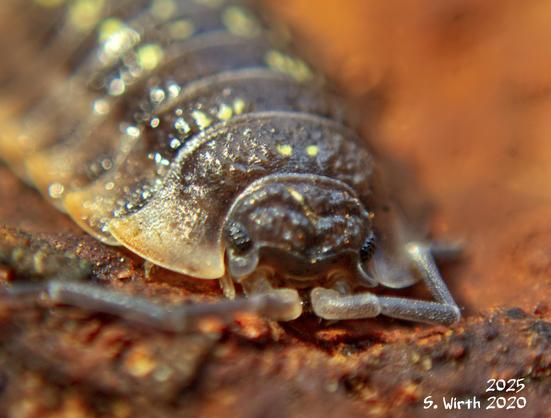
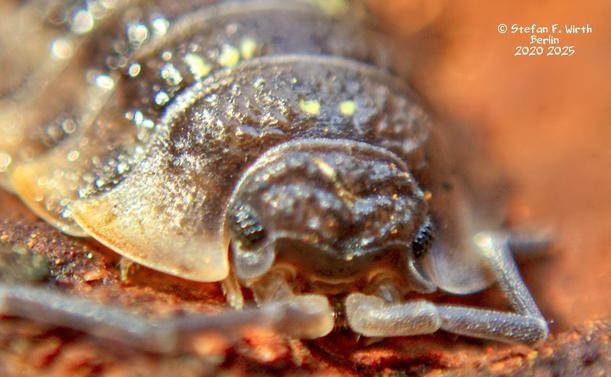
The #woodlouse #Oniscus #asellus (Oniscidae) is originally distributed in Western #Europe, but today one of the most common isopods in #CentralEurope, occuring e g. in dead wood or #leaflitter and is neozoon in North America. D. T. Bilton (2008), names two morphologically/ecologically different #subspecies, O. asellus asellus and O. asellus #occidentalis.

© #StefanFWirth Bln 2025

Reference

D. T. Bilton (2008):
http://dx.doi.org/10.1111/j.1096-3642.1994.tb01478.x

Photos
O. asellus, #Berlin © S. F. Wirth 2020, edit 2025
#lostbones #FossilFriday! 🐂🦥🐴🐘🐪🐟🍃 This Friday’s specimens are two bison skulls recovered in Itasca County during Scenic Hwy 7 road construction along with many other postcranial skeletal elements.

They are currently on loan from Isacka County to the Minnesota Discovery Center in Chisholm, Minnesota.

www.itascahistorical.org
www.mndiscoverycenter.com

#pleistocene #bison #occidentalis #paleontology #MinnesotaDiscoveryCenter #paleontology #shareyourdiscovery #citizenscience #bisonbison #skull

Thrilled to share our new article "Temperate Zone Isolation by Climate: An Extension of Janzen’s 1967 Hypothesis," in The American Naturalist https://www.journals.uchicago.edu/doi/10.1086/722558 #IsolationByEnvironment #IsolationByClimate #PopulationGenetics #Janzen1967 #Sceloporus #occidentalis #Phylogenetics
Temperate Zone Isolation by Climate: An Extension of Janzen’s 1967 Hypothesis | The American Naturalist

Abstract One of the most stunning patterns of the distribution of life on Earth is the latitudinal biodiversity gradient. In an influential article, Janzen (1967) predicted that tropical mountains are more effective migration barriers than temperate mountains of the same elevation, because annual temperature variation in the tropics is lower. A great deal of research has demonstrated that the mechanism envisioned by Janzen operates at broad latitudinal scales. However, the extent that the mechanism mediates biodiversity generally, and at smaller scales, is far less understood. We investigated whether climate overlap is associated with genetic similarity between populations within temperate regions using lizards in the Sierra Nevada mountain range of California as a study system. By comparing genetic differentiation between high- and low-elevation populations, we found that in addition to the expected strong pattern of isolation by distance, high climate overlap was negatively associated with genetic differentiation, indicating that population pairs that inhabit climatically similar environments are less genetically differentiated. Moreover, while climate overlap between high- and low-elevation sites is predicted to increase from the equator to temperate regions, we find that in adjacent mountain ranges at the same latitude in temperate regions, climate overlap values can vary widely. This study suggests that in addition to the well-studied main effect of latitude on climate overlap and population differentiation, local climate factors within bioclimatic regions can also influence genetic differentiation between populations and do so by the same general mechanism that operates at larger geographic scales.

The American Naturalist