 Oskar Contreras
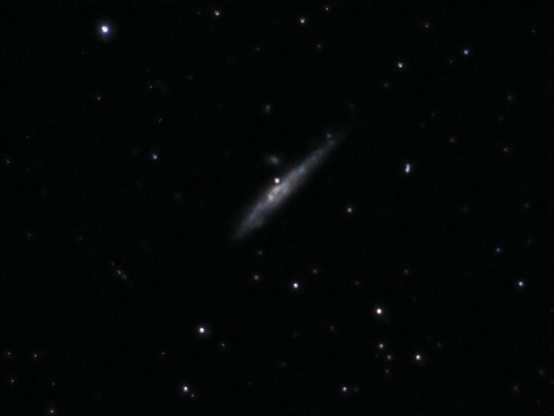
Last observation of the morning. Objects listed from top to bottom - #NGC4627 / #NGC4631 #TheWhaleGalaxy / #NGC4657. #seestar #S50 #space #astronomy #amateur




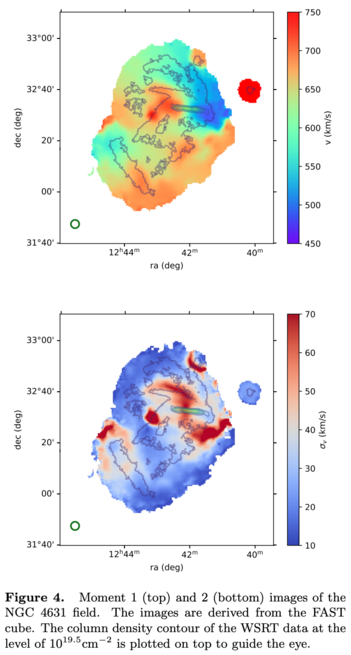
We use the single-dish radio telescope FAST to map the HI in the tidally interacting NGC 4631 group with a resolution of 3.24$'$ (7 kpc), reaching a 5-$σ$ column density limit of $10^{17.9}$ cm$^{-2}$ assuming a line width of 20 km s$^{-1}$. Taking the existing interferometric HI image from the HALOGAS project of WSRT as reference, we are able to identify and characterize a significant excess of large-scale, low-density, and diffuse HI in the group. This diffuse HI extends for more than 120 kpc across, and accounts for more than one fourth of the total HI detected by FAST in and around the galaxy NGC 4631. In the region of the tidal tails, the diffuse HI has a typical column density above $10^{19.5}$ cm$^{-2}$, and is highly turbulent with a velocity dispersion around 50 km s$^{-1}$. It increases in column density with the dense HI, and tends to be associated with the kinematically ``hotter'' part of the dense HI. Through simple modeling, we find that the majority of the diffuse HI in the tail region is likely to induce cooling out of the hot IGM instead of evaporating or being radiatively ionized. Given these relations of gas in different phases, the diffuse HI may represent a condensing phase of the IGM. Active tidal interactions on-going and in the past may have produced the wide-spreading HI distribution, and triggered the gas accretion to NGC 4631 through the phase of the diffuse HI.
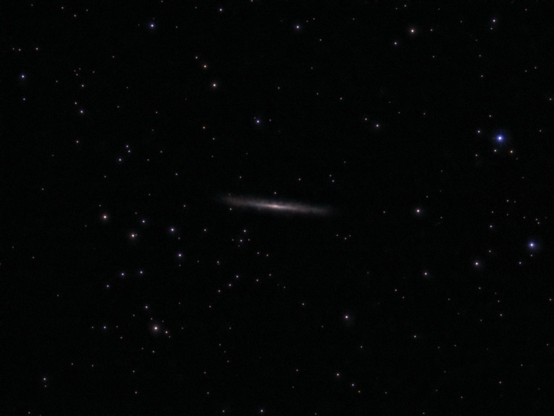
NGC 4631 Whale Galaxy
Magnitude 9.8 barred spiral galaxy located 30 million light-years away in the constellation Canes Venatici. This galaxy's slightly distorted wedge shape gives it the appearance of a herring or a whale, hence its nickname.
#astrophotography #astronomy #space #unistellar #citizenscience #ngc4631 #galaxy #canesvenatici #caldwell32
NGC 4631 Whale Galaxy
Magnitude 9.8 barred spiral galaxy located 30 million light-years away in the constellation Canes Venatici. This galaxy's slightly distorted wedge shape gives it the appearance of a herring or a whale, hence its nickname.
#astrophotography #astronomy #space #unistellar #citizenscience #ngc4631 #galaxy #canesvenatici
 Release the Tuunbaq
 Vinz Frank
 Cathie LeBlanc
 Dr Kelley Hess
 Khurram Wadee ✅
 Ethan Teng 🏳️🌈🏳️⚧️🇹🇼