
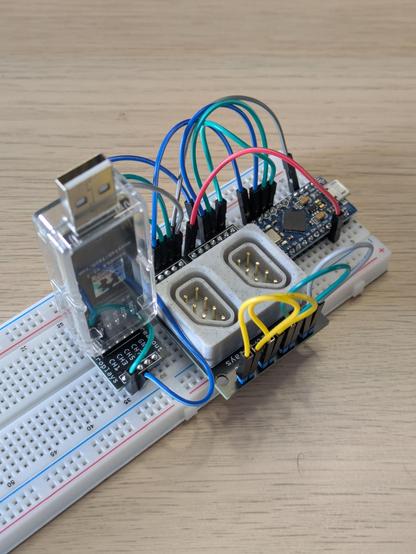
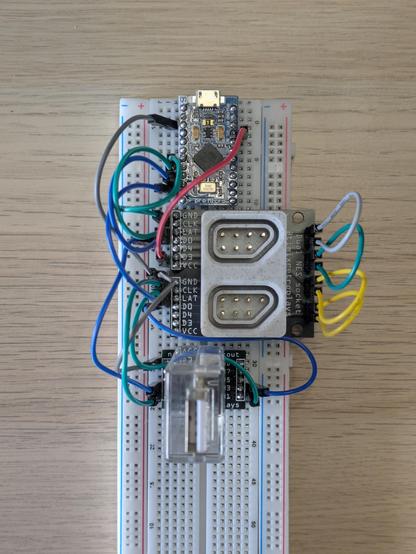
And finally, the whole shebang - an #Arduino Pro Micro clone, my own custom dual #NES controller breakout with a #3DPrinting socket, and the #nanoDLA logic analyser ready to help me learn how to talk to a NES Four Score - and later, to help document how to do the same with a NES Satellite!

This is the confluence of a decade plus of hobby learning and making.

A note mainly for myself: CLK and LAT are pins 5 and 6, and channels 0 and 1; P1D0 is pin 7 and channel 2, P2D0 is pin 8 and channel 3.

First proper look at some more Advanced Gravis controllers with my #nanoDLA logic analyser.

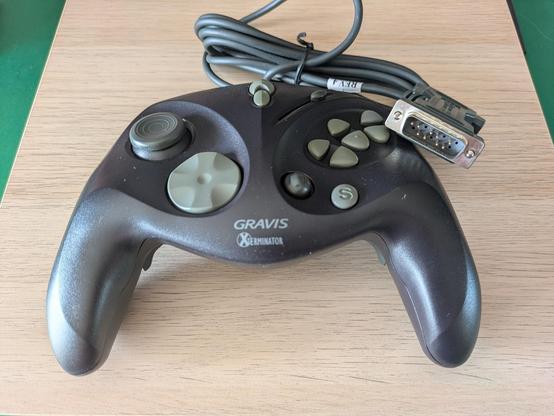
Here's the original Gravis XTerminator gamepad. It's got an analog stick, a D-pad, a ton of action buttons, analog and digital shoulder buttons, a POV hat and a throttle slider - all of which is made to work on the 15-pin gameport with the Gravis GrIP digital protocol.

Check out that gameport plug - I had trouble with this pad initially because I'd wired up +5V and GND to missing pins in the connector.
Pausing the project here for a bit. With seven pins dedicated to reading a #SEGA controller, I can use the 8th pin as a signal from the #Arduino not just to indicate when a certain thing is happening, but also as a trigger in #PulseView to start capturing data.

Are you an Arduino/generally a microcontroller or electronics hobbyist? You should go buy a #nanoDLA logic analyser - for a few bucks you can easily visualise exactly what's going on with your I/O signals. Solid recommendation from me.

Tonight's setup - the SEGA controller is now hooked up to an #Arduino Pro Micro alongside the #nanoDLA. To start with I'm just flicking the signal line up and down every 200ms.

I know digitalWrite can make changes on the order of single-digit microseconds - I wonder how fast a Megadrive controller can react?

Six days later, a #nanoDLA 1.3 has arrived. It cost me AU$10.54 including postage. It's an open source logic analyser, documentation in English here: https://github.com/wuxx/nanoDLA/blob/master/README_en.md

This thread will document my first explorative experiences with it and sigrok's #PulseView, an open source logic analyser software package and the recommended counterpart to the nanoDLA: https://sigrok.org/wiki/PulseView

nanoDLA/README_en.md at master · wuxx/nanoDLA

24MHz sampling rate Logic Analyzer based on fx2lafw - wuxx/nanoDLA

GitHub

Finished design, with a press-fit lid and a funky color 😅

#teamorange #electronics #nanodla #3dprinting

Designing a simple little enclosure for my #nanoDLA as My First #Fusion360 Project.

#3dprinter #3dprinting