
The Edge of the Forge: Why the Fire Feels Like a Threat

2,005 words, 11 minutes read time.

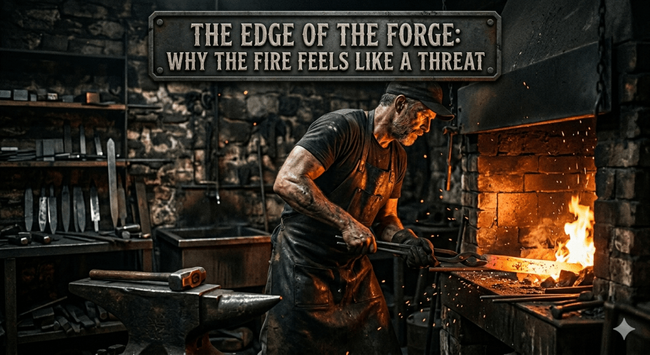
The heat in the workshop was absolute, a living thing that demanded total submission. Nash Holden wiped sweat from his brow with a forearm darkened by years of coal dust and scale. Outside, the wind was biting, tearing at the siding of his metal-clad shed, but inside, the air was a steady, dry furnace. He was working on a commission that had been keeping him awake for three weeks: a custom wilderness survival blade for Julian Vane. Vane ran a modest but respected YouTube channel called The Practical Woodsman, where he focused on the tedious, unglamorous reality of remote living. Vane’s audience of 300,000 subscribers valued authenticity above all else; they would catch a failure in seconds. If a blade snapped during a simple wood-splitting demonstration, Vane’s brand would take a hit, and Nash’s reputation—built on fifteen years of perfection—would evaporate in a single edit.

For Nash, this wasn’t just a job; it was a high-stakes spotlight on his own inadequacies. The design called for 400 layers of 1084 and 15N20 high-carbon steel. He had spent the morning carefully stacking the alternating layers, tack-welding them into a solid billet, and heating them to a precise 2,250 degrees until they fused at a molecular level. To build the layer count, Nash had to draw the billet out, cut it into sections, restack those sections, and fuse them again. It was a grueling cycle of heat, pressure, and precision. If he made a mistake—if one weld didn’t hold or a microscopic piece of slag remained between the layers—the blade could snap in the middle of a routine task. The thought of that potential failure made his stomach turn. He had built his livelihood on the promise that his steel was bulletproof, and the idea that a flaw could be hiding inside this billet, invisible to the eye but waiting to shatter his career, was a constant, low-level hum of terror in the back of his mind.

Nash wasn’t a man of many words, and he liked it that way. He’d grown up in the shadow of a father who was a foreman at a local manufacturing plant—a man who believed that if you weren’t producing, you were wasting oxygen. Nash had spent his life trying to prove he was a high-yield producer. He’d built his reputation on reliability. But lately, the man behind the hammer felt like a brittle piece of low-carbon scrap. He’d started attending a men’s group at his church, expecting to find guys who were as stoic and put-together as he was. Instead, he found men who admitted they were lost, men who talked about shame and inadequacy as if it were a common cold. At first, it irritated him. He wanted solutions, not a support group for the broken. But the more they talked, the more he realized his own “perfect” professional life was a facade, a polished handle on a blade that was internally fractured.

The fear that had been gnawing at him wasn’t just about the blade; it was the fear he’d voiced to his pastor during a lunch last week: if he truly gave everything to God, if he stopped holding back the parts of his life he wanted to manage himself, would he be signing up for a life of wreckage? He looked at the historical accounts of men like Job or the Apostle Paul, and he didn’t see a life of comfort; he saw a life of trials that would have leveled a lesser man. Nash gripped the tongs until his knuckles turned white. He wanted to be a man of faith, but he was terrified that the price of admission was a crucible he wasn’t built to survive. If he surrendered to God, would God put him through a “survival scenario” just to test his integrity? Was it better to keep his faith in the “safe” zone, or did he have to be willing to be broken just to prove he was worth something to his Maker?

He pulled the billet from the forge, the metal glowing with a color that sat somewhere between cherry red and a threatening orange. He placed it on the anvil and brought the heavy hammer down. Clang. The sound reverberated through the shed, a singular note of absolute finality. He hammered, drawing the steel out, then cut it, stacked it, and fused it again, his mind racing. He imagined God as a blacksmith, but a blacksmith who didn’t seem to mind how much he hammered the steel. Was that the only way to get the impurities out? Was Nash just a piece of metal on the anvil, waiting for the next blow? He thought about his own life—the missed opportunities to be a better husband, the pride that kept him from apologizing, the secret jealousy he felt when he saw other men succeeding where he felt stalled. If God really took hold of his life, would He just hammer those things out until there was nothing left of Nash but a sharp, cold tool?

He looked at the blade, now cooling slightly, its surface showing the first hints of the Damascus pattern—the intricate, swirling lines that only emerged after repeated trauma and heat. He used to think the pattern was the point. Now, he wondered if the pattern was just the aftermath of the survival. He remembered a man in his group, a guy named Elias who had lost his business and his home in the span of a year, saying that he’d never felt more “known” by God than when he had nothing left to lose. Nash didn’t want to lose anything. He liked his shed. He liked his forge. He liked the feeling of being in control of his own heat. He wondered if that was the barrier—the belief that he needed to protect his own soul from the very hands that had formed it.

The furnace roared as he kicked the bellows, pushing the temperature back up to prepare for the next fusion. He felt the heat prickle his skin, a reminder of how close he was to the fire. He was a man who worked with dangerous things every day, yet the thing he feared most was the quiet realization that he didn’t have the final say. If he was truly “known,” truly surrendered, did that mean he had to be prepared for the kind of fire that refined, not the kind that comforted? He didn’t have an answer. The steel didn’t care about his theology; it only responded to the heat and the hammer. He looked at the glowing billet, a beautiful, violent thing, and realized he was no closer to knowing if he could trust the blacksmith. He reached for the tongs again, his hands shaking slightly, not from the weight of the metal, but from the weight of the silence that filled the shed. He brought the steel back to the heat, the roar of the fire drowning out every other thought, leaving him alone with the orange glow, the heavy hammer, and the unanswered question of whether he would ever be brave enough to stop holding the hammer himself. He waited, held his breath, and brought the metal down against the iron, the clang echoing into the night, leaving him to wonder just how much more heat he could stand, and if, at the end of it all, he would be a masterpiece or just discarded scrap.

Author’s Note: Stop Polishing the Rust

Listen close. You’re walking around with a smile that doesn’t reach your eyes, sweating bullets because you think the whole operation is one bad day away from total collapse. You’ve got a business to run, a house to keep, and a reputation that’s held together by duct tape and sheer, stubborn willpower. But at 3:00 AM, when the shop is dark and the house is quiet, that nagging voice in your head doesn’t stop. It tells you that you’re a fraud. It tells you that your “inadequacy” is a terminal diagnosis.

And then there’s the God part. You look at guys like Paul—who got shipwrecked, beaten, and hunted—or Job, who lost everything that mattered—and you think, “If I actually surrender to that, I’m finished.” You’re terrified that letting God into the driver’s seat means He’s going to turn your life into a dumpster fire just to test the integrity of your faith.

Cut the crap. You’re viewing the Creator of the universe like some petty tyrant waiting to sabotage your production line.

The blacksmith doesn’t throw a billet into the forge because he wants to ruin it. He puts it in the fire because he knows that’s the only way to purge the impurities. You think your “weakness” is a liability? Read your manual. 2 Corinthians 12:9 isn’t a suggestion; it’s the law of the land: “But he said to me, ‘My grace is sufficient for you, for my power is made perfect in weakness.’ Therefore I will boast all the more gladly about my weaknesses, so that Christ’s power may rest on me.” That’s not a platitude for the faint of heart. That is a directive for warriors.

Stop trying to patch your life with cheap, home-store adhesive. Stop trying to hide the cracks in your soul with a high-polish finish. Shame is a parasite. It lives in the dark, sucking the life out of your work and your marriage, thriving because you’re too proud to admit you’re out of your depth. You aren’t “scrap metal.” You’re a project in progress, and the Master is trying to get the impurities out so He can finally put an edge on you that won’t snap when the pressure hits.

James 1:2-4 isn’t a fairy tale. It’s the hard truth about building a man: “Consider it pure joy, my brothers and sisters, whenever you face trials of many kinds, because you know that the testing of your faith produces perseverance. Let perseverance finish its work so that you may be mature and complete, not lacking anything.” That is what generates the iron in your spine.

You want to keep holding the hammer? Fine. But don’t complain when the blade snaps in the dirt because you were too scared to let the Fire refine you. You’re holding onto the control because you don’t trust the outcome. It’s time to stop the charade.

Here’s the call to action: Put down the hammer. Write down the one thing you’re most terrified of people finding out about you—the secret “dent” in your character you’ve been trying to buff out—and bring it to one guy you actually trust. No excuses. No polished exterior. Just the raw, ugly truth. Break the silence today, or watch the rust eat you alive.

“Being confident of this, that he who began a good work in you will carry it on to completion until the day of Christ Jesus.” — Philippians 1:6

Now, get back to work.

SUPPORTSUBSCRIBECONTACT ME

D. Bryan King

Sources

Disclaimer:

The views and opinions expressed in this post are solely those of the author. The information provided is based on personal research, experience, and understanding of the subject matter at the time of writing. Readers should consult relevant experts or authorities for specific guidance related to their unique situations.

Related Posts

Rate this:

#2Corinthians129 #authenticManhood #BibleVersesOnStrength #blacksmithing #blacksmithingMetaphor #bladesmithingTechniques #brotherhoodForMen #buildingPerseverance #buildingResilience #characterDevelopment #DamascusPattern #DamascusSteel #dealingWithImposterSyndrome #facingInadequacy #faithUnderPressure #forgingSteel #gritLit #handlingFailure #highCarbonSteel #innerStrength #James124 #lifeTrials #manToManAdvice #manlyVirtues #menSDiscipleship #menSMentalHealth #menSSupportGroups #mentalToughness #overcomingFear #overcomingPride #overcomingShame #perfectionismInMen #personalAccountability #personalRefinement #Philippians16 #professionalInadequacy #professionalReliability #refiningFire #spiritualDiscipline #spiritualFormation #spiritualGrowthForMen #steelHeatTreatment #stoicismVsSurrender #survivalGear #survivalKnifeMaking #testingOfFaith #truthAndTransparency #vulnerabilityForMen #workshopLife

The Iron Weight of a Dead Engine

2,984 words, 16 minutes read time.

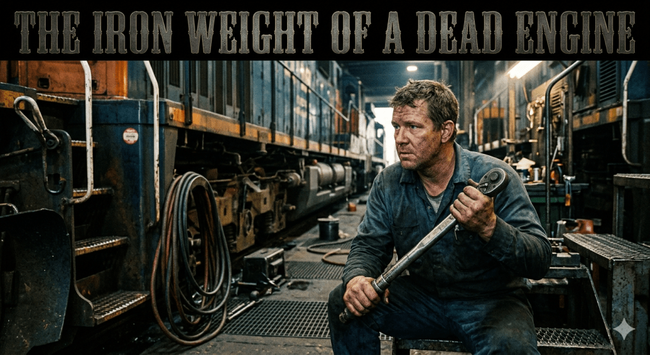
The rain in this city doesn’t wash anything away; it just pushes the grime from the rail yards into the drainage ditches, mixing with the diesel fuel and the regret. I sat in the cab of my truck, the engine ticking as it cooled, listening to the rhythm of the storm against the windshield. My name is Silas Thorne. I’ve spent the better part of a decade as a lead locomotive technician, a job that runs on precision, calloused hands, and a refusal to let anyone tell me how to overhaul a prime mover. Out here, deep in the guts of a two-hundred-ton diesel-electric engine, the only authority that matters is the one that follows the technical manual or holds the torque wrench. It’s a clean existence, mechanically speaking. There are no gray areas in a seized cylinder liner, and there’s no room for someone else’s opinion when you’re the one deciding whether a locomotive is fit for the tracks. But lately, the silence in my house, the kind that settles in after the radio goes dead, has started to feel less like peace and more like a verdict. It’s a stubborn kind of pride, the type that keeps you standing in the rail yard long after your shift is over because you’d rather soak through than admit you’re tired of carrying the weight alone.

I’ve always been the guy who keeps his head down and his mouth shut. That’s how you survive in the shop. In the world I grew up in, showing a chink in the armor was an invitation for someone to drive a wedge right through it. You keep your struggles locked behind your teeth. If you’re angry, you channel it into the grit of stripping down a traction motor. If you’re lonely, you bury it under the stress of shipping schedules and failed inspections. It’s a self-reliant creed, a gospel of the heavy iron. But lately, the Bible study flyer that’s been sitting on my kitchen counter—the one my sister keeps leaving there—has started to look less like an invitation and more like a threat. It speaks of accountability, of community, of submission to a higher authority than the one staring back in the mirror. To me, that sounds like a surrender. It sounds like handing over the keys to a life I built bolt by bolt with my own sweat, and I’ve never been one for giving up control.

The irony isn’t lost on me. I know the story of Jonah. Most men in the industry know it, even if they don’t admit they’ve read it. It’s the ultimate tale of a man who thought he could outrun his own reality, who thought he knew better than the voice that had been calling him since he was a kid. Jonah wanted to go to Tarshish; he wanted to run away from the discomfort of accountability, from the burden of a message he didn’t want to deliver. He was a man who prized his own comfort and his own status over the messy, complex reality of God’s mercy. I see myself in that running. I see myself in the way I look at my life—as a closed system, a closed loop where I am the beginning and the end. I’ve spent years building a fortress of status and mechanical competence, convinced that if I just work hard enough, I won’t have to deal with the inherent brokenness that everyone else seems to be stumbling through.

There’s a specific kind of arrogance in thinking you don’t need an anchor. I look at the guys in the shop, men who are just as hardened by grease and vibration as I am, and I wonder what they’re hiding. We talk about rail specs, about injector timing, about the price of alloy steel, but we never talk about the fact that we’re all holding onto the edge of a cliff. We treat our pride like a heavy-duty frame, a structure that supports our identity, but it’s actually the rust eating away at the integrity of the whole machine. I remember thinking that admitting I needed help was a failure of masculinity. I thought that being a man meant being a monolith—impenetrable, unmovable, and entirely self-contained. The Bible calls this heart-hardening, a refusal to bow to an authority that isn’t of our own making. It’s the pride that keeps us locked in the storm, shivering in our own trucks, convinced that asking for shelter is the same thing as admitting we’re a mechanical failure.

The truth is, we are all running to our own versions of Tarshish. Maybe it’s not a boat for you. Maybe it’s a twelve-hour shift in the yard so you never have to be alone with your own thoughts. Maybe it’s a bottle, or a string of shallow distractions, or a fierce, defensive temper that keeps people at a distance. We build these lives, these elaborate structures of self-reliance, and we pray they never collapse. But they always do. The wind comes, the rain falls, and the foundations we laid in our own strength turn out to be nothing more than shifting ballast. I’ve lived with that anxiety for years, the subtle, creeping fear that one day the engine will seize permanently, and I won’t be able to fix it with the tools I have in my kit. I’ve held onto my autonomy like a prize fighter holding onto a title belt, unaware that the weight of the belt is the very thing keeping me from breathing.

When you look at the structure of accountability described in the scriptures, it isn’t about being told what to do by some distant, uncaring force. It’s about being known. That’s the part that terrifies men like me. We’re okay with being respected for our work, but we’re paralyzed by the idea of being truly seen. To be known is to have your weaknesses laid out on the workbench, to have your anger, your lust, your pride, and your failures examined by someone else. It feels like an execution. We fear that if we take off the mask, there won’t be anything left underneath but a hollow, rusted casing. But that’s the lie we’ve been sold. We’ve been led to believe that our value is tied to our utility, to what we can produce, what we can fix, and how much we can control. The reality is that the authority we resist is the only thing that offers us an identity that doesn’t depend on our performance.

I spent Tuesday night at that study, the one I’d been avoiding for months. I didn’t go because I had a sudden epiphany or because the heavens opened up. I went because the weight of the silence in my truck had finally become heavier than the weight of my pride. Walking into that room felt like walking onto the shop floor where the technical diagrams were written in a language I didn’t understand. There were men there—machinists, engineers, guys who clearly spent their days trying to keep their own internal mechanisms from locking up. We didn’t talk about the union or the latest management nightmare. We talked about the things we usually leave in the dark. Someone mentioned the concept of “yielding,” and for a second, I felt a physical resistance in my chest. It felt like a betrayal of everything I’d worked to build. But then I looked around, and I saw that none of these guys were weak. They were just finished with the pretense of being indestructible.

There’s a passage about the heart being deceitful above all things, and that’s a tough pill for a man who prides himself on his diagnostic skills. We trust our gut. We trust our experience. We trust the logic we’ve developed over years of trial and error in the shop. But when you’re building your life on your own logic, you’re just stacking parts in a void. You might get a good look at the track ahead for a while, but eventually, the physics of the fall win. Yielding isn’t about giving up your manhood; it’s about realizing that you were never designed to carry the world on your shoulders in the first place. That’s a divine burden, and we aren’t divine. When we try to be our own gods, we don’t end up with more power; we end up with more isolation. We become the sailors on Jonah’s boat, panicking as the sea rises, realizing that the storm is there specifically because of the weight we refused to drop.

It’s about the struggle to be real, really real, in a world that demands you be a caricature of strength. We live in a culture that incentivizes the suppression of the soul. If it doesn’t serve the bottom line, if it doesn’t increase your standing as a provider, it’s not worth your time. That’s the lie. True strength is the ability to stand in the truth of your own limitations. It’s the courage to admit that you’ve been chasing a ghost of independence that has only left you more trapped. I think about the men who feel like they have to keep the performance going, the ones who wake up every morning and put on the greasy coveralls before they even touch the floor. It’s an exhausting way to exist. It’s a life defined by defense, by keeping people out and keeping the truth locked away in the locker room.

Accountability is the act of opening the door. It’s deciding that you don’t want to live in the storm anymore, even if you’re the one who caused it. When we resist authority, we’re really just resisting the possibility of healing. We think that if we are held accountable, we will be crushed, but it’s the exact opposite. Accountability is the structure that allows the overhaul to actually happen. You can’t fix a seized engine if you’re unwilling to strip it down to the block. You can’t seal a leak if you’re too proud to admit the seal is blown. I’ve spent my life convinced that I could just paint over the rust, keep the surface shiny, and hope the engine wouldn’t notice. But the engine always knows. You can’t lie to the machine you inhabit.

The transition from self-reliance to submission is the hardest work I’ve ever done. It’s not a one-time event; it’s a daily demolition. Every morning, I have to choose to lay down the tools I use to protect myself. I have to admit that I don’t have all the answers for the chaos of my own life. It’s a humbling thing to realize that the smartest guy in the shop is often the one who is most lost, simply because he refuses to ask for a manual or a mentor. I’ve stopped looking at the Bible as a set of demands that infringe on my freedom and started looking at it as a set of technical specifications for a human life that actually works. It’s not about stifling my drive or my ambition; it’s about aligning those things with a purpose that is actually sustainable.

I look at the guys at that table now, and I don’t see competitors. I see brothers in the same trench, fighting the same battle against the urge to hide and the addiction to control. We talk about the pride that almost cost one guy his marriage, the anger that nearly got another fired from his lead role. There’s no posturing. There’s no need to project an image of success because we’ve already admitted that the image is a lie. That kind of honesty is more intimidating than anything I’ve faced in a rail yard, but it’s also the only thing that makes me feel like I’m actually living. It’s the difference between building a façade and building a engine that can actually pull its own weight. A façade is just for the supervisors to look at; a functioning engine is where you go to be restored.

I’m still the guy who likes things done right. I’m still the guy who appreciates the sharp line of a calibrated gauge and the solid weight of a well-seated gasket. But I’m starting to understand that the most important repair job I’ll ever undertake isn’t made of steel or iron. It’s the internal architecture of my own character, and for the first time, I’m willing to listen to the Architect. It doesn’t mean I’m perfect, and it doesn’t mean the rain has stopped. The rain is still coming down, and the city is still just as gritty as it was when I started this story. But the truck isn’t running anymore, and I’m not sitting in the dark waiting for a storm that I’m trying to ignore. I’m going inside. I’m letting go of the steering wheel, and for once, the weight of the world doesn’t feel like it’s going to break my back. That’s the secret, I guess. The moment you stop trying to be the foundation, you finally find the one that’s actually capable of holding you up. It’s a strange, terrifying, and ultimately beautiful surrender. And for a man who has spent his whole life trying to keep the train on the tracks by force of will, it’s the first time I’ve ever felt truly safe.

Author’s Note: The Myth of the Lone Wolf

As men, we like to think that if we just tighten the bolts hard enough, nothing will ever break. We spend our lives in the shop, on the road, or in the office, convinced that the only way to keep the engine of our lives running is to be the only one holding the wrench. I know that feeling because I’ve lived it, and I have seen many more men that are the same way; it’s the way we think. We’ve been conditioned to believe that asking for help is an admission of mechanical failure, and that admitting you’re lost is the ultimate surrender of your command.

But look at the design. Even Jesus, the man who carried the weight of everything, didn’t do it alone. He chose twelve. He didn’t just pick associates or colleagues; He chose men to walk with Him, eat with Him, and see the unfiltered reality of His life. He understood that a man without a tribe is a man waiting to drift. Meanwhile, most of us are out here trying to navigate the wreckage with maybe two or three distant friends—men we see once a year if we’re lucky, and who we wouldn’t dare tell the truth to if we did.

I’ve been lucky. I found a group of men a while back—a tribe that actually pulled no punches. We sat in that room and tore down the façades. Some of those guys are still in my corner, iron sharpening iron, every single day. But let’s be honest: the road is narrow, and the toll is high. We’ve lost a few along the way. Some guys couldn’t handle the heat of being fully known; others got distracted by the siren call of their own pride and drifted back into the isolation of the storm. It hurts to lose them, but it’s a reminder that this kind of brotherhood isn’t for the faint of heart.

Proverbs 27:17 tells us, “As iron sharpens iron, so one person sharpens another.” But iron doesn’t get sharpened by sitting on a shelf; it gets sharpened by friction, by heat, and by hard, direct contact. You can’t be sharpened by someone who stays at a distance. You can’t be sharpened by a “friend” who is just there for the good times and the shallow talk.

The “strong, silent, independent man” is a design flaw. It’s a machine built for a static environment, not for the real, grinding friction of this world. When we hold onto our pride like it’s a load-bearing wall, we don’t realize the rot is already at the foundation. We are so busy keeping up the appearance of a locomotive that can pull any load, we fail to notice we’ve been running on an empty tank for years.

This story isn’t just about the mechanics of the rail yard; it’s about the mechanics of the human heart. Resisting authority—biblical or otherwise—is usually just a fancy way of saying we are afraid to let anyone else see our blueprints. We fear that if we’re exposed, we’ll be condemned. The paradox is that true freedom isn’t found in total autonomy. It’s found in the surrender to an authority that actually knows how we were built to function, and in the company of men who will hold us to that standard when we’d rather quit.

If you’re reading this and you feel that tightness in your chest, know this: you aren’t being asked to break. You’re being asked to be built properly. You don’t have to live in the storm of your own making. Stop running to your own version of Tarshish. Find a church with a real men’s group, and if you can’t find one, start one. Stop waiting for someone to give you permission—because that invitation isn’t coming. A man doesn’t wait for a sign to step up; he takes the initiative.

It is time we start a campaign for our own souls: Find your twelve—or your three—and start being real. The storm doesn’t stop because you’re fast; it stops because you finally drop the weight and let someone help you carry it.

SUPPORTSUBSCRIBECONTACT ME

D. Bryan King

Sources

Disclaimer:

The views and opinions expressed in this post are solely those of the author. The information provided is based on personal research, experience, and understanding of the subject matter at the time of writing. Readers should consult relevant experts or authorities for specific guidance related to their unique situations.

#accountabilityForMen #accountabilityPartners #authenticFaith #authenticManhood #biblicalManhood #biblicalMasculinity #breakingTheLoneWolfMyth #buildingALegacy #buildingCharacter #buildingCommunity #ChristianBrotherhood #ChristianLeadership #communityOverControl #emotionalHealthForMen #faithInAction #faithInTheWorkplace #faithBasedMentoring #findingPeace #findingYourTribe #howToStartAMenSGroup #intentionalFriendship #intentionalRelationships #ironSharpensIron #maleLonelinessEpidemic #manOfGod #masculineIdentity #menSAccountability #menSBibleStudy #menSDiscipleship #menSMinistry #menSSmallGroups #mentalToughness #modernMaleStruggles #overcomingAnger #overcomingIsolation #overcomingLifeSStorms #overcomingLust #overcomingPride #PersonalGrowth #purposeForMen #resistingAuthority #scriptureForMen #selfRelianceVsFaith #spiritualFoundations #spiritualGrowthForMen #spiritualTransformation #stopWaitingForPermission #strengthInSurrender #theWeightOfPride #vulnerabilityInMen

The Great Commission Starts at Your Front Door — Stop Ignoring It

2,504 words, 13 minutes read time.

The Great Commission is not a suggestion, not a gentle invitation for the spiritually ambitious, and certainly not an optional add-on for Christians who happen to have free time. Matthew 28:18-20 records the risen Christ issuing a direct command to make disciples of all nations, baptizing them and teaching them to observe everything He commanded. This is a marching order from the King of Kings, and it applies to every man who claims the name of Christ. The problem is that most Christian men have conveniently reinterpreted this command to mean “support missionaries financially” or “hope the pastor handles it.” The result is neighborhoods filled with lost souls, communities decaying under the weight of godlessness, and Christian men sitting in comfortable pews congratulating themselves for their attendance record while doing absolutely nothing to bring the gospel to the people within walking distance of their own front doors. The Great Commission begins at home, in the community, among the neighbors and coworkers and strangers encountered daily — and the failure to execute it there is a damning indictment of modern masculine faith.

This article confronts the epidemic of Great Commission neglect among Christian men, exposes the theological bankruptcy of outsourcing evangelism and discipleship, and lays out the non-negotiable biblical mandate to actively make disciples within arm’s reach. There is no escaping this responsibility. The mission field is not some distant land requiring a passport — it is the cul-de-sac, the workplace, the gym, the school pickup line. Every Christian man stands accountable for whether he carried the gospel to the people God placed in his path or whether he buried his talent in the ground like the worthless servant condemned in Matthew 25.

The Great Commission: A Direct Command for Local Evangelism and Disciple-Making

The Great Commission in Matthew 28:18-20 opens with Christ declaring that all authority in heaven and on earth has been given to Him, establishing the foundation upon which the command rests — this is not a request from a peer but a directive from the One who holds absolute sovereignty over every realm of existence. The command itself is structured around one main verb in the original Greek: “mathēteusate,” meaning “make disciples.” The participles “going,” “baptizing,” and “teaching” describe how this disciple-making happens, but the imperative force lands squarely on the creation of disciples. This linguistic reality demolishes the excuse that evangelism is merely about sharing information or planting seeds with no responsibility for the outcome. Christ commandsams the production of disciples — people who follow Him, learn from Him, and obey Him — and He assigns this task to His followers without exception or escape clause. According to research published by the Barna Group, only 52% of churchgoing Christians say they have shared their faith even once in the past six months, and among men, the numbers are often worse due to cultural pressures against religious conversation. This is not a minor shortfall; it is wholesale desertion of the mission.

The phrase “all nations” in the Great Commission does not exclude the local community; it includes it as the starting point. Acts 1:8 clarifies the geographic expansion of the gospel mission: “You will be my witnesses in Jerusalem, and in all Judea and Samaria, and to the ends of the earth.” Jerusalem came first. The apostles did not skip their immediate context to pursue more exotic mission fields. They started where they were, with the people they knew, in the language they spoke, and they built outward from that foundation. Modern Christian men have inverted this pattern, often showing more enthusiasm for supporting distant mission efforts than for speaking a single word of the gospel to the neighbor they have known for a decade. The Pew Research Center’s Religious Landscape Study consistently shows that a significant percentage of Americans claim no religious affiliation, with the “nones” rising to nearly 30% of the adult population in recent surveys. These are not people hiding in remote jungles — they are coworkers, neighbors, family members, and friends living in the same zip code. The mission field is not far away; it is dangerously close, and the failure to engage it is a failure of obedience.

Discipleship as defined by the Great Commission is not a one-time conversation or a gospel presentation delivered and then forgotten. The command includes “teaching them to observe all that I have commanded you,” which implies an ongoing relationship of instruction, correction, and modeling. This is the work of spiritual fatherhood, of investment over time, of pouring truth into another human being until they are equipped to do the same for others. The early church understood this model, as seen in Paul’s relationship with Timothy, Barnabas’s investment in Mark, and the pattern of elder-to-younger transmission described throughout the pastoral epistles. LifeWay Research has found that personal relationships remain the most effective pathway for people coming to faith, with friends and family cited far more often than programs, events, or media as the primary influence. The relational nature of discipleship cannot be outsourced to a church program or a podcast. It demands personal presence, consistent effort, and a willingness to be inconvenienced for the sake of another soul.

Building Disciples in the Neighborhood: The Mechanics of Community-Level Obedience

Executing the Great Commission in a local community requires intentionality, courage, and a willingness to be identified publicly as a follower of Christ. The days of cultural Christianity providing cover are over; the American religious landscape has shifted dramatically, and to speak openly about Jesus Christ is now to invite scrutiny, pushback, and potential social cost. Barna research indicates that practicing Christians often experience hesitation about evangelism due to fear of rejection, lack of confidence in their ability to answer questions, or uncertainty about how to start spiritual conversations. These fears are real, but they are not excuses. The apostles faced imprisonment, beatings, and execution for their witness, and they continued anyway because they understood that the eternal destiny of souls outweighed temporary discomfort. The man who cannot muster the courage to invite a neighbor to church or to explain why he follows Jesus has a faith problem, not a skill problem.

The practical mechanics of community-level discipleship begin with visibility and consistency. Neighbors notice patterns — they see who helps when there is trouble, who shows up when there is need, who lives differently in a world of chaos. The New Testament describes Christians as salt and light, preserving and illuminating their environments through their presence and conduct. This is not a passive process of hoping someone notices; it is an active pursuit of engagement, service, and conversation. Research from the Hartford Institute for Religion Research shows that churches with strong community engagement practices — food pantries, tutoring programs, crisis support — see higher rates of visitor retention and conversion, because people respond to demonstrated love before they respond to proclaimed truth. The man who claims to follow Christ but remains invisible in his community has removed his lamp from the stand and hidden it under a basket, directly violating the command of Matthew 5:14-16.

Disciple-making also requires verbal proclamation of the gospel, not merely good deeds performed in silence. Romans 10:14-17 establishes the necessity of preaching for faith to arise: “How then will they call on him in whom they have not believed? And how are they to believe in him of whom they have never heard? And how are they to hear without someone preaching?” The modern tendency to substitute “lifestyle evangelism” for actual gospel proclamation is a cowardly retreat from the full biblical mandate. Good works open doors and build credibility, but they do not save anyone. The gospel must be spoken — the reality of sin, the justice of God, the substitutionary death and resurrection of Christ, the call to repentance and faith. According to the Lausanne Movement’s Cape Town Commitment, integral mission includes both social action and gospel proclamation, and neither can replace the other. The man who serves his neighbor but never speaks the name of Jesus has given a cup of water while withholding the living water.

Reproducing disciples means identifying and investing in specific individuals who show spiritual hunger or openness. The pattern of Jesus choosing twelve from among many followers, and then investing most deeply in three within that twelve, demonstrates selective focus in discipleship. Not every contact will become a disciple, but every community contains people whom God has prepared for the message. Second Timothy 2:2 describes a multi-generational transmission model: “What you have heard from me in the presence of many witnesses entrust to faithful men, who will be able to teach others also.” This is the exponential multiplication strategy that built the early church, and it remains the blueprint today. The Center for the Study of Global Christianity estimates that Christianity has grown from a handful of disciples to over 2.5 billion adherents through this person-to-person transmission across two millennia. Every man who makes one disciple who makes another disciple participates in this unbroken chain, and every man who neglects the task breaks the chain in his section of the world.

The Cost of Commission Neglect: Spiritual Consequences and Community Decay

The failure to live out the Great Commission carries consequences that extend beyond personal disobedience to systemic community decay. When Christian men retreat from evangelism and discipleship, they cede the moral and spiritual territory of their communities to competing worldviews and ideologies. The Pew Research Center has documented the rapid rise of secularism, the decline of religious affiliation, and the erosion of traditional moral frameworks in American society over the past several decades. This shift did not happen in a vacuum; it happened in part because those who knew the truth chose silence over proclamation, comfort over mission, and reputation over obedience. The neighborhood without active Christian witness becomes a neighborhood shaped entirely by secular values, media narratives, and the appetites of fallen humanity. Children grow up without ever hearing the gospel from a credible adult who lives it out. Marriages collapse without anyone offering the biblical framework for covenant love. Men spiral into addiction, despair, and purposelessness because no one told them about the Christ who transforms lives.

The spiritual consequences for the disobedient believer are equally severe. The parable of the talents in Matthew 25:14-30 describes a servant who buried his master’s money rather than putting it to work; the master’s judgment is devastating: “You wicked and slothful servant… cast the worthless servant into the outer darkness.” The talent given was not merely for personal safekeeping but for active investment that produced a return. The gospel entrusted to every believer is meant to be deployed, not buried under layers of fear, comfort, and distraction. James 4:17 states plainly: “So whoever knows the right thing to do and fails to do it, for him it is sin.” The man who knows his neighbor is lost and does nothing, who understands the commission and ignores it, who possesses the truth and hoards it — that man is in sin, and no amount of church attendance, theological knowledge, or religious activity erases that failure.

The corporate witness of the church also suffers when individual men abdicate their responsibility. The Barna Group’s research on church perception shows that non-Christians often view the church as judgmental, hypocritical, and irrelevant — perceptions formed not primarily by official church statements but by personal encounters (or lack thereof) with individual Christians. When Christian men in a community are known only for what they oppose and never for the love and truth they extend to their neighbors, the gospel itself becomes associated with negativity rather than hope. Conversely, research from Alpha International and other evangelistic ministries consistently shows that personal invitation remains the most effective way to bring people into contact with the gospel, with most participants in evangelistic courses arriving because a friend, family member, or colleague invited them. The man who invites, who shares, who speaks truth in love becomes the doorway through which others enter the kingdom. The man who remains silent becomes a locked gate.

The Great Commission is not merely about saving souls in the abstract; it is about the concrete transformation of communities as the gospel takes root and produces fruit. The early church described in Acts did not exist in isolation from its surrounding culture; it impacted that culture through generosity, mutual care, and bold proclamation, such that “the Lord added to their number day by day those who were being saved” (Acts 2:47). Historical research on the spread of Christianity, including sociologist Rodney Stark’s work on the rise of Christianity in the Roman Empire, demonstrates that the faith grew through personal networks, community care during plagues, and the remarkable willingness of believers to risk themselves for others. These were not professional clergy operating programs; they were ordinary believers living out the commission in their neighborhoods, workplaces, and households. The same pattern applies today, and the same choice confronts every Christian man: participate in the mission or watch the community decay.

The Great Commission stands as the defining mission of every follower of Jesus Christ, and there is no exemption for comfort, fear, or cultural resistance. The command to make disciples applies locally and immediately, starting with the people God has placed within reach. Evangelism and discipleship are not optional programs for the especially gifted or called; they are baseline obedience for anyone who names Christ as Lord. The cost of neglect is measured in lost souls, decaying communities, personal spiritual rot, and a worthless-servant judgment that no man should want to face. The mission field is not across the ocean — it is across the street, across the office, across the dinner table. Every man who claims to follow Christ will either take up this commission or stand accountable for abandoning it.

Call to Action

If this study encouraged you, don’t just scroll on. Subscribe for more bible studies, share a comment about what God is teaching you, or reach out and tell me what you’re reflecting on today. Let’s grow in faith together.

D. Bryan King

Sources

Disclaimer:

The views and opinions expressed in this post are solely those of the author. The information provided is based on personal research, experience, and understanding of the subject matter at the time of writing. Readers should consult relevant experts or authorities for specific guidance related to their unique situations.

#Acts18 #biblicalManhood #ChristianAccountability #ChristianCommunity #ChristianCourage #ChristianLeadership #ChristianLiving #ChristianMen #ChristianMission #ChristianObedience #ChristianResponsibility #ChristianService #ChristianWitness #Christianity #churchGrowth #churchPlanting #communityEvangelism #communityImpact #communityOutreach #communityTransformation #discipleMaking #discipleMakingMovement #discipleMakingProcess #discipleship #evangelism #evangelismCourage #evangelismTraining #faithSharing #gospelProclamation #GreatCommission #GreatCommissionObedience #localChurch #localMissionField #makeDisciples #Matthew28 #menSBibleStudy #menSChristianGrowth #menSChristianity #menSDiscipleshipProgram #menSSpiritualHealth #menSSpiritualLeadership #menSDiscipleship #menSFaith #menSMinistry #menSSpiritualDiscipline #menSSpiritualJourney #mentorship #neighborhoodEvangelism #neighborhoodMinistry #neighborhoodWitness #personalEvangelism #spiritualFatherhood #SpiritualGrowth #spiritualWarfare

The Great Commission starts at your front door. Stop hiding behind "supporting missionaries" while your neighbor goes to hell. Time to make disciples where you live. #GreatCommission #MensDiscipleship #ChristianMen 🔥

https://bdking71.wordpress.com/2026/03/29/the-great-commission-starts-at-your-front-door-stop-ignoring-it/?utm_source=mastodon&utm_medium=jetpack_social

The Great Commission Starts at Your Front Door — Stop Ignoring It

Christian men are failing the Great Commission by ignoring their local communities. Discover why discipleship starts at your front door and how to make disciples in your neighborhood. Stop outsourc…

Bryan King