 Bryan King
The Edge of the Forge: Why the Fire Feels Like a Threat
2,005 words, 11 minutes read time.
The heat in the workshop was absolute, a living thing that demanded total submission. Nash Holden wiped sweat from his brow with a forearm darkened by years of coal dust and scale. Outside, the wind was biting, tearing at the siding of his metal-clad shed, but inside, the air was a steady, dry furnace. He was working on a commission that had been keeping him awake for three weeks: a custom wilderness survival blade for Julian Vane. Vane ran a modest but respected YouTube channel called The Practical Woodsman, where he focused on the tedious, unglamorous reality of remote living. Vane’s audience of 300,000 subscribers valued authenticity above all else; they would catch a failure in seconds. If a blade snapped during a simple wood-splitting demonstration, Vane’s brand would take a hit, and Nash’s reputation—built on fifteen years of perfection—would evaporate in a single edit.
For Nash, this wasn’t just a job; it was a high-stakes spotlight on his own inadequacies. The design called for 400 layers of 1084 and 15N20 high-carbon steel. He had spent the morning carefully stacking the alternating layers, tack-welding them into a solid billet, and heating them to a precise 2,250 degrees until they fused at a molecular level. To build the layer count, Nash had to draw the billet out, cut it into sections, restack those sections, and fuse them again. It was a grueling cycle of heat, pressure, and precision. If he made a mistake—if one weld didn’t hold or a microscopic piece of slag remained between the layers—the blade could snap in the middle of a routine task. The thought of that potential failure made his stomach turn. He had built his livelihood on the promise that his steel was bulletproof, and the idea that a flaw could be hiding inside this billet, invisible to the eye but waiting to shatter his career, was a constant, low-level hum of terror in the back of his mind.
Nash wasn’t a man of many words, and he liked it that way. He’d grown up in the shadow of a father who was a foreman at a local manufacturing plant—a man who believed that if you weren’t producing, you were wasting oxygen. Nash had spent his life trying to prove he was a high-yield producer. He’d built his reputation on reliability. But lately, the man behind the hammer felt like a brittle piece of low-carbon scrap. He’d started attending a men’s group at his church, expecting to find guys who were as stoic and put-together as he was. Instead, he found men who admitted they were lost, men who talked about shame and inadequacy as if it were a common cold. At first, it irritated him. He wanted solutions, not a support group for the broken. But the more they talked, the more he realized his own “perfect” professional life was a facade, a polished handle on a blade that was internally fractured.
The fear that had been gnawing at him wasn’t just about the blade; it was the fear he’d voiced to his pastor during a lunch last week: if he truly gave everything to God, if he stopped holding back the parts of his life he wanted to manage himself, would he be signing up for a life of wreckage? He looked at the historical accounts of men like Job or the Apostle Paul, and he didn’t see a life of comfort; he saw a life of trials that would have leveled a lesser man. Nash gripped the tongs until his knuckles turned white. He wanted to be a man of faith, but he was terrified that the price of admission was a crucible he wasn’t built to survive. If he surrendered to God, would God put him through a “survival scenario” just to test his integrity? Was it better to keep his faith in the “safe” zone, or did he have to be willing to be broken just to prove he was worth something to his Maker?
He pulled the billet from the forge, the metal glowing with a color that sat somewhere between cherry red and a threatening orange. He placed it on the anvil and brought the heavy hammer down. Clang. The sound reverberated through the shed, a singular note of absolute finality. He hammered, drawing the steel out, then cut it, stacked it, and fused it again, his mind racing. He imagined God as a blacksmith, but a blacksmith who didn’t seem to mind how much he hammered the steel. Was that the only way to get the impurities out? Was Nash just a piece of metal on the anvil, waiting for the next blow? He thought about his own life—the missed opportunities to be a better husband, the pride that kept him from apologizing, the secret jealousy he felt when he saw other men succeeding where he felt stalled. If God really took hold of his life, would He just hammer those things out until there was nothing left of Nash but a sharp, cold tool?
He looked at the blade, now cooling slightly, its surface showing the first hints of the Damascus pattern—the intricate, swirling lines that only emerged after repeated trauma and heat. He used to think the pattern was the point. Now, he wondered if the pattern was just the aftermath of the survival. He remembered a man in his group, a guy named Elias who had lost his business and his home in the span of a year, saying that he’d never felt more “known” by God than when he had nothing left to lose. Nash didn’t want to lose anything. He liked his shed. He liked his forge. He liked the feeling of being in control of his own heat. He wondered if that was the barrier—the belief that he needed to protect his own soul from the very hands that had formed it.
The furnace roared as he kicked the bellows, pushing the temperature back up to prepare for the next fusion. He felt the heat prickle his skin, a reminder of how close he was to the fire. He was a man who worked with dangerous things every day, yet the thing he feared most was the quiet realization that he didn’t have the final say. If he was truly “known,” truly surrendered, did that mean he had to be prepared for the kind of fire that refined, not the kind that comforted? He didn’t have an answer. The steel didn’t care about his theology; it only responded to the heat and the hammer. He looked at the glowing billet, a beautiful, violent thing, and realized he was no closer to knowing if he could trust the blacksmith. He reached for the tongs again, his hands shaking slightly, not from the weight of the metal, but from the weight of the silence that filled the shed. He brought the steel back to the heat, the roar of the fire drowning out every other thought, leaving him alone with the orange glow, the heavy hammer, and the unanswered question of whether he would ever be brave enough to stop holding the hammer himself. He waited, held his breath, and brought the metal down against the iron, the clang echoing into the night, leaving him to wonder just how much more heat he could stand, and if, at the end of it all, he would be a masterpiece or just discarded scrap.
Author’s Note: Stop Polishing the Rust
Listen close. You’re walking around with a smile that doesn’t reach your eyes, sweating bullets because you think the whole operation is one bad day away from total collapse. You’ve got a business to run, a house to keep, and a reputation that’s held together by duct tape and sheer, stubborn willpower. But at 3:00 AM, when the shop is dark and the house is quiet, that nagging voice in your head doesn’t stop. It tells you that you’re a fraud. It tells you that your “inadequacy” is a terminal diagnosis.
And then there’s the God part. You look at guys like Paul—who got shipwrecked, beaten, and hunted—or Job, who lost everything that mattered—and you think, “If I actually surrender to that, I’m finished.” You’re terrified that letting God into the driver’s seat means He’s going to turn your life into a dumpster fire just to test the integrity of your faith.
Cut the crap. You’re viewing the Creator of the universe like some petty tyrant waiting to sabotage your production line.
The blacksmith doesn’t throw a billet into the forge because he wants to ruin it. He puts it in the fire because he knows that’s the only way to purge the impurities. You think your “weakness” is a liability? Read your manual. 2 Corinthians 12:9 isn’t a suggestion; it’s the law of the land: “But he said to me, ‘My grace is sufficient for you, for my power is made perfect in weakness.’ Therefore I will boast all the more gladly about my weaknesses, so that Christ’s power may rest on me.” That’s not a platitude for the faint of heart. That is a directive for warriors.
Stop trying to patch your life with cheap, home-store adhesive. Stop trying to hide the cracks in your soul with a high-polish finish. Shame is a parasite. It lives in the dark, sucking the life out of your work and your marriage, thriving because you’re too proud to admit you’re out of your depth. You aren’t “scrap metal.” You’re a project in progress, and the Master is trying to get the impurities out so He can finally put an edge on you that won’t snap when the pressure hits.
James 1:2-4 isn’t a fairy tale. It’s the hard truth about building a man: “Consider it pure joy, my brothers and sisters, whenever you face trials of many kinds, because you know that the testing of your faith produces perseverance. Let perseverance finish its work so that you may be mature and complete, not lacking anything.” That is what generates the iron in your spine.
You want to keep holding the hammer? Fine. But don’t complain when the blade snaps in the dirt because you were too scared to let the Fire refine you. You’re holding onto the control because you don’t trust the outcome. It’s time to stop the charade.
Here’s the call to action: Put down the hammer. Write down the one thing you’re most terrified of people finding out about you—the secret “dent” in your character you’ve been trying to buff out—and bring it to one guy you actually trust. No excuses. No polished exterior. Just the raw, ugly truth. Break the silence today, or watch the rust eat you alive.
“Being confident of this, that he who began a good work in you will carry it on to completion until the day of Christ Jesus.” — Philippians 1:6
Now, get back to work.
SUPPORTSUBSCRIBECONTACT MED. Bryan King
Sources
- iForgeIron: Global Blacksmithing Community & Metallurgy
- The Bladesmith’s Forum: Advanced Billet & Pattern-Welding Techniques
- American Bladesmith Society: Education on Steel Performance
- The Practical Woodsman: Real-World Survival Gear Testing
- 2 Corinthians 12:9: The Strength Found in Weakness
- James 1:2-4: The Purpose of Trials and Perseverance
- Philippians 1:6: The Assurance of Completion
- National Weather Service: Skywarn Spotter Training (Disciplined Observation)
- ARRL: Amateur Radio Public Service Corps (Service Under Pressure)
- The Art of Manliness: Vulnerability as a Manly Virtue
- NWS: Standard Operating Procedures (The Standard of Professionalism)
- Psychology Today: Overcoming the Internal Weight of Shame
- The Forge Magazine: Spiritual Disciplines and the Refining Fire
- Survivalist Boards: Post-Failure Analysis of Cutting Tools
- Christianity Today: Why Men Need Community to Beat Shame
Disclaimer:
The views and opinions expressed in this post are solely those of the author. The information provided is based on personal research, experience, and understanding of the subject matter at the time of writing. Readers should consult relevant experts or authorities for specific guidance related to their unique situations.
Related Posts
Rate this:
#2Corinthians129 #authenticManhood #BibleVersesOnStrength #blacksmithing #blacksmithingMetaphor #bladesmithingTechniques #brotherhoodForMen #buildingPerseverance #buildingResilience #characterDevelopment #DamascusPattern #DamascusSteel #dealingWithImposterSyndrome #facingInadequacy #faithUnderPressure #forgingSteel #gritLit #handlingFailure #highCarbonSteel #innerStrength #James124 #lifeTrials #manToManAdvice #manlyVirtues #menSDiscipleship #menSMentalHealth #menSSupportGroups #mentalToughness #overcomingFear #overcomingPride #overcomingShame #perfectionismInMen #personalAccountability #personalRefinement #Philippians16 #professionalInadequacy #professionalReliability #refiningFire #spiritualDiscipline #spiritualFormation #spiritualGrowthForMen #steelHeatTreatment #stoicismVsSurrender #survivalGear #survivalKnifeMaking #testingOfFaith #truthAndTransparency #vulnerabilityForMen #workshopLife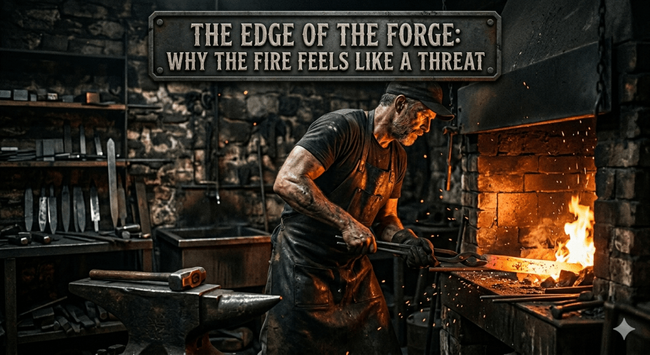
 GeekProjects News