
The Empty Stool at The Anvil

2,171 words, 11 minutes read time.

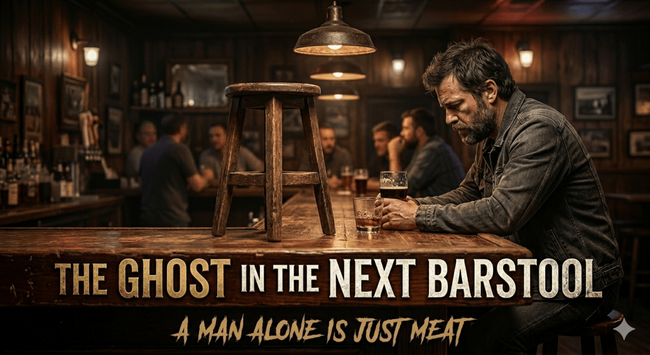
The neon light of the Budweiser sign hummed with a low, electric anxiety that mirrored the vibration in Mark Sullivan’s own chest. He didn’t pull up in his truck this time; he had walked the three blocks from his silent house, the soles of his boots rhythmic against the cracked pavement, a funeral march for one. The air was thick with the scent of damp asphalt and woodsmoke, the kind of night that felt like it was waiting for something to break. He stepped into the familiar musk of The Anvil—hops, floor wax, and the ghosts of a thousand Saturday nights—and instinctively veered toward the far end of the mahogany bar. There were two stools there, tucked into a corner where the shadows were deepest and the noise of the jukebox felt a world away. Mark took his usual spot, but he didn’t slide his jacket over the back of the neighboring chair. He left it bare. He left it open. He sat there with his left shoulder angled slightly toward the void, his head tilted as if waiting for a punchline to a joke that had been cut short six months ago.

Tommy had been the iron to Mark’s rust, a man who didn’t care about your batting average or your golf handicap, but cared deeply about whether you were keeping your word to your family and your God. They hadn’t just been “golf buddies” who traded tips on their backswing; they were the kind of men who knew the exact frequency of each other’s silence. When Tommy’s heart had given out on a Tuesday afternoon—a sudden, violent exit that left no room for goodbyes—a piece of Mark’s world had simply stopped spinning. Now, Mark functioned in a state of arrested development, a man living in a museum of a friendship that no longer breathed. He would catch himself starting a sentence—”You won’t believe what the foreman said today”—only to feel the words turn to ash in his mouth when his eyes met the polished, vacant wood of the stool beside him. He wasn’t delusional; he knew Tommy was six feet under the Georgia clay, but the muscle memory of brotherhood was a hard thing to kill, a phantom limb that still throbbed with every heavy breath.

The bartender, a man named Saul who had seen enough grief to recognize it as a permanent resident, moved with a quiet, heavy efficiency. He didn’t ask questions. He didn’t offer a menu. He simply placed a sweating pint of lager on the bar and followed it with a thick-bottomed shot glass of cheap, stinging whiskey. It was the “Long Shift” special, the same pair Mark and Tommy had ordered every Friday for a decade. Saul lingered for a second, his rag hovering over the mahogany, his eyes offering a bridge that Mark wasn’t ready to cross. Mark just nodded, his jaw tight, his knuckles white as he gripped the cold glass. This was his liturgy, a ritual of remembrance that had slowly morphed into a fortress of isolation. He didn’t want new friends; the very idea felt like a betrayal, a cheap, plastic replacement for a vintage bond forged in the fires of life’s hardest years.

He watched the other men in the bar—the “football buddies” shouting at the overhead screen, their laughter loud and brittle—and felt a cynical, cold distance. They were playing at a game they didn’t understand, trading surface-level banter like it was currency. They had the camaraderie of the scoreboard, but they were terrified of the deep water where Mark was currently drowning. He realized, with a bitter clarity, that if any of those men dropped dead tomorrow, the others would toast a beer, share a story about a touchdown, and find a new person to fill the gap within a week. But Tommy… Tommy was the man who had asked the hard questions, the ones that made Mark sweat and stammer. Tommy was the one who reminded him who he was in Christ when Mark was too busy trying to be a success in the eyes of the world. Now, without that friction, Mark felt himself becoming dull, his edges rounding off into a soft, useless complacency.

As the night deepened and the whiskey began to burn a hole through his defensive layers, the isolation began to do what it does best: it began to lie to him. It whispered that Mark was better off alone, that the pain of loss was the price of admission for being real, and he wasn’t willing to pay it again. He was operating under a self-imposed exile, hiding his weakness behind a mask of “honoring the dead.” But Proverbs 27:17 doesn’t say that iron sharpens itself in memory of a lost blade; it requires the active, present, and often painful friction of another living soul. Mark was becoming brittle, his spirit oxidized by a grief that had turned into an idol of self-reliance. He was holding onto the ghost of Tommy so tightly that he couldn’t reach out to the living, and in the silence of that bar, the enemy of his soul was turning his mourning into a prison. He thought he was being loyal to a memory, but he was actually being a coward, afraid to let another man see the jagged, unhealed edges of his heart.

The shift happened when a man named Caleb—a stranger with hands that looked like they’d spent a lifetime gripping heavy machinery and a face like a topographical map of hard miles—sat down not on the empty stool, but two seats away. He didn’t offer a greeting, and he didn’t look at the television. He just sat there, staring at his own beer with a grim, focused intensity. After twenty minutes of shared silence, Caleb spoke, his voice a low, gravelly rumble that cut through the bar’s ambient noise like a saw through pine. He didn’t ask Mark how he was doing; he didn’t offer a “how ’bout them Dawgs?” He looked at the empty stool, then looked Mark dead in the eye and asked who was supposed to be sitting there. It was a intrusive question, the kind that usually makes a man bristle and reach for his tab to escape the intrusion.

Mark’s first instinct was to snap, to protect the sanctity of his sorrow with a sharp word and a cold stare. But Caleb’s eyes weren’t looking for a fight; they were looking for a brother who was lost in the woods. Caleb told Mark about his own empty chairs, about the men he’d buried in the desert and the mistakes he’d made trying to be a “solitary hero” in the aftermath of the carnage. He spoke of the “Satan’s playground” that is a man’s mind when he decides he no longer needs a tribe, when he decides that his own strength is enough to navigate the darkness. He talked about the Bible not as a book of soft, Sunday-school platitudes, but as a manual for survival in a world that wants to see men isolated, neutralized, and eventually broken. He told Mark that Tommy wouldn’t have wanted a monument of silence; he would have wanted Mark to find another man to strike against, to find the sparks that only come from the collision of two souls.

The stranger didn’t offer a platitude; he offered a challenge that tasted like the whiskey in Mark’s glass—harsh, direct, and necessary. He told Mark that being real meant showing the wound while it was still bleeding, not waiting for the scar to form so you could tell a story about it later. He explained that a man alone is a man who is easily lied to, a man who begins to believe his own excuses and his own pride. As Mark walked back to his house that night, the cold air stinging his lungs, the silence of the streets didn’t feel like a weight anymore; it felt like a space waiting to be filled. He realized that the greatest way to honor the brother he had lost was to become the kind of brother someone else—perhaps even someone in that very bar—desperately needed. He wasn’t leaving Tommy behind; he was carrying the fire Tommy had helped light into a new dark room. He was a man, raw and visceral in his grief, but finally willing to step out of the shadows of the past and back into the forge of the present.

Author’s Note: The 40% Decline

Let’s stop dancing around the wreckage. This story is a mirror, and for many of you, the reflection is ugly. The Lack of Authentic Male Friendships isn’t just a “social hurdle”—it’s a slow-motion spiritual execution. It’s one of the 25 Real Struggles we bury under work, whiskey, and shallow talk while our souls rot in the dark. To be honest, it’s a trench I’m still fighting my way out of.

The world is loud, wired, and completely emotionally bankrupt. It isn’t just Hollywood—it’s the architecture of our entire society. It’s politicians wielding the power of federal and state governments like a hammer against the faithful. We saw the mask slip during COVID: a world where churches were shuttered by decree while strip clubs and liquor stores were deemed “essential.” That isn’t policy; it’s a coordinated assault on the assembly of brothers. Hebrews 10:25 warns us not to give up meeting together—but the state made that habit a mandate. We’ve traded the bone-on-bone friction of brotherhood for the digital anesthesia of a screen.

This isn’t just gut feeling; it’s documented decay. Empathy has plummeted by 40% since the ’70s. People refuse to hear your struggle because your pain is “too expensive for their comfort.” I’ve seen this Empathy Gap in action a thousand times. I’ve watched it in those gut-wrenching videos of unjust policing—where officers stand by like statues while a soul is crushed, and the bystanders stay silent while a man is unjustly prosecuted. It’s a gutless betrayal of the badge by the officer and a gutless betrayal of your neighbor. Proverbs 24:11 commands us to “Rescue those being led away to death; hold back those staggering toward slaughter.” Yet, we stay quiet to stay safe. In America, we have the God-given power of our voice and our vote to smash that silence, and there is hope in men like Matt Thornton who actually have the spine to stand and speak-up against the tide of unjust policing.

But make no mistake: the enemy’s primary tactic is isolation. 1 Peter 5:8 describes the devil as a roaring lion looking for someone to devour. A lion doesn’t attack the pride; he stalks the one that wanders off alone. If he can get you away from the pack, he can work on you.

Look at the Apostle Paul. His hardships weren’t just the prison cells or the religious hit squads; he carried the heavy, haunting history of being the persecutor himself, once leading the very “wolf pack” he later fled. He understood the lethal cost of isolation better than anyone. He didn’t survive his transformation or his ministry as a “lone wolf”; he survived because of a network of brothers who risked their necks to lower him in baskets over city walls.

Then look at Stephen. While Paul stood by holding the coats of the executioners, Stephen stood alone against a mob that had closed its ears to the truth. He was stoned to death for speaking out, but he didn’t die in a vacuum—he died seeing Jesus standing at the right hand of God, a final salute to a soldier who refused to be silent, even as Paul watched from the shadows.

Isolation is Satan’s playground. Proverbs 27:17 isn’t a suggestion; it’s a combat order: “As iron sharpens iron, so one man sharpens another.” Real sharpening is violent. It’s sparks, screaming metal, and the brutal grinding away of everything that makes you dull. If you aren’t clashing with men who love you enough to hurt your pride, you aren’t growing—you’re oxidizing. You’re turning to rust in a world that needs you at your sharpest. Ecclesiastes 4:10 puts it bluntly: “If either of them falls down, one can help the other up. But pity anyone who falls and has no one to help them up.”

Mark Sullivan’s story is a warning. Honoring a ghost or protecting your ego by staying quiet isn’t “steady”—it’s a slow suicide. Being a man of God requires the courage to be truly known. It means finding brothers who will drag you back to the light and remind you who you are in Christ when you’ve forgotten.

Stop settling for the cheap seats and the “football buddies” who don’t know your soul. Find your iron. Get in the forge. A man standing alone is just meat; a man among brothers is a fortress the gates of hell cannot breach.

SUPPORTSUBSCRIBECONTACT ME

D. Bryan King

Disclaimer:

The views and opinions expressed in this post are solely those of the author. The information provided is based on personal research, experience, and understanding of the subject matter at the time of writing. Readers should consult relevant experts or authorities for specific guidance related to their unique situations.

#1Peter58 #AmericanCivilRights #ApostlePaulPrison #authenticMaleFriendships #biblicalBrotherhood #BiblicalLeadership #biblicalMasculinity #brotherhoodOfBelievers #buildingAFortress #ChristCenteredFriendships #ChristianAccountability #ChristianBlogForMen #ChristianCommunity #ChristianGhostwriting #ChristianIntegrity #ChristianMenStruggles #ChristianMenSGroup #ChristianWarrior #churchClosuresCOVID #discipleshipForMen #empathyGap #essentialVsNonEssential #faithAndGrit #faithBasedFiction #findingATribe #garageBrotherhood #gospelTruth #gritLitShortStory #hardboiledChristianFiction #hardeningOfHearts #Hebrews1025 #honestFaith #ironSharpensIron #loneWolfSyndrome #lonelyChristianMan #masculinityAndFaith #MattThorntonPolicing #menOfGod #menSMentalHealth #modernBrotherhood #overcomingIsolation #overcomingPride #Proverbs2717 #religiousFreedom #SatanSPlayground #societalEmpathyDecline #spiritualDiscipline #spiritualEndurance #spiritualIsolation #spiritualSharpening #spiritualSurvival #spiritualWarfareForMen #standingForJustice #StephenTheMartyr #unjustPolicing #visceralChristianWriting #visceralStorytelling #vulnerabilityInMen
The Empty Leaderboard

2,530 words, 13 minutes read time.

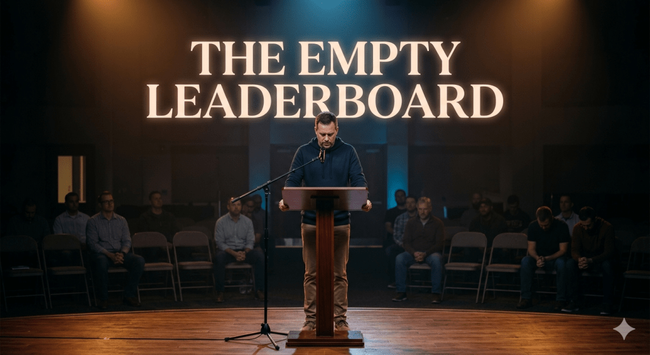
Mark Holloway felt the heat of the stage lights on his neck, but for the first time in his life, it didn’t feel like a spotlight of judgment. It felt like a cleansing fire. He stayed in that embrace with Chris for a long moment—long enough for the silence in the room to turn from awkward to heavy, and finally, to something holy. When he pulled back, he saw that Chris wasn’t the “Lakefront King” he had built him up to be in his mind. Chris looked exhausted. There were dark circles under his eyes that no Instagram filter could have hidden if Mark had been looking for them instead of looking for reasons to feel inferior.

“Mark,” Chris whispered, his voice barely audible over the hum of the cooling fans in the ceiling. “That lake photo? That was the only ten minutes of that entire weekend we weren’t screaming at each other. My oldest son told me he hates me on the drive home. I spent the last three nights sleeping on the couch because I don’t know how to talk to my wife anymore. I saw you walk in every Sunday and I thought, ‘There’s Holloway. He’s got that quiet, steady strength. I wish I was that composed.'”

Mark felt a dry, ironic laugh bubble up in his chest. “We’ve been haunting each other, Chris. We’ve been living in each other’s shadows, and the shadows aren’t even real.”

The pastor, a man named Miller who usually kept a tight grip on the “order of service,” didn’t move toward the microphone. He stayed in the front row, his head bowed, his shoulders shaking slightly. The “program” had officially died, and in its place, something raw was breathing. Mark looked back at the stage—the mahogany lectern, the expensive lighting, the 4K screens. It all looked like cardboard now. It was all just scaffolding for the real work happening on the floor.

Mark turned toward the rest of the men. He didn’t go back to the microphone. He didn’t need the ten thousand watts anymore. “I used to think that being a ‘Man of God’ meant being a man of answers,” he said, his natural voice carrying through the hushed rows. “I thought it meant having the firmest grip and the most certain spirit. But look at us. We’re a room full of experts on things that don’t matter and novices on the things that do. We know the stats of players who don’t know we exist, but we don’t know the fears of the man sitting six inches away from us.”

A man in the back, someone Mark recognized as a high-powered attorney named Steven, stood up. Steven was known for his sharp suits and an even sharper tongue in committee meetings. He wasn’t wearing a suit tonight. He was wearing a faded polo shirt, and he looked smaller than Mark remembered.

“I’ve spent forty thousand dollars on a kitchen remodel I didn’t need because I wanted my brother to be jealous,” Steven said, his voice cracking. “And my daughter hasn’t looked me in the eye in six months because I’m never home to eat in that kitchen. I’m a success in the courtroom and a stranger in my own hallway. I look at all of you and I feel like I’m wearing a costume.”

One by one, the “Holloway Effect” began to ripple through the pews. It wasn’t a landslide; it was a slow, steady breaking of a dam. These weren’t the polished testimonies you hear on a Sunday morning—the ones where the struggle is safely in the past tense and wrapped in a neat bow. These were “present tense” confessions.

Mark sat down on the edge of the stage, his legs dangling over the side. He felt a strange sense of peace watching the hierarchy of the church evaporate. The “Alpha” guys, the “Quiet” guys, the “Success” stories, and the “Struggling” cases were all bleeding into a single, unified color: human.

He thought about his house—the one with the mortgage that felt like a collar around his neck. He thought about the SUV with the French fry in the seat crack. He thought about the regional account he didn’t get. For years, those things had been the metrics of his soul. If the account was up, Mark was up. If the house needed a repair he couldn’t afford, Mark was “broken.” He had tied his identity to a set of moving targets, and he was exhausted from the chase.

“You know,” Mark said, catching the attention of a younger guy in the front row who looked like he was about to bolt for the exit out of sheer vulnerability-overload. “The hardest thing I ever had to do wasn’t admitting I failed. It was admitting that even if I succeeded, it wouldn’t be enough. We’re all trying to fill a canyon with pebbles. We think if we just get a bigger pebble—a faster car, a better title, a more ‘spiritual’ reputation—the hole will go away. But the hole is infinite. And the only thing that fits in an infinite hole is an infinite grace.”

He looked at his hands. They were the hands of a middle-manager. They were soft in some places, calloused in others. They weren’t the hands of a warrior or a titan of industry. They were just Mark’s hands.

“I spent my whole life wanting to be David,” he mused, referring to the biblical king. “But I think I’m actually just one of the guys in the army who was hiding in the trenches because Goliath looked too big. And the irony is, I was hiding from you guys too. I thought if you saw my fear, you’d leave me behind. I didn’t realize you were in the trench next to me, just as terrified, watching me to see if I’d run first.”

The atmosphere in the room had shifted from a “conference” to a “hospital.” The fluorescent hum of the lobby seemed miles away. Here, under the dimming stage lights, there was a sense of heavy, honest brotherhood that Mark had spent forty years looking for and forty seconds finding once he stopped lying.

He stood up again, but this time he walked toward the back of the room. He wanted to get away from the “Main Stage” entirely. He wanted to be on the level ground. He passed David, the man with the truck, who reached out and gripped Mark’s forearm. David didn’t say anything, but the look in his eyes was a silent “thank you.” It was the look of a man who had been given permission to stop holding his breath.

Mark reached the back doors, the heavy oak handles cool to the touch. He turned back one last time to look at the room. The men were no longer sitting in neat rows. They were gathered in small clusters, talking, some with hands on each other’s shoulders, some just sitting in a shared, comfortable silence. The “Leaderboard” was gone. The “Highlight Reel” had been edited down to the raw footage.

“I’m going home,” Mark whispered to himself.

But home didn’t feel like a place he had to perform for anymore. Home was just the next stop on a journey where he didn’t have to be anyone but Mark Holloway. He pushed the doors open, the cool night air hitting him like a physical blessing.

The cool night air was sharp, smelling of rain and the distant scent of pine mulch from the church’s landscaping. Mark stood on the sidewalk for a moment, letting the silence of the parking lot wash over him. The gravel crunched under his feet as he walked toward his SUV—the silver crossover he had spent so many years despising because it wasn’t something else.

As he reached for the door handle, he heard the heavy thud of the sanctuary doors opening behind him. He turned to see Jim, the group leader with the booming charisma, stepping out into the light of the entryway. Jim looked different without the pulpit in front of him. He looked smaller, his shoulders slightly hunched against the chill.

“Mark! Wait up,” Jim called out. He jogged down the concrete steps, his breath blooming in the air like small, white ghosts. When he reached Mark, he didn’t offer a handshake or a pat on the back. He just stood there, looking at the silver SUV.

“I’ve lived in this town for fifteen years,” Jim said softly. “I’ve led this group for five. And tonight was the first time I felt like I wasn’t the only one in the room who didn’t have a clue what he was doing.”

Mark leaned against his car door. “You too, Jim? I figured you had a direct line. You always look like you’ve got the next five years mapped out.”

Jim let out a short, hollow laugh. “Mark, I spend my Tuesday afternoons rehearsing my ‘spontaneous’ prayers in the shower so I don’t sound like an idiot. I stay up until two in the morning wondering if I’m just a professional Christian who’s lost the plot. When you got up there and talked about the leaderboard… I realized I’m the one who built the leaderboard. I thought that was my job. To keep everyone climbing.”

“It’s a long way down,” Mark said, not unkindly.

“It is,” Jim agreed. “But the air is better down here, isn’t it?”

They stood in silence for a minute, two men in a parking lot, no longer defined by their titles or their perceived successes. Jim reached out and squeezed Mark’s shoulder. “See you Sunday, Mark. And hey… don’t worry about the parking spot next to David’s truck. He told me he’s selling it tomorrow. He’s going back to a sedan so he can start paying off his kid’s tuition.”

Mark watched Jim walk to his own car, then he climbed into the driver’s seat of his SUV. He didn’t turn on the radio. He didn’t check his phone for notifications. He just sat in the dark. He reached down and picked up the lone, shriveled French fry from the console—the tiny, greasy monument to his “mediocre” life. He looked at it for a second and then tossed it into the small trash bag hanging from the dash. It was a small act of cleaning, a minor order in the chaos.

The drive home felt shorter than usual. He wasn’t racing the phantom cars of his imagination. He wasn’t rehearsing the speech he’d give his boss to explain why the regional account was better off with the younger guy. He just drove. He noticed the way the streetlights reflected in the puddles, the way the neighborhood houses looked warm and yellow in the dark.

When he pulled into his driveway, he saw the light in the living room was still on. He saw the shadow of his wife, Sarah, moving past the window. Usually, this was the moment the “Mask” went on. He would straighten his posture, wipe the exhaustion from his face, and prepare to be the “Standard-Issue Husband.”

But tonight, Mark Holloway stayed in the car for a moment longer. He looked at his reflection in the rearview mirror. He saw a man who was tired, yes, but he also saw a man who was finally, undeniably real. He thought about his son, Leo, and the bike chain that needed fixing. He thought about the daughter who was becoming a stranger and the wife who deserved to know the man she actually married, not the one he was trying to be.

He opened the garage door, the motor groaning with a familiar, domestic rhythm. He walked through the mudroom, kicking off his sneakers. The house smelled like laundry detergent and the taco seasoning from dinner.

Sarah was on the couch, a book open in her lap. She looked up as he walked in, her eyes searching his face with that intuitive, terrifyingly accurate “wife-radar.”

“How was the meeting?” she asked, her voice soft. “Was it the usual? Coffee and a ‘be a better man’ lecture?”

Mark walked over to the couch. He didn’t stand over her. He sat down on the floor by her feet, leaning his back against the cushions. It was a position of vulnerability, of being “less than” in a way that felt entirely right.

“No,” Mark said, reaching up to take her hand. “It wasn’t that at all. I think… I think I finally quit my job today.”

Sarah’s eyes widened, her hand tensing in his. “The firm? Mark, we can’t—”

“No, not the firm,” he interrupted, turning to look at her. “I quit the other job. The one where I try to be everyone else. I’m just going to be me for a while. Is that okay? It might be a little messy. I might not have the best truck in the lot or the most polished prayer in the room.”

Sarah looked at him for a long beat, her expression softening into something Mark hadn’t seen in years—a look of pure, uncomplicated relief. She reached down and ran her fingers through his thinning hair.

“Mark Holloway,” she whispered. “I’ve been waiting for that guy to come home for a decade.”

Upstairs, a floorboard creaked. Leo was probably awake, sneaking a book under the covers. Tomorrow, there would be bills to pay. Tomorrow, the younger guy would start the regional account. Tomorrow, the world would still be full of leaderboards and highlight reels.

But as Mark sat there on the floor, his wife’s hand in his and the weight of the world finally off his shoulders, he knew he wasn’t afraid of tomorrow anymore. He had found the one thing that no amount of competition could provide: he had been found out, and he was still loved.

The leaderboard was gone. The race was over. And for the first time in his life, Mark Holloway was exactly where he wanted to be. He was home.

Author’s Note

This story is for the man sitting in his driveway with the engine idling, staring at the garage door and wondering when the hell he’s finally going to feel like he’s “arrived.”

We’ve all been sold a lie. We’ve been told that manhood is a ladder, and if you aren’t climbing, you’re suffocating. We walk into our churches, our offices, and our gyms with our chests out and our secrets locked in the basement, terrified that if the guy next to us sees a single dent in our armor, we’re finished. We spend our lives comparing our raw, unedited internal disasters to the polished, high-definition highlight reels of everyone else.

Mark Holloway is the guy in the mirror. He’s the man who realized that the “Leaderboard” he was killing himself to climb was actually a gallows. He finally understood that you can’t be loved if you refuse to be known, and you can’t be known if you’re too busy pretending to be a goddamn superhero.

Stop looking at the guy in the next lane. Stop measuring your worth by the badge on your grille or the title on your door. As it says in Galatians 6:4:

“Each one should test their own actions. Then they can take pride in themselves alone, without comparing themselves to someone else.”

This story is a punch in the mouth to the “Sunday Morning Mask.” It’s a reminder that the most masculine thing you will ever do isn’t winning a fight or closing a deal—it’s having the stones to drop the shield and tell the truth.

The race is a scam, brothers. Step off the track. The only person you’re supposed to outrun is the fake version of yourself you’ve been dragging around for years. Go inside. Be real. Be home.

Call to Action

If this story struck a chord, don’t just scroll on. Join the brotherhood—men learning to build, not borrow, their strength. Subscribe for more stories like this, drop a comment about where you’re growing, or reach out and tell me what you’re working toward. Let’s grow together.

D. Bryan King

Sources

Disclaimer:

The views and opinions expressed in this post are solely those of the author. The information provided is based on personal research, experience, and understanding of the subject matter at the time of writing. Readers should consult relevant experts or authorities for specific guidance related to their unique situations.

#authenticBrotherhood #beingKnown #biblicalManhood #breakingSilence #breakingTheMask #ChristianBrotherhood #ChristianLiving #ChristianMenSFiction #ChristianMenSGroup #ChristianMentalHealth #ChristianResilience #churchBasementStories #churchCommunity #churchCulture #churchFellowship #churchSmallGroups #churchStageStories #competitiveSpirituality #emotionalHonesty #faithAndFamily #faithBasedStorytelling #fatherhoodAndFaith #FatherhoodStruggles #findingSelfWorth #Galatians64 #graceVsPerformance #healingThroughHonesty #heartOverAppearance #honestFaith #identityInChrist #lettingGoOfPride #livingWithoutComparison #maleComparison #maleLoneliness #malePeerPressure #MarkHolloway #menSGroupTopics #menSMinistryResources #mentalHealthAndFaith #mentalHealthForMen #modernChurchStory #modernDiscipleship #modernManStruggles #overcomingInadequacy #redemptionStories #relationalHealth #religiousFiction #religiousMenSStories #religiousShortStories #socialMediaComparison #spiritualBurnout #spiritualFreedom #SpiritualGrowth #spiritualIdentity #theComparisonTrap #TheEmptyLeaderboard #toxicMasculinityInChurch #vulnerabilityAndLeadership #vulnerabilityInMen