Atrocities take place in democratic nations as well as autocratic ones – our database has logged them all | IwPost

Forty years of data suggests atrocities are on the rise globally.

IwPost

USCIRF’s new report links severe religious freedom violations to the risk of genocide and mass atrocities, naming Yazidis, Christians, Muslims, Uyghurs, and Armenians as targets, but notably omitting Pagans, polytheists, and contemporary Pagan traditions.

https://wildhunt.org/2025/09/uscirf-warns-religious-freedom-violations-signal-atrocity-risk-but-omits-pagans-and-polytheists.html

#uscirf #genocideandatrocitiespreventionact #massatrocities #massviolence #religiousfreedom #pagan #religion

Africa: Statement By H.E. Adama Dieng, African Union Special Envoy On the Prevention of Genocide and Other Mass Atrocities, On the 31st Commemoration of the 1994 Genocide Against the Tutsi in Rwanda: [African Union] H.E. Mahmoud Ali Youssouf, Chairperson of the African Union Commission, http://newsfeed.facilit8.network/TK4R3c #GenocidePrevention #RwandaGenocide #AfricanUnion #HEDieng #MassAtrocities
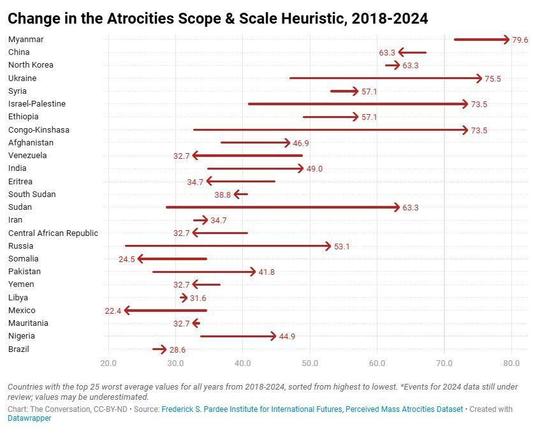
With major conflicts in Africa, the Middle East, Europe and Southeast Asia, 1 in 8 people worldwide were exposed to conflict in 2024. Geopolitical analysts work to objectively assess the extent of humanitarian suffering around the world, with a mass atrocity index. https://theconversation.com/from-myanmar-to-gaza-ukraine-to-sudan-2024-was-another-grim-year-according-to-our-mass-atrocity-index-246294 #HumanRights #MassAtrocities
From Myanmar to Gaza, Ukraine to Sudan – 2024 was another grim year, according to our mass atrocity index

While overall atrocities declined last year, they came down from one of the worst years on record. Meanwhile, a number of areas actually got worse in 2024.

The Conversation
With major conflicts in Africa, the Middle East, Europe and Southeast Asia, 1 in 8 people worldwide were exposed to conflict in 2024. Geopolitical analysts work to objectively assess the extent of humanitarian suffering around the world, with a mass atrocity index: https://theconversation.com/from-myanmar-to-gaza-ukraine-to-sudan-2024-was-another-grim-year-according-to-our-mass-atrocity-index-246294 #HumanRights #MassAtrocities
From Myanmar to Gaza, Ukraine to Sudan – 2024 was another grim year, according to our mass atrocity index

While overall atrocities declined last year, they came down from one of the worst years on record. Meanwhile, a number of areas actually got worse in 2024.

The Conversation
I’ve linked to this resource before. Part III deals specifically with museums and their potential to foster #HistoricalDialogue and prevent #MassAtrocities. https://www.routledge.com/Historical-Dialogue-and-the-Prevention-of-Mass-Atrocities/Barkan-Goschler-Waller/p/book/9781032336756
Historical Dialogue and the Prevention of Mass Atrocities

This book brings together a diverse range of international voices from academia, policymaking and civil society to address the failure to connect historical dialogue with atrocity prevention discourse and provide insight into how conflict histories and historical memory act as dynamic forces, actively facilitating or deterring current and future conflict. Established on a variety of international case studies combining theoretical and practical points of view, the book envisions an integrated un

Routledge & CRC Press

'We are seeing urgent signs of more mutual #MassAtrocities to come in #Israel and #Gaza

There is little chance that the spiral of killing will subside. The international community must work to prevent further death'
https://www.theguardian.com/commentisfree/2023/oct/20/urgent-signs-mutual-mass-atrocities-israel-gaza-war
#WarCrimes #Palestine #OPT

We are seeing urgent signs of more mutual mass atrocities to come in Israel and Gaza

There is little chance that the spiral of killing will subside. The international community must work to prevent further death

The Guardian
Super interesting #OpenAccess article by Iva Vukusic (Utrecht University) on “Archives of Mass Violence: Understanding and Using #ICTY Trial Records” https://www.degruyter.com/document/doi/10.1515/soeu-2021-0050/html #history #InternationalTribunals #InternationalCriminalLaw #InternationalLaw #ICL #Memory #MassAtrocities #Academia
Archives of Mass Violence: Understanding and Using ICTY Trial Records

The most relevant collection for studying the wars accompanying the breakup of Yugoslavia, which resulted in over 130,000 dead or missing, is the archive of the International Criminal Tribunal for the Former Yugoslavia (ICTY) in The Hague. The Tribunal established by the UN Security Council in 1993 to prosecute genocide, crimes against humanity, and war crimes indicted 161 people and had accumulated millions of pages of testimony, military and police reports, and videos when it closed in late 2017. This invaluable record details the massacres and includes well-known incidents, such as the mass executions after the fall of Srebrenica, but also killings and torture elsewhere in the former Yugoslavia. This article investigates the history of this archive, analyzes its contents, and argues that the collection has two important features which present both a huge opportunity and a significant challenge for research—the immense volume of the archive, and a lack of access to important parts of it.

De Gruyter