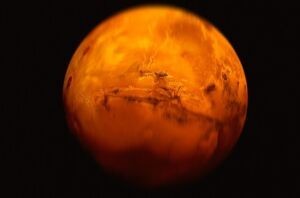
Seismic evidence for a highly heterogeneous martian mantle: https://hal.science/hal-05228766v1 -> NASA #Marsquake Data Reveals Lumpy Nature of Red Planet’s Interior: https://www.nasa.gov/missions/insight/nasa-marsquake-data-reveals-lumpy-nature-of-red-planets-interior/
Seismic evidence for a highly heterogeneous martian mantle

A planet’s interior is a time capsule, preserving clues to its early history. We report the discovery of kilometer-scale heterogeneities throughout Mars’ mantle, detected seismically through pronounced wavefront distortion of energy arriving from deeply probing marsquakes. These heterogeneities, likely remnants of the planet’s formation, imply a mantle that has undergone limited mixing driven by sluggish convection. Their size and survival constrain Mars’ poorly known mantle rheology, indicating a high viscosity of 10 21.3 to 10 21.9 pascal-seconds and low temperature dependence, with an effective activation energy of 70 to 90 kilojoules per mole, suggesting a mantle deforming by dislocation creep. The limited mixing, coupled with ubiquitous, scale-invariant heterogeneities, reflects a highly disordered mantle, characteristic of the more primitive interior evolution of a single-plate planet, contrasting sharply with the tectonically active Earth.

Most monstrous marsquake ever reveals where it came from

A seismic event that looked like an impact, but no craters to be seen.

Ars Technica

“The Big One”: The Most Powerful #Marsquake Ever Detected
https://www.seti.org/big-one-most-powerful-marsquake-ever-detected

The ground shakes. Paintings tilt. Walls crack. Rubble may fall. On Earth, we understand how and where these events happen due to the discovery of plate tectonics – the continental crust’s creation, movement, and destruction. A new paper explains how the largest recorded seismic event on Mars provided evidence for a different sort of tectonic origin — the release of stress within the Martian crust.

#mars #scicomm

“The Big One”: The Most Powerful Marsquake Ever Detected

The ground shakes. Paintings tilt. Walls crack. Rubble may fall. On Earth, we understand how and where these events happen due to the discovery of plate tectonics – the continental crust’s creation, movement, and destruction. However, when astronauts placed seismometers on the lunar surface during NASA’s Apollo mission era, those instruments recorded quakes on the Moon.

SETI Institute

A new paper in Geophysical Research Letters explains how the largest recorded seismic event on Mars provided evidence for a different sort of tectonic origin — the release of stress within the Martian crust.

My first story with @universetoday !

https://universetoday.com/163852/the-big-one-the-most-powerful-marsquake-ever-detected/

#mars #marsquake #science #scicomm

"The Big One": The Most Powerful Marsquake Ever Detected

The largest recorded seismic event on Mars provided evidence for the release of stress within the Martian crust.

Universe Today

According to #NASA a #Marsquake occurred on 4 May 2022. The #quake occurred hours after the planet was in conjunction with #Mercury and #Venus. Our statistics confirm the combination of these two planets also as an #earthquake trigger for #Earth.

https://www.nasaspaceflight.com/2023/10/s1222a-origins/

Through international collaboration, scientists find cause of InSight’s most powerful Marsquake - NASASpaceFlight.com

An international team of scientists has found the cause of the largest Martian seismic event,…

NASASpaceFlight.com
Through international collaboration, scientists find cause of InSight’s most powerful Marsquake https://www.nasaspaceflight.com/2023/10/s1222a-origins/ #elysiumplanitia #marsexpress #marsquake #tianwen-1 #featured #insight #science #s1222a #other #uaesa #cnsa #hope #isro #mars #nasa #esa
Through international collaboration, scientists find cause of InSight’s most powerful Marsquake - NASASpaceFlight.com

An international team of scientists has found the cause of the largest Martian seismic event,…

NASASpaceFlight.com

A strong "#Marsquake" measured by a #NASA spacecraft likely comes from some kind of internal activity on the planet. Scientists investigated the strongest #quake measured by the #InSight #Mars lander during its mission, a magnitude 4.7 event that had more seismic energy than all the other quakes InSight measured combined. Scientists now believe it was some kind of tectonic event within the planet at levels much stronger than previously expected.

https://www.scientificamerican.com/article/monster-quake-hints-at-mysterious-source-within-mars/

‘Monster Quake’ Hints at Mysterious Source within Mars

Images from each and every spacecraft now orbiting Mars have ruled out a meteorite strike as the cause of a 4.7-magnitude marsquake, the strongest temblor ever detected beyond Earth

Scientific American
Scientists Puzzled by Sudden, Super-Loud Rumble Inside Mars

A record shattering tremor on Mars still has scientists uncertain on its origin, after new research ruled out a meteoroid impact.

Futurism

"A quake on Mars showed its crust is thicker than Earth’s

Planetary scientists now know how thick the Martian crust is, thanks to the strongest Marsquake ever observed.

On average, the crust is between 42 and 56 kilometers thick, researchers report in a paper to appear in Geophysical Research Letters. That’s roughly 70 percent thicker than the average continental crust on Earth.

(...)

Knowing the crust’s depth, the team also calculated that much of Mars’ internal heat probably originates in the crust. Most of this heat comes from radioactive elements such as potassium, uranium and thorium. An estimated 50 to 70 percent of those elements are probably in the crust rather than the underlying mantle, computer simulations suggest. That supports the idea that parts of Mars still have volcanic activity, contrary to a long-held belief that the Red Planet is dead"

🔗: https://www.sciencenews.org/article/mars-quake-crust-thickness-earth

#Mars #NASA #Insight #lander #MarsQuake #Science #space

A quake on Mars showed its crust is thicker than Earth's

Seismic data from NASA’s Insight lander reveal the crust is roughly 50 kilometers thick, with the northern crust being thinner than the south’s.

Science News
Mars Has a Thick Crust. Its Internal Heat Mainly Comes from Radioactivity
How thick is the crust of Mars? This question is what a recent study published in Geophysical Research Letters attempted to answer as it reported on data from a magnitude 4.7 marsquake recorded in May 2022 by NASA’s InSight lander, which remains the largest quake ever recorded on another planetary body.
https://www.universetoday.com/161460/mars-has-a-thick-crust-its-internal-heat-mainly-comes-from-radioactivity/ #mars #crust #radioactivity #marsquake
Mars Has a Thick Crust. Its Internal Heat Mainly Comes from Radioactivity

How thick is the crust of Mars? This question is what a recent study published in Geophysical Research Letters attempted to answer as it reported on data from a magnitude 4.7 marsquake recorded in May 2022 by NASA’s InSight lander, which remains the largest quake ever recorded on another planetary body. As it turns out, … Continue reading "Mars Has a Thick Crust. Its Internal Heat Mainly Comes from Radioactivity"

Universe Today