 Andy Arthur - Threadinburgh
The thread about Sciennes; how you pronounce it, where the name comes from and its important moment in Scottish literary history
This thread was originally written and published in February 2020.
There was some chat the other week about place names that were so unapparent in their pronunciation that they were the shibboleth of the real local. One which kept coming up for Edinburgh was Sciennes. First things first, it is Sciennes; as in Sheens; as in Machine; as in Rise of the Machines. The name comes directly from St. Catherine of Siena, a convent in her honour being established in the locality in 1517. In Scots, Siena was Seynis or Schiennes. From there it’s a short leap to the modern Sciennes, but the pronunciation has remained true to the original local form.
St. Catherine of Siena, by Giovanni Battista TiepoloThe convent occupied a 2 acre site and was surrounded by an enormous wall, some 13 feet high. The land had been fued off the Burgh Muir (common moor land owned by the city) to the Canon of St. Giles in 1513, who founded a chapel and hermitage to St. John before giving it to the Sisters.
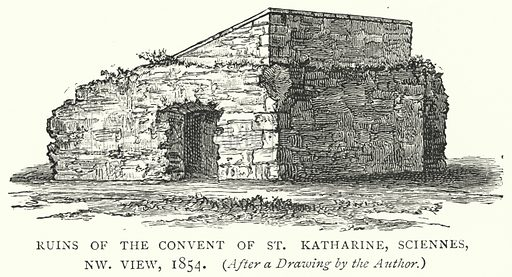
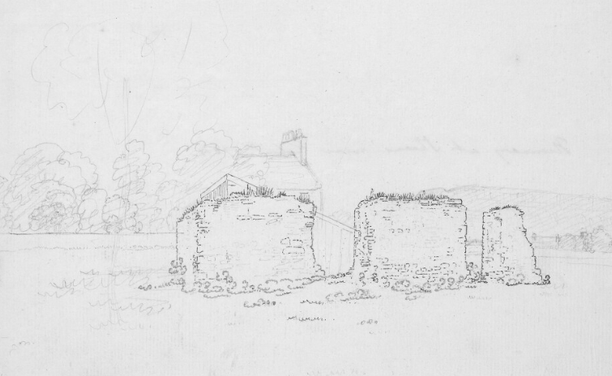
The ruins of Sciennes convent, from Old & New Edinburgh by James Grant. Probably in use as a barn at this time.Another view of the same ruins, looking north east towards Salisbury Crags in the distance. From the Hutton Drawings, vol. 2, CC-BY-SA 4.0 National Library of ScotlandGiven the location of the convent some 1,000m outside of the city walls (hence the big defensive enclosure) it is consistently missed off of all the older town plans and it’s not until Kirkwood’s plan of 1817 that it makes an appearance. We can see an old rendition of Scienes and the reference to Siena. The designation as a monastery is a mistake.
Kirkwood’s 1817 Town Plan. Reproduced with the permission of the National Library of ScotlandNotice the 2 arrows in the above map and notice that they correspond to two obvious kinks in the modern street layouts. These mark the turn of the boundary wall of the convent – I have found a good rule of thumbs when looking at old streets in Edinburgh which is that if there is a bend or kink in an otherwise straight road that seems to serve no apparent purpose, there’s a very good chance that it respects the alignment of an even older property boundary. See this thread for instance. Or this one!
Kirkwood’s 1817 Town Plan. Reproduced with the permission of the National Library of ScotlandThe presence of the convent also explains why Sciennes Street (marked in green below and now known as just Sciennes) splits off at a very shallow angle from Causewayside (red arrow) . Until the early 19th century one of the two main road south east out of the city – leaving that odd gushet formed by Lord Russell Place; it was the alignment of the original footpath to the convent from St. Giles to the north.
Ainslie’s 1804 Town Plan. Reproduced with the permission of the National Library of ScotlandAfter the quagmire of the Boroughloch began to be drained in the 18th century and the Meadows began to be laid out as a pleasant, formal park, some of the rich of the city built large villas along the southern edge. A roadway formed at the back of the plots to give coach access, meeting the old route to the convent at its eastern extremity.
Ainslie’s own Plan of 1804, showing the villa plots along the south of the Meadows. Reproduced with the permission of the National Library of ScotlandAnd at this junction stood a place called Sciennes Hill House. This building isn’t actually on a hill as such, but when entering the city from Causewayside it is at the top of the ascending grade from the south. The Scottish philosopher and historian of the Enlightenment, Professor Adam Ferguson of Raith, lived here at the end of the 18th century. His property was ¾ miles from the city walls at the Bristo Port and so his friends took to jokingly calling it Kamchatka on account of its perceived remoteness.
Adam Ferguson in 1781, by Sir Joshua Reynolds.The National Gallery has the below sketch of the house and notes a soiree which took place there in 1786 that was attended by a young Walter Scott, Robert Burns, Dugald Stewart, Joseph Black, James Hutton and John Home! One can only imagine how inadequate you’d feel, staring into your tea, sitting round a table while that lot had a debate! This was both the first and last time that the young Scott met Burns and it was a formative experience for the former, then just 15 years old.
Sciennes Hill House. CC-by-NC National Galleries ScotlandBy this time Sciennes was a well-established place name and had given its name to that lane along the back of the big villas, as Sciennes Road, to Sciennes Hill House, to Sciennes House Place and Sciennes Hill Place. And what became of the house itself? Well, believe it or not, it’s actually still there, hiding in plain sight, even if you look straight at it. Its clever disguise is that the back of the house is now the street façade, and the house has been subdivided and reconstructed into what looks from the street to be an unremarkable tenement.
But when you look at it again when armed with the facts, suddenly things begin to look incongruous. That rubble finish doesn’t quite look Victorian, that stair door is out of alignment, and the vertical spacing of the windows is well out with its neighbours.
The rear of Sciennes Hill House is now the front.Oh and those plaques are a bit of a give away too…
Plaque on Sciennes Hill House. CC-BY-SA 3.0 Kim TraynorAnd if you can get around the back, this ain’t your usual finish for a tenement back green! It’s quite obviously the (restored) façade of an altogether different and grander Georgian house.
The original (restored) facade of Sciennes Hill House. CC-BY-SA 2.0 Kim TraynorThe rear of the building was restored in 1989 (there are pictures of it here just prior to this) and given the much quite regular appearance above. In the old engraving below it can be clearly seen where the original doorway and portico was, at 1st floor level, by the gap in the horizontal bands of masonry and window spacing.
Sciennes Hill House in 1891, from “The Literary Landmarks of Edinburgh”in Harper’s New Monthly Magazine.St. Catherine of Siena lent her name to one other street in the neighbourhood, that of St. Catherine Place, a street of grand Victorian semi-detached villas on the boundary with The Grange. For some reason though, when Bertrams Ltd. built a large factory in Sciennes, they went for a different spelling and we got the St. Katherine’s Works. Bertrams were ironfounders and engineers, specialising in roller machines for papermaking and printing.
Bertram’s St. Katherine’s Works. Note the malt kiln cupola to the right of the large chimney, from the West Sciennes Distillery. © Edinburgh City LibrariesBertram’s were a very successful company in their time, with a foundry in Gorgie at Westfield and also one in London – another St. Katherine’s Works – to serve the newspaper industry. Sadly the Sciennes works burned down in 1983 at what was a difficult time for the company, with the Scottish print and papermaking industries in terminal decline. The whole company was gone by 1985 and when new housing was built on the site later it was appropriately named Siena Gardens.
https://www.flickr.com/photos/maleny_steve/42942242202
Sciennes of course also gives its name to the local school (I am typing to you from an old teacher’s desk of that establishment, recovered from a skip). I recall the first time I saw the name, written on an Edinburgh schools football league fixtures sheet about 30-odd years ago and yes I too did imagine it was pronounced Scy-ens.
There’s one more “place” in Sciennes that’s been lost to time, which is the romantic sounding Glen Sciennes. Indeed it’s a place that never even existed anywhere but on paper as a faux-Highland brand name for the spirit from a distillery in the district belonging to Thomas Duncanson & Co. It was being advertised in the London papers in 1854 but the firm went bankrupt in 1859, so Glen Sciennes had a life span of only five years. After this the distillery ran through a number of other names; the Newington Distillery, the West Sciennes Distillery; the Edinburgh Distillery before closing in 1925 by which time it was the last malt distillery in the city. The buildings were incorporated into Bertram’s works.
1850s Post Office Directory entry for the Glen Sciennes distillery.I don’t know of any contemporary illustrations of the Sciennes distillery, but a William Channing sketch of 1852 of Sciennes Court – where the Sienna Gardens student flats are these days – shows its chimney in the background.
Sciennes Court, 1852 by William Channing © Edinburgh City LibrariesAlways be on the lookout for unexplained kinks in old streets or buildings that feel a bit out of place; if you dig into them a little bit you might find out more local history than you bargained for!
Note to readers: unfortunately in April 2026, a third-party plug-in more than exceeded its authority and broke many of the image links on this site. No images were lost but I will have to restore them page-by-page, which may take some time. In the meantime please bear with me while I go about rectifying this issue.
If you have found this site useful, informative or amusing then you can help contribute towards its running costs by supporting me on ko-fi. This includes my commitment to keeping it 100% advert and AI free for all time coming, and in helping to find further unusual stories to bring you by acquiring books and paying for research.
Or please do just share this post on social media or amongst friends and like-minded people, sites like this thrive on being shared.
Explore Threadinburgh by map:
Travelers' Map is loading...If you see this after your page is loaded completely, leafletJS files are missing.
These threads © 2017-2026, Andy Arthur.
NO AI TRAINING: Any use of the contents of this website to “train” generative artificial intelligence (AI) technologies to generate text is expressly prohibited. The author reserves all rights to license uses of this work for generative AI training and development of machine learning language models.
#Lochend #Logan #Restalrig #StMargaret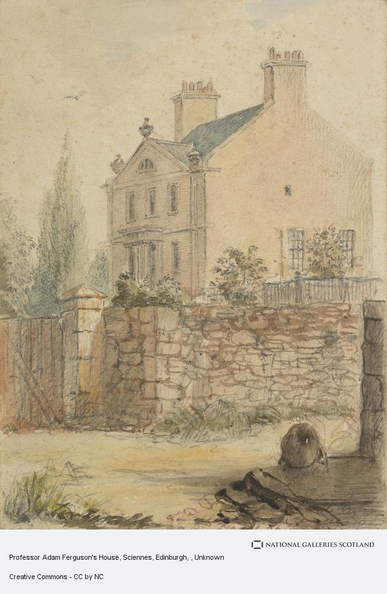

 dave cykl
 LordWoolamaloo

 Jimmy Angelakos

 ABS
ABS