The Long Now of the Web: Inside the Internet Archive’s Fight Against Forgetting – HackerNoon
New Story, 1,290 reads
The Long Now of the Web: Inside the Internet Archive’s Fight Against Forgetting
by Bruce Li, January 12th, 2026
A Comprehensive Engineering and Operational Analysis of the Internet Archive
Introduction: The Hum of History in the Fog
If you stand quietly in the nave of the former Christian Science church on Funston Avenue in San Francisco’s Richmond District, you can hear the sound of the internet breathing. It is not the chaotic screech of a dial-up modem or the ping of a notification, but a steady, industrial hum—a low-frequency thrum generated by hundreds of spinning hard drives and the high-velocity fans that cool them. This is the headquarters of the Internet Archive, a non-profit library that has taken on the Sisyphean task of recording the entire digital history of human civilization.
Internet Archive’s office in San Francisco
Here, amidst the repurposed neoclassical columns and wooden pews of a building constructed to worship a different kind of permanence, lies the physical manifestation of the “virtual” world. We tend to think of the internet as an ethereal cloud, a place without geography or mass. But in this building, the internet has weight. It has heat. It requires electricity, maintenance, and a constant battle against the second law of thermodynamics. As of late 2025, this machine—collectively known as the Wayback Machine—has archived over one trillion web pages.1 It holds 99 petabytes of unique data, a number that expands to over 212 petabytes when accounting for backups and redundancy.3
The scale of the operation is staggering, but the engineering challenge is even deeper. How do you build a machine that can ingest the sprawling, dynamic, and ever-changing World Wide Web in real-time? How do you store that data for centuries when the average hard drive lasts only a few years? And perhaps most critically, how do you pay for the electricity, the bandwidth, and the legal defense funds required to keep the lights on in an era where copyright law and digital preservation are locked in a high-stakes collision?
This report delves into the mechanics of the Internet Archive with the precision of a teardown. We will strip back the chassis to examine the custom-built PetaBox servers that heat the building without air conditioning. We will trace the evolution of the web crawlers—from the early tape-based dumps of Alexa Internet to the sophisticated browser-based bots of 2025. We will analyze the financial ledger of this non-profit giant, exploring how it survives on a budget that is a rounding error for its Silicon Valley neighbors. And finally, we will look to the future, where the “Decentralized Web” (DWeb) promises to fragment the Archive into a million pieces to ensure it can never be destroyed.5
To understand the Archive is to understand the physical reality of digital memory. It is a story of 20,000 hard drives, 45 miles of cabling, and a vision that began in 1996 with a simple, audacious goal: “Universal Access to All Knowledge”.7
Part I: The Thermodynamics of Memory
The PetaBox Architecture: Engineering for Density and Heat
The heart of the Internet Archive is the PetaBox, a storage server custom-designed by the Archive’s staff to solve a specific problem: storing massive amounts of data with minimal power consumption and heat generation. In the early 2000s, off-the-shelf enterprise storage solutions from giants like EMC or NetApp were prohibitively expensive and power-hungry. They were designed for high-speed transactional data—like banking systems or stock exchanges—where milliseconds of latency matter. Archival storage, however, has different requirements. It needs to be dense, cheap, and low-power.
Brewster Kahle, founder of Internet Archive (with the PetaBox behind him)
Brewster Kahle, the Archive’s founder and a computer engineer who had previously founded the supercomputer company Thinking Machines, approached the problem with a different philosophy. Instead of high-performance RAID arrays, the Archive built the PetaBox using consumer-grade parts. The design philosophy was radical for its time: use “Just a Bunch of Disks” (JBOD) rather than expensive RAID controllers, and handle data redundancy via software rather than hardware.
Editor’s Note: Read the rest of the story, at the below link.
Continue/Read Original Article Here: The Long Now of the Web: Inside the Internet Archive’s Fight Against Forgetting | HackerNoon
Tags:
Architecture,
Brewster Kahle,
California,
Fight Against Forgetting,
HackerNoon,
Internet Archive,
Long Now,
Memory,
PetaBox,
San Francisco,
Storage,
World Wide Web,
WWW
#Architecture #BrewsterKahle #California #FightAgainstForgetting #HackerNoon #InternetArchive #LongNow #Memory #PetaBox #SanFrancisco #Storage #WorldWideWeb #WWW zenkat
 Brian Sletten
 Matthias MProve
 Hacker News
 DrWeb
DrWeb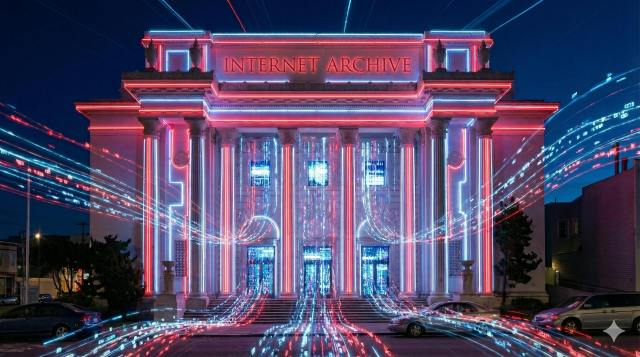
 Jack
Jack
 Rebecca
 Steven Sandoval
 Jon Udell
 Jon Udell