 grgr
grgr Simple DIY Electronic Music Projects
When I’m looking around for an off-the-shelf module to do something I can sometimes be a little guilty of seeing a range of cheap implementations and just getting one of each to have a go with them, rather than research them first.
Small, cheap amplifiers was one such set or purchases a while back, so I thought it might be useful to compare the specs of what I have and see how they get on.
Warning! I strongly recommend using old or second hand equipment for your experiments. I am not responsible for any damage to expensive instruments!
If you are new to electronics, see the Getting Started pages.
The Modules
These are the modules I have. Pretty much all of them are available online for <£few.
My basic requirement is a mono, relatively low-level signal, up to line-level voltages, and direct output to loudspeakers. Volume control is optional, but powered by 12V or less, 5V as a bonus.
Doesn’t need to be particularly high powered, but just a useful volume for personal use in a household room.
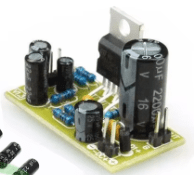
TDA2030A Amplifier
- TDA2030A (now obsolete).
- DC 6-12V power.
- Mono 18W.
- Peak output current: 3A.
- Trim pot for gain/volume.
- 4Ω or 8Ω direct speaker connection.
- Pre-built modules or kits available.
More information:
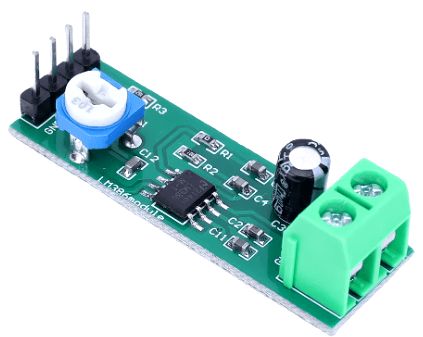
LM386 Amplifier Module
- LM386.
- DC 4-12V power.
- Mono 325mW.
- Adjustable volume.
- Default 200x fixed gain, can be set to 20x by removing a resistor.
- Pre-build module.
- 4Ω to 32Ω direct speaker connection.
More information:
PAM8402 Stereo Amp
- PAM8403.
- DC 2.5-5.5V power.
- Stereo 3W.
- Some versions with volume pot.
- Pre-built PCBs.
- 4Ω or 8Ω direct speaker connection.
More information:
LM358 Amp Kit
- LM358.
- DC 5-16V power.
- Mono.
- Volume control.
- Direct speaker connection.
- Kit.
More Information:
NE3352P Stereo Pre-amp
- NE3352P OpAmp.
- DC 9-15V power.
- Pre-build module.
This appears to have three wires for power, so might require a dual power supply. Very little information appears online about it, but the above design seems to be a “diymore” design.
AD828 Stereo Pre-amp
- AD828 Dual low-power video op-amp.
- DC 5-15V power.
- Stereo.
- R2/R5 resistors can be changed to adjust gain (default is x5).
- Pre-amp only.
- Pre-built module.
More information:
Closing Thoughts
This post isn’t about comparing or reporting results. In truth, I’ve not used any of them in anger at present, but it was more to get them onto a single page for direct comparison after having a bit of an initial play.
Of course, if you browse any online marketplace you will find hundreds of different designs with varying specs, quality and price.
With hindsight, for most of my applications I’m going to be wanting an amplifier rather than a pre-amp, so that will almost certainly bias my own usage towards those.
But for my purposes I think I’m probably looking at the PAM8403 based modules – with or without a pot. They are just so cheap and pretty versatile and can be powered from 5V.
But the LM386 is another useful, cheap module too with a wide range of power supply. The TDA2030A is probably just as good though if I’m using a larger voltage for power.
But all of them can drive 4Ω or 8Ω speakers, so really I would probably be fine with any of them.
Kevin
https://diyelectromusic.com/2024/10/18/cheap-mini-amplifiers/
 Techrm

 GeekProjects News