Press Release #1!

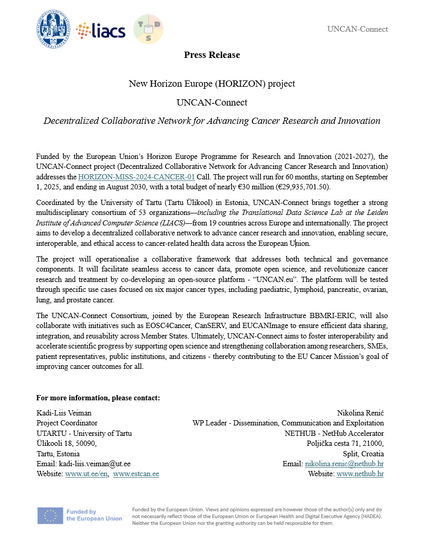
Funded by the European Unionโ€™s Horizon Europe Programme for Research and Innovation (2021-2027), the UNCAN-Connect project (Decentralized Collaborative Network for Advancing Cancer Research and Innovation) addresses the HORIZON-MISS-2024-CANCER-01 Call. The โ‚ฌ30 million project will start on Sept 1, 2025, and is coordinated by the University of Tartu in Estonia. UNCAN-Connect brings together a strong multidisciplinary consortium of 53 organizationsm, including #tdslab #liacs ๐Ÿ‘

https://gamma.app/docs/Jaaroverzicht-Cairelab-2024-Bijlage-z2i9dmpv9jd4q3d?mode=doc#card-266r0qpek6kwhik

Here's a nice 2024 overview (in Dutch) of the Clinical AI work performed at the #tdslab that intersects the #HealthCampusDenHaag and #liacs departments on Population Health research from the Clinical AI Research and Implementation Lab (CAIReLab)'s perspective.

Why do we bond with 'others'? Could one of the factors be simply a matter of sharing space, time and experiences? Check out our in-the-wild study with couch-surfing robots, and also learn how it relates to the 'intentional stance'. Lead researcher Joost Mollen (Leiden University, now at TU Delft), joint work with Kate Darling (MIT Media Lab). #robot #hri #thri #liacs https://dl.acm.org/doi/10.1145/3563702
Bonding with a Couchsurfing Robot: The Impact of Common Locus on Human-Robot Bonding In-the-Wild | ACM Transactions on Human-Robot Interaction

Due to an increased presence of robots in human-inhabited environments, we observe a growing body of examples in which humans show behavior that is indicative of strong social engagement towards robots that do not possess any life-like realism in ...

ACM Transactions on Human-Robot Interaction