There was a Sentinel-1 scene capture some hours after the Vanuatu earthquake yesterday, so I went to create an interferogram using ASF's on-demand Vertex service from an image pair (2024-12-05 to 2024-12-17). Estimates range from about 5cm of subsidence to 10cm of uplift.

Processed InSAR product files can be downloaded from
https://d3gm2hf49xd6jj.cloudfront.net/c03a1054-506b-4405-a7a8-7087dd0626ab/S1AA_20241205T071348_20241217T071347_VVR012_INT40_G_weF_D415.zip (expires in 14 days). See https://hyp3-docs.asf.alaska.edu/guides/insar_product_guide/#image-files for details on what each file refers to.

#Vanuatu #Earthquake #InSAR #interferogram #displacement

Open Source спутниковая интерферометрия PyGMTSAR (Python InSAR)

С тех пор, как я рассказывал на хабре про мой открытый проект спутниковой интерферометрии PyGMTSAR (Python InSAR библиотека) для обработки и анализа радарных данных спутников Sentinel-1, прошло много времени и сегодня PyGMTSAR представляет собой наиболее мощный инструмент среди всех открытых InSAR. Притом, PyGMTSAR действительно общедоступен, поскольку не требует скачивать огромные данные, устанавливать программное обеспечение и так далее — достаточно просто открыть ссылки на Google Colab в браузере и посмотреть и запустить готовые примеры или адаптировать их для своей территории и области интереса. Предлагаемые Google Colab примеры включают в себя создание отдельных интерферограмм для анализа результатов сейсмических событий (землетрясений) и наводнений, создание рельефа, анализ серий интерферограмм для мониторинга оползней и проседаний грунта. И все эти возможности доступны в один клик онлайн на Google Colab и в Docker контейнерах. Для профессионалов предоставляется полностью программируемая среда для выполнения InSAR задач и интерактивной 3D визуализации, доступная на Google Colab, в Docker контейнерах, на GitHub Action runners, и, конечно, на локальных компьютерах и на облачных хостах.

https://habr.com/ru/articles/800939/

#PyGMTSAR #InSAR #Python #Sentinel1 #Open_Source #DEM #Interferogram #SBAS #PS #PSI
Open Source спутниковая интерферометрия PyGMTSAR (Python InSAR)

С тех пор, как я рассказывал на хабре про мой открытый проект спутниковой интерферометрии PyGMTSAR (Python InSAR библиотека) для обработки и анализа радарных данных спутников Sentinel-1, прошло много...

Хабр

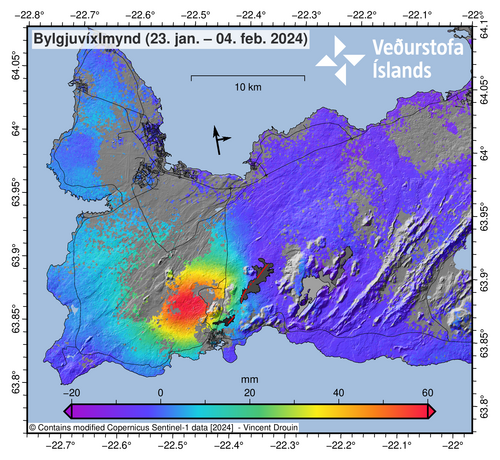
We now estimate that 9 million m³ of magma have accumulated near Svartsengi since last eruption. This is based on modeling with both #InSAR and #GNSS data.

During the previous eruption the volume loss from the same reservoir is estimated at 9-13 million m³. Image is #sentinel1 unwrapped #interferogram covering 23 Jan – 4 Feb.

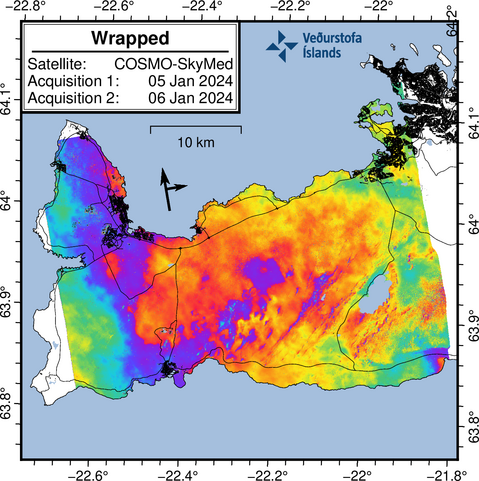
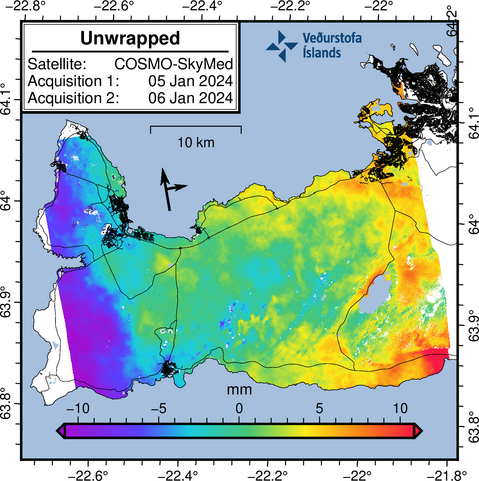
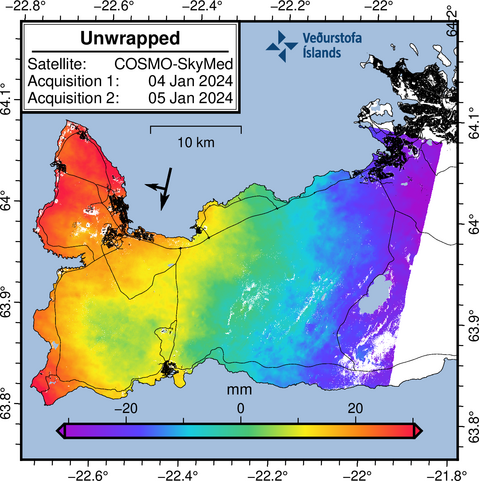
The rate of inflation at #Svatsengi has now decreased enough so it cannot be seen on these pair of 24 hr. Interferograms from COSMO-SkyMed.

#InSAR #interferogram #SAR #Reykjanes #CSK

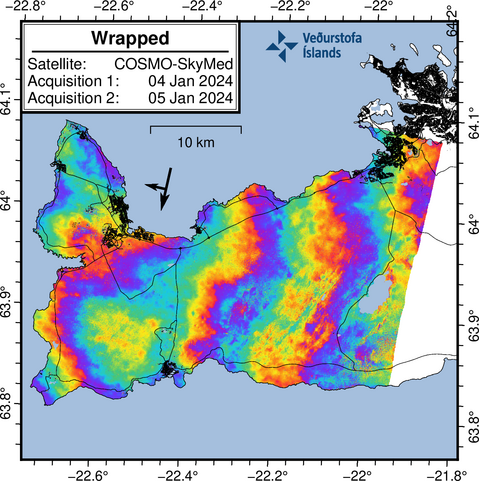
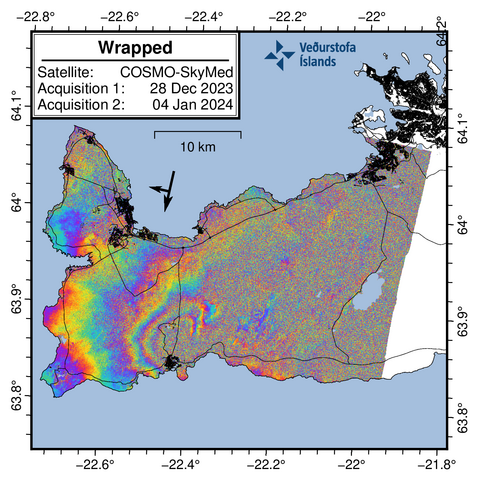
This is our lates #interferogram image for #Reykjanes peninsula spanning a week of inflation up to December 4 acquired by COSMO-SkyMed 🇮🇹 There are large areas with little coherence causing the noisy result. This is most likely caused by snow-cover. Soon we might get images from SAOCOM satellite constellation (Argentina's space agency 🇦🇷 ) that has L-band capabilities that might perform better in lightly snow-covered areas? Any insight from #InSAR people?

Reykjanes peninsula unrest developments 🔔

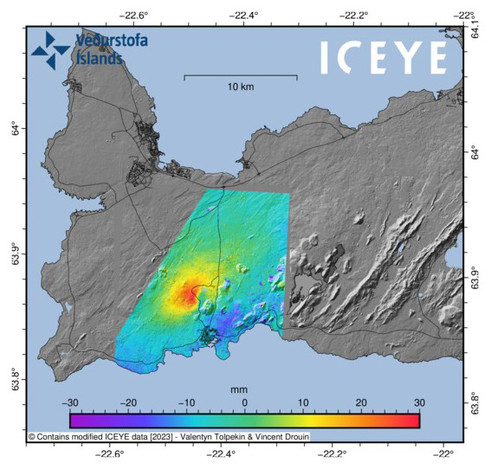
We now see clear signs of surface deformation. A recent 24hr. #interferogram based on data from our friends at #ICEYE shows inflation. Signal is centered around the Blue Lagoon (tourist attraction) and a geothermal power plant. We have seen inflation at this location before on 3 separate occasions before the first eruption at Fagradalsfjall. Earthquae activity is now clearly decreasing. More info: https://en.vedur.is/about-imo/news/a-seismic-swarm-started-north-of-grindavik-last-night

#earthquake #insar #Iceland

Magma volume beneath Svartsengi reaching similar level as prior to last eruptions | News | Icelandic Meteorological office

Icelandic Meteorological office

"New #radar #interferogram of #MaunaLoa eruption shows deformation thought Dec. 2 at 6:13 AM HST. Deflation of overall volcano by ~50 cm (20 in) with uplift/spreading along summit caldera axis and NE Rift Zone. Thanks to @ASI_spazio for access to COSMO-Skymed data!"
"The legend to the original figure contains a typo -- this version of the figure corrects that mistake. Apologies!"

#MaunaLoaEruption #MaunaLoaErupts #Hawaii
https://twitter.com/USGSVolcanoes/status/1599156267066753024?t=hGavQ0TxLO7zCWgv2jrtBQ&s=19

https://twitter.com/USGSVolcanoes/status/1599173059541286912?t=Thk11O7Ala0HdAr0UM23tA&s=19

USGS Volcanoes🌋 on Twitter

“New #radar #interferogram of #MaunaLoa eruption shows deformation thought Dec. 2 at 6:13 AM HST. Deflation of overall volcano by ~50 cm (20 in) with uplift/spreading along summit caldera axis and NE Rift Zone. Thanks to @ASI_spazio for access to COSMO-Skymed data!”

Twitter
New #radar #interferogram of #MaunaLoa eruption shows deformation thought Dec. 2 at 6:13 AM HST. Deflation of overall volcano by ~50 cm (20 in) with uplift/spreading along summit caldera axis and NE Rift Zone. Thanks to @ASI_spazio for access to COSMO-Skymed data!
Volcano Watch — Reading the rainbow: How to interpret an interferogram | U.S. Geological Survey

Since the early 1990s, scientists have used radar satellites to map movement, or deformation, of Earth’s surface. Interferometric Synthetic Aperture Radar (InSAR) calculates the difference between two radar images acquired by an orbiting satellite taken at different times but looking at the same place on Earth.

#Radar #interferogram showing deformation of Mauna Loa through Nov. 29 at 00:22 HST. Article on how to interpret this image is at http://ow.ly/a9wv50LROXU
Volcano Watch — Reading the rainbow: How to interpret an interferogram | U.S. Geological Survey

Since the early 1990s, scientists have used radar satellites to map movement, or deformation, of Earth’s surface. Interferometric Synthetic Aperture Radar (InSAR) calculates the difference between two radar images acquired by an orbiting satellite taken at different times but looking at the same place on Earth.