
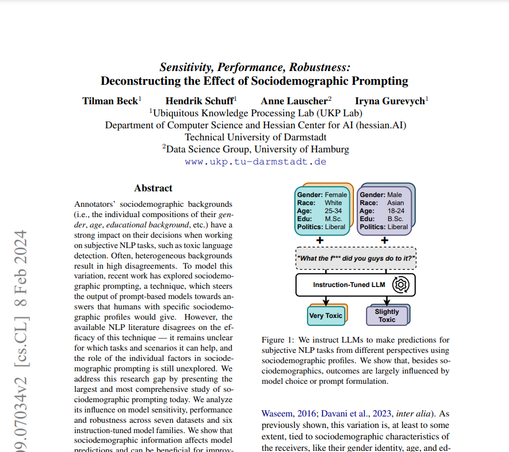

And consider getting in touch with the authors Tilman Beck, Hendrik Schuff, Anne Lauscher (Universität Hamburg) and Iryna Gurevych (@UKPLab), if you are interested in more information or an exchange of ideas.

See you this week in Malta!

(9/9) #EACL2024 #NLProc #Prompting #InstructGPT #LLMs

"Despite making significant progress, our #InstructGPT models are far from fully aligned or fully safe; they still generate toxic or biased outputs, make up facts, and generate sexual and violent content without explicit prompting"
https://openai.com/research/instruction-following

I know the feeling: Asy the asymmetric cat hardly ever bites people, and I'm very proud of him.
#ai #catsofmastodon

Aligning language models to follow instructions

We’ve trained language models that are much better at following user intentions than GPT-3 while also making them more truthful and less toxic, using techniques developed through our alignment research. These InstructGPT models, which are trained with humans in the loop, are now deployed as the default language models on our API.

What We Know About LLMs (Primer)
https://willthompson.name/what-we-know-about-llms-primer
Discussion: https://news.ycombinator.com/item?id=36860992

An emergent property of LLMs post-InstructGPT (https://arxiv.org/abs/2203.02155) is their capacity as reasoning agents.

Given a set of instructions an instruction fine-tuned/aligned LLM is able to stepwise reason to produce a desired output.
This has lead to a flurry of research into prompt techniques ...

#LLM #PromptEngineering #InstructGPT #ReinforcementLearning #GPT #LargeLanguageModels #AutonomousAgents

What We Know About LLMs (Primer)

Will Thompson

What We Know About LLMs (Primer)

@southernwolf @nixCraft

Strange choice of test for general mathematics capability. I wouldn't expect a transformer network to be that well suited to primality testing

But this suspected trend of #LargeLanguageModels getting worse as they are "aligned" was already acknowledged by #OpenAI in their #InstructGPT paper
https://openai.com/research/instruction-following

"it introduces an “alignment tax”: aligning the models only on customer tasks can make their performance worse on some other academic NLP tasks."

Aligning language models to follow instructions

We’ve trained language models that are much better at following user intentions than GPT-3 while also making them more truthful and less toxic, using techniques developed through our alignment research. These InstructGPT models, which are trained with humans in the loop, are now deployed as the default language models on our API.

Exploring the Robustness of Large Language Models for Solving Programming Problems
https://arxiv.org/abs/2306.14583

State-of-the-art models such as InstructGPT and ChatGPT show higher robustness to superficial modifications and have an outstanding capability for solving programming problems.

#LLM #AutomatedProgramming #programming #GPT #GPT3 #ChatGPT #InstructGPT #LargeLanguageModels

Exploring the Robustness of Large Language Models for Solving Programming Problems

Using large language models (LLMs) for source code has recently gained attention. LLMs, such as Transformer-based models like Codex and ChatGPT, have been shown to be highly capable of solving a wide range of programming problems. However, the extent to which LLMs understand problem descriptions and generate programs accordingly or just retrieve source code from the most relevant problem in training data based on superficial cues has not been discovered yet. To explore this research question, we conduct experiments to understand the robustness of several popular LLMs, CodeGen and GPT-3.5 series models, capable of tackling code generation tasks in introductory programming problems. Our experimental results show that CodeGen and Codex are sensitive to the superficial modifications of problem descriptions and significantly impact code generation performance. Furthermore, we observe that Codex relies on variable names, as randomized variables decrease the solved rate significantly. However, the state-of-the-art (SOTA) models, such as InstructGPT and ChatGPT, show higher robustness to superficial modifications and have an outstanding capability for solving programming problems. This highlights the fact that slight modifications to the prompts given to the LLMs can greatly affect code generation performance, and careful formatting of prompts is essential for high-quality code generation, while the SOTA models are becoming more robust to perturbations.

arXiv.org

What else can #psychology's #thinkAloud studies do? Design #AI!

Recording people think out loud inspired distinctions between three different types of questions: surface, testing, and deep.

So they made a series of modules (QASA) corresponding to each type: associative selection, rationale generation, and systematic composition.

The results? QASA "outperform[ed] the state-of-the-art #InstructGPT by a big margin."

https://openreview.net/forum?id=5ud0h8OXwD

#ML #LLM #processTracing #computerScience #cogSci

QASA: Advanced Question Answering on Scientific Articles

Reasoning is the crux of intellectual thinking. While question answering (QA) tasks are prolific with various computational models and benchmark datasets, they mostly tackle factoid or shallow QA...

OpenReview
Warum der KI-Textgenerator ChatGPT so fasziniert

Der Chatbot ChatGPT generiert zu jedem Thema erstaunliche Texte und hat Antworten auf jede Frage. Wir blicken auf die Möglichkeiten und Grenzen der Technologie,

c't Magazin

https://open-assistant.io

Please register and participate (as annotator) to the amazing
@ykilcher
project that has the goal to build a crowd sourced #opendata #opensouce alternative to proprietary #chatGPT, based on the #instructgpt logic, with much more!

#OpenAssitant #RLHF

https://www.youtube.com/watch?v=64Izfm24FKA

Open Assistant

Conversational AI for everyone. An open source project to create a chat enabled GPT LLM run by LAION and contributors around the world.

This script extracts text from a given file/URL and splits into sections. It writes extracted text and each section to a separate text file. It writes out the #AI-generated summary for each subsection, and a combined section summary if needed.

It splits into subsections of 1000-3000 tokens based on HTML section headings or numbered section headings. It uses #InstructGPT (text-davinci-003) to generate section summaries, and then summarizes the lower-level summaries to produce an overall summary.

Wissen Sie, wie ChatGPT trainiert wurde? ChatGPT ist "einfach" ein feinabgestimmtes GPT-3-Modell mit einer überraschend geringen Datenmenge!
Dieser Prozess ist hier vollständig beschrieben:
https://arxiv.org/pdf/2203.02155.pdf
Das Papier beschreibt auch ein Geschwistermodell namens InstructGPT.
#ChatGPT #Ai #InstructGPT #KI