 Insomni'hack
With less than two hours before the end of the CTF, almost all the challenges have been completed at least once and the three first teams are neck-and-neck.
#INS23 #ctf
#INS23 #ctf


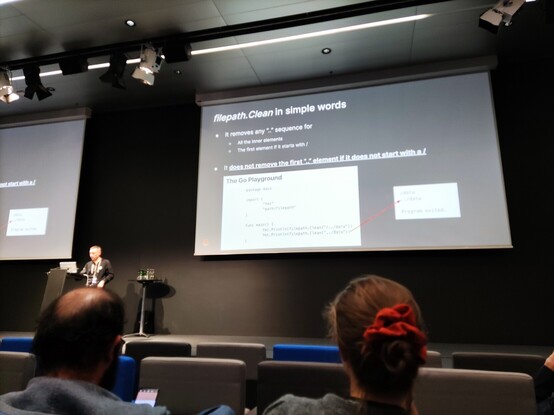
Jeremy Matos on Go security pitfalls @1ns0mn1h4ck
Makes me want to learn Go.
- Fuzzing embedded: nice
- I hate functions starting with capital letters though lol
The slides for my talk "Hacking your Jump Rope or your Coffee Machine", at Insomni'hack are available here: https://github.com/cryptax/talks/tree/master/Insomnihack-2023
I've published the slides of my Insomni'Hack /@1ns0mn1h4ck keynote about INCENTIVES in IT security.
This is a list of the key points of my talk.
The talk brings many different examples for incentives of different stakeholders. Sometimes the incentives are obvious, sometimes, namely our own ones, they are not so easy to identify. I've put a lot of emphasis on that. Also with the first example.
Incentive is an economical term; a parameter to drive performance. If we want to improve security, then incentives need to be aligned with this goal. If not, we we waste $$$ and resources producing friction instead of security.
Nessus reports with hundreds of findings trigger an urge us to start on page 1 and to work through the findings. However, this is often symptom control when the root cause of the vulns are poor policies and processes. On top: Ton of false positives bring huge friction.
Inflated numbers all around. We are advertising the number of attacks, but all we report is the number of bullets fired. Inflated numbers lead to budgets assigned to the wrong areas, wrong teams, wrong software products - or mgmnt stopping to believe reports.
Dashboards are a huge distractor since they pretend actionabiblity (-> incentives), yet they often reproduce survivorship bias based on readily available data; failing to direct us to the real dangers.
Bug Bounty hunters are driven by financial incentives to specialize in certain areas. This combined with the lack of qualified hunters in Switzerland leads to spotty coverage.
Pentesters help to improve the security without destroying the objects of their reports (with the full truth). Mainly their mgmnt is driven to obtain followup contracts. They call this long term partnership. This leads - again - to spotty coverage.
Business is incentivized to drive down costs and improve the margins. This results in cluster risks that are hard to keep in check and lead to huge data breaches.
In crisis communication it is best to hide everything and play down any evidence. Unless of course the public finds out and media starts to cover the problems. Then it's a lot better to be transparent and proactive from the start. Contradicting incentives.
To pay or not to pay is a hugely interesting question in ransomware cases. When cyber insurance comes into the game, it becomes even more interesting. There is evidence that cyber insurance makes you a more attractive target for an attack, leading to contradicting incentives.
Finally, my own work with the @CoreRuleSet project, a Web Application Firewall rule set. As an open source hashtag #WAF developer, I have a strong interest to close all holes, to my hashtag #wafbypass impossible, to fight false negatives (for fame and glory).
Necessarily, this leads to false positives. It's a deliberate choice: You either have false positives of false negatives. You can't go without.
The incentives of commercial WAF vendors are exactly the opposite. They have a strong desire to avoid false positives, since every false positive is a direct threat to their business. False negatives on the other hand are acceptable.
Summing this up, I see two levels of bad incentives: Level 1 means wrong incentives placed by carelessness or ignorance and people following them because they fail to realize they are walking in the wrong direction.
Level 2 means bad incentives deliberately placed for immediate financial gain, consciously leading away from security. Shame on you.
But here comes the good news: In most of the cases, all we need to do is taking a step back and to think about the incentives of all the stakeholders for a couple of minutes. And if we realize incentives and security are misaligned, then we need to stop.

Everybody, Blueteam and Redteam players alike, are driven by incentives. Good incentives persuade us to do the right thing and patch our servers. Bad incentive…
Want to share a nice moment with your peers from the infosec community in a relaxed and hacker-friendly environment? Joins us at MAD Club for Insomni'hack NOTworking dinner on March 23rd!
Details and registration: https://insomnihack.ch/notworking-dinner-mad-club/

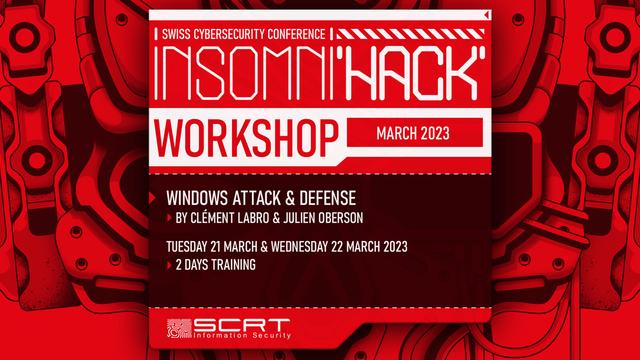
[WORKSHOP] Windows Attack & Defense by Clément Labro (@itm4n) and Julien Oberson.
Don’t miss this opportunity to attend this 2-days workshop at Insomni’hack 2023! Details and registration: https://insomnihack.ch/workshops-2023/
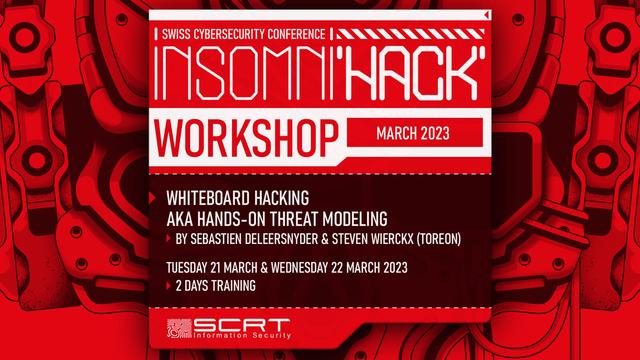
[WORKSHOP] Whiteboard Hacking aka Hands-on Threat Modeling by Sebastien Deleersnyder & Steven Wierckx.
Don’t miss this opportunity to attend this 2-days workshop at Insomni’hack 2023! Details and registration: https://insomnihack.ch/workshops-2023/
[WORKSHOP] Cloud Security Masterclass by Abhinav Singh.
Don’t miss this opportunity to attend this 2-days workshop at Insomni’hack 2023! Details and registration: https://insomnihack.ch/workshops-2023/

You’ve been waiting for it… The registration for Insomni’hack 2023’s CTF is now open: https://insomnihack.ch/register/
Thanks to our new venue in Lausanne, we have extended the capacity to 750 seats. As usual registration is totally FREE. See you there on March 24th. #INSO23 #INS23 #CTF

Super excited to be part of this year's @1ns0mn1h4ck conference! My presentation will analyze the elaborate and highly targeted social engineering attacks we have been observing recently, and will include case studies.
I look forward to attending other talks in person again, but mostly, I look forward to meeting everyone!
#INS23 #INSO23 #socialengineering
The talk schedule: https://insomnihack.ch/talks-2023/
 cryptax
 Christian Folini ⛑️
 Christina Lekati