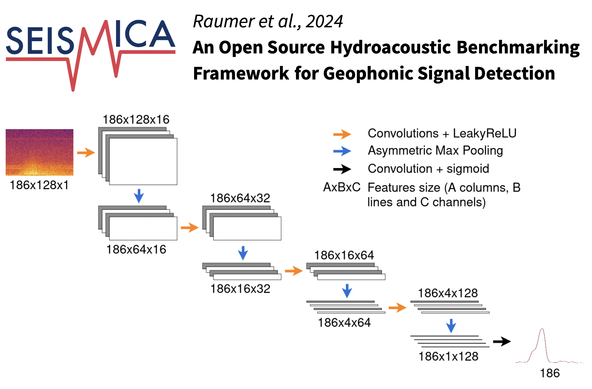
How can we face the challenge of automating the detection of hydroacoustic earthquake-born signals?

Raumer et al. introduce both TiSSNet, a model to detect them, and a rigorous evaluation framework:
https://seismica.library.mcgill.ca/article/view/1344

#hydroacoustics #Seismology #EarthquakeScience #peerreviewed #DiamondOpenAccess #Earthquake #OpenAccess #OpenScience

An Open Source Hydroacoustic Benchmarking Framework for Geophonic Signal Detection

Passive hydroacoustic studies have underscored the efficiency and relevance of deploying autonomous hydrophones for the surveillance of underwater geophony. In particular, monitoring networks have been deployed for detecting SOFAR-propagating hydroacoustic waves generated by seismic events and locating their sources. The technique has been extended to study other hydroacoustic signals, such as P-waves from teleseismic events or impulsive waves generated by sea water-lava interactions. A significant challenge in this endeavor lies in the time required for the manual detection and annotation of these signals in long-term records. To address this issue, we tested the feasibility of implementing automated algorithms based on machine learning to detect and identify these various signals, and obtained satisfying classification and time picking accuracies. We incorporated those models in a benchmarking framework, proposing a training dataset, two evaluation datasets, two tasks to solve and the evaluations of the mentionned models on them. The goal of this framework is to foster the development of new models in the community, as it gives a clear way to evaluate them.

Seismica

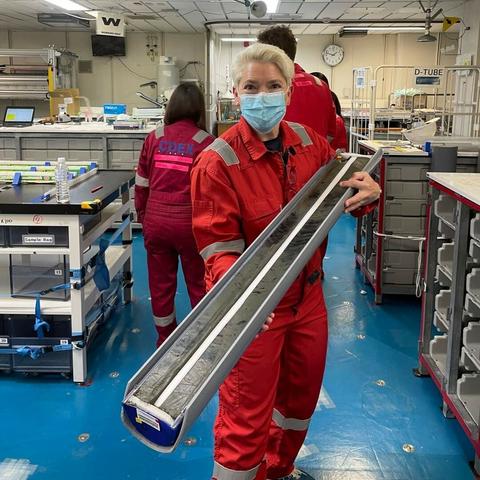
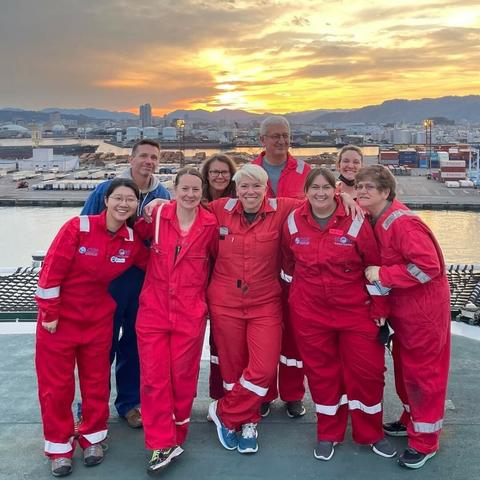
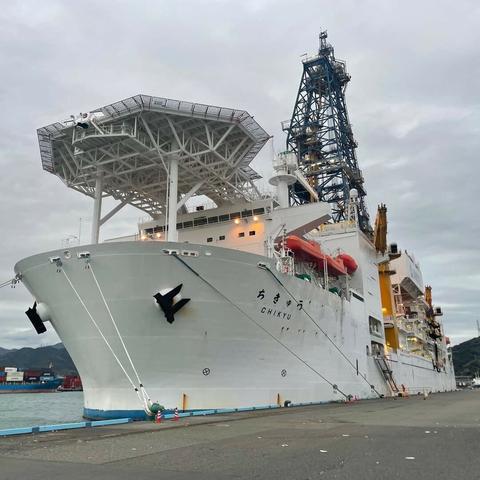
#IODP Expedition 386: Japan Trench Paleoseismology smashed 2 #ScientificOceanDrilling depth records — opening up exciting new possibilities for understanding how #earthquake systems work.

University of Western Australia's Professor Myra Keep is currently onboard the #JAMSTEC(海洋研究開発機構) #Chikyu drilling vessel in Shimizu Port, where she is taking part in the Personal Sampling Party for the expedition as team leader for #hydroacoustics.

Learn more of Myra's journey: https://iodp.org.au/myra-keep-exp386/

Drilling deeper into Earth’s seismic history: Professor Myra Keep on IODP Expedition 386 – ANZIC – Australian and New Zealand International Ocean Discovery Program Consortium