 PPC Land
FYI: Amazon Music Unlimited lands in India with HD audio at Rs 99 a month: Amazon Music Unlimited launches in India today with HD, Spatial Audio, and Dolby Atmos at Rs 99 per month for Prime members, alongside a six-month free trial. https://ppc.land/amazon-music-unlimited-lands-in-india-with-hd-audio-at-rs-99-a-month/ #AmazonMusic #Streaming #MusicLovers #HDAudio #IndiaLaunch
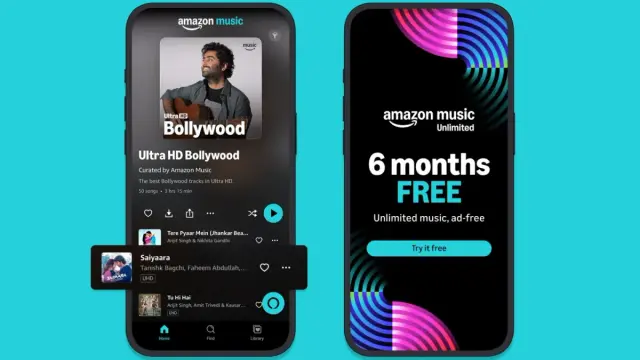
ICYMI: Amazon Music Unlimited lands in India with HD audio at Rs 99 a month: Amazon Music Unlimited launches in India today with HD, Spatial Audio, and Dolby Atmos at Rs 99 per month for Prime members, alongside a six-month free trial. https://ppc.land/amazon-music-unlimited-lands-in-india-with-hd-audio-at-rs-99-a-month/ #AmazonMusic #MusicStreaming #HDAudio #DolbyAtmos #SpatialAudio
Amazon Music Unlimited lands in India with HD audio at Rs 99 a month: Amazon Music Unlimited launches in India today with HD, Spatial Audio, and Dolby Atmos at Rs 99 per month for Prime members, alongside a six-month free trial. https://ppc.land/amazon-music-unlimited-lands-in-india-with-hd-audio-at-rs-99-a-month/ #AmazonMusic #MusicStreaming #IndiaLaunch #HDAudio #SpatialAudio
 YaMaCrak PRO
 knockoffs with HD AUDIO #1

knockoffs with HD AUDIO #1
 Code of Amor 💘
@farah Okay, this is just a quick overview.
1. Source
You can have the highest quality stereo in the world, or the best headphones or the best hearing and it won't matter if you're just streaming from Spotify.
If you are streaming from Spotify, that's not a bad option - I do it all the time - just don't expect the audio quality to be the best possible. Always set your streaming quality to 320Kbps or better if it is offered, and if you can afford the bandwidth.
If you're interested in better, there are some lossless streaming services out there - in fact, I think Apple Music does offer lossless as an option - but I haven't reviewed it critically, and frankly, I don't care. The kind of music I stream from Spotify is adequate at 320kbps. If I really like it, I'll buy the album on CD and rip it.
If you rip your music from CD, be sure to do it at the highest quality. And that's just the extraction - the transcoding is another matter. Use something like cdparanoia or engines based on it (or better) to ensure that what is on the CD ends up in your extracted files. When it comes time to encode those files from WAV to save some space (and increase compatibility), I always choose lossless compression. For the systems I have set up, I use ALAC, which is an Apple-compliant version of FLAC.
So the bottom line is - use the best quality source for your listening pleasure, or you're just short-changing yourself!
2. Playback
Be sure whatever you use for playback of your audio files (or Spotify client, or stream relaying program) plays back audio well. These days, most players will suffice, because most of them use the same backend libraries. My systems here run using Snapcast to send music to multiple rooms with synchronisation, and optional delay. Even my listening post, which I will get to shortly, uses a Snapcast client to tap in to the audio streams available here. Snapcast uses FLAC internally for network data transmission, so your audio quality is never compromised (lossless!). Other parts of my system of playback involve various Spotify clients (LibreSpot, Official client for linux, official client for iOS), MPD (and mpc), and Quod Libet (linux).
3. Transmission
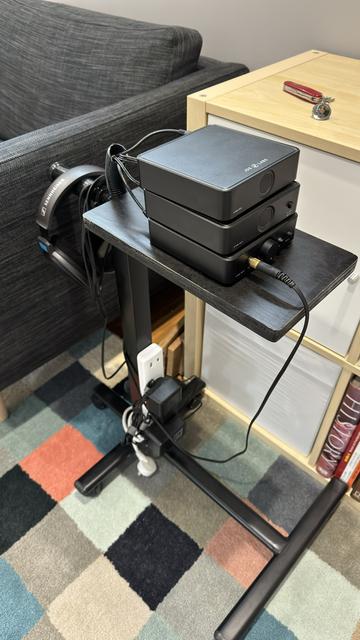
To ensure the signal from your player gets to your preamplifier/amplifier with no electrical noise or distortion whatsoever, the only choice is to use optic fibre cables, also known as TOSLink or SPDIF cables. This electrical disconnect from the power supplies and the circuitry means that what the player sends (in purely digital streaming form) is what the (pre-) amplifier receives. It has the maximum signal amount, and minimum noise. Of course, this assumes that you're using a DAC between your source and your amplifier. This converts the audio from the pristine, lossless, digital form, into analog, electrical waveforms that can be amplified by your amplifier. Some units come all-in-one. I use an Atom DAC+, and an Atom Amp+, both from JDS labs - and they're a bargain at less than $100USD each.
4. Amplification
See above - I highly recommend JDS Labs audio gear. It forms the core of my listening post stack.
5. Output
I am a purist when it comes to listening to music. I prefer to listen to it the way the artist and mixing professionals intended. They spend hours and hours just tuning and tweaking every aspect of the sound stage, so I focus my efforts on faithfully recreating that on my equipment. For this, I always buy what is known as "Reference Audio" (RA) gear. Headphones, or speakers. RA gear is specifically designed to reproduce precisely what the audio sounds like without processing or embellishment. RA gear is what audio engineers and artists use in studios to ensure that what they are hearing is exactly what the audio is in the recording they are playing back. This allows them to adjust all bands of frequency and make all sorts of tweaks to make the music pop. Additionally, RA headphones and speakers are the best bar none, for listening to classical music, orchestral symphonies, and scores. I use headphones for this. I have two pairs, but I mostly use my favourite for the listening post, and the other is reserved for if I need to travel and block out sound. The latter is a pair of closed-backed AKG K550, that I've refurbished and improved on. The former, which I recommend over and over, are my open-backed Sennheiser HD600 headphones. Note the model number. Bigger numbers do not mean better. They hit gold when they made this model. They are light, with a broad sound stage, and super crisp tones.
I will add in a special mention here for my "daily drivers". These are a low-cost pair of open-backed KOSS clip-over-ear headphones. Despite the absolute bargain basement pricetag, these simple, hardy, metal-driver headphones have an excellent use of the sound stage and drive some impressive sounds for such small, unpowered, things. I'll add a note if you're interested, later, of the exact model number, as it's not printed on them at all, and it always trips me up when recommending them.
I hope this has been as interesting for you to read as it has been for me to divulge. I have barely touched on anything but the absolute essential details, so if you'd like to know more, by all means, ask away.
 Luke
LukeFinally managed to get my WIIM to play BBC radio in HD again. The BBC Sounds app is pants even streaming over chromecast (and this isn’t a subtle difference)…
Here’s BBC Music for example:
http://lstn.lv/bbc.m3u8?station=bbc_6music&bitrate=96000
(Try switching from this to the chromecast sounds app stream… which I assume is limited at best 320 kbps, happy to be corrected)
See https://gist.github.com/bpsib/67089b959e4fa898af69fea59ad74bc3
For a complete list of direct URLs
(Same issue with the recently updated radio France app which hides the HD streams which can be accessed via a browser or hardware streamer).




Con cada mes que transcurre, me sumerjo más y más en las profundas aguas de este fascinante océano que es el mundo del #audio digital de #altaresolución.
Ahora bien, investigar y aprender estas cuestiones lleva a un absurdo callejón sin salida en el mundo del #audiodigital de #altadefinición que es: o bien obtener compatibilidad, o bien obtener audio de altísima calidad.
Pero, pareciera que no se puede pedir ambas cosas al mismo tiempo…
 🧷💜Raven✨of🏴Justice•{🚫⚖️🚫🏳️}
#NowPlaying #Juassic5 "Feedback"
.
Link is to #Odesli #Songlink
.
https://album.link/zj393td2x022q
.
.
#Music #HipHop #HipHopMusic #HRAudio #FLAC #DAC #DAP #FiiO #Audiophile #HDAudio #Album
.
Link is to #Odesli #Songlink
.
https://album.link/zj393td2x022q
.
.
#Music #HipHop #HipHopMusic #HRAudio #FLAC #DAC #DAP #FiiO #Audiophile #HDAudio #Album
