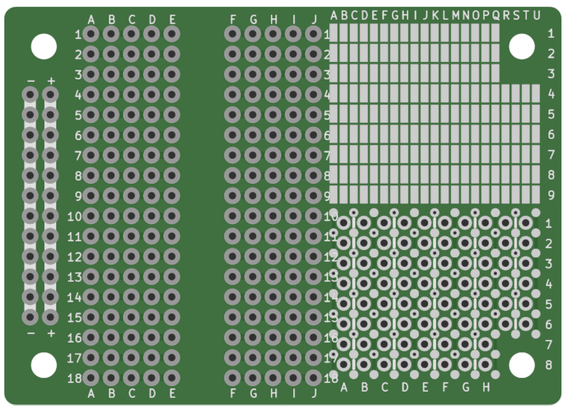
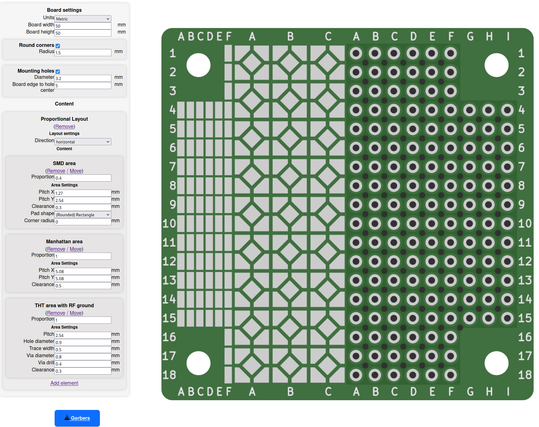
#gerbonara v1.4.0 is now out. The big new thing is that #gerbolyze's protoboard generator has moved into gerbonara. You can now run the protoboard generator through

$ pip install -U gerbonara && gerbonara protoboard interactive

Apart from that, Kicad file format support is now up-to-date with the current 8.99 nightlies.
#python #electronics #pcb

@revk Hey, maintainer of #gerbolyze and #gerbonara here. Would you mind emailing me these Gerbers at [email protected]? (I will treat them as confidential of course) I've seen a lot of Gerbers, and I might be able to tell you what exactly went wrong. I also want to add a test to gerbonara that checks for this, so until JLC and/or KiCad fix this, you can use the rewrite tool in gerbonara's CLI to fix up files.

The boards for #8seg, a light installation I'm doing just arrived. Here's some pictures of the #gerbolyze'd bottom sides.

#pcb #electronics

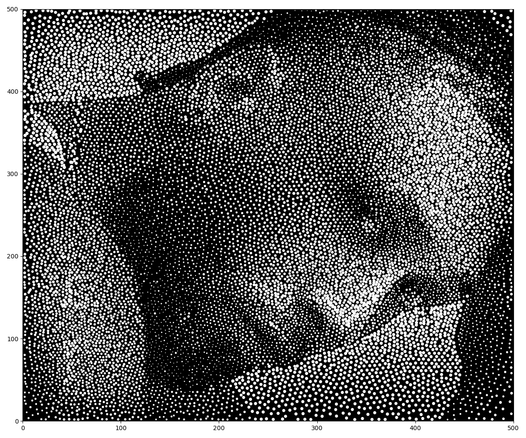
A new halftone algorithm is on its way to #gerbolyze! This one adapts the underlying grid pattern to both conform to edges, and to maximize contrast by adjusting cell size.

The test picture is this one by photographer Marlon Schmeiski: https://unsplash.com/photos/a-man-with-tattoos-sitting-on-a-stool-mMT3bxPxL2s

Photo by Marlon Schmeiski on Unsplash

Download this photo by Marlon Schmeiski on Unsplash

New releases of #gerbonara and #gerbolyze are out today!

These releases bring some bug fixes, as well as a workaround for extremely broken aperture macro handling in the software stack of a certain cheap pcb fab when rotating KiCad nightly files using gerbonara.

I pushed new #gerbolyze and #gerbonara releases today. gerbonara now with full KiCad file format I/O, new protoboard layouts, and a bunch of smaller bug fixes and improvements. gerbolyze should now just pip'install without issues on at least any non-windows system. Grab your copy now with `pip install gerbonara gerbolyze`
@lethalbit As a stop-gap solution, #gerbolyze has Kicad schematic read/write support from python, so with it you could either load-modify-save a schematic from the notebook, or have a command-line python script that gets invoked from e.g. a makefile.
The gobo itself is a PCB stencil that was produced by JLCPCB. I put the original stencil on a flat-bed-scanner to figure out the geometry.
Then the various logos where collected (vectorized if required) and put into the correct location. The logos did require some tinkering because we cannot have 'floating' parts. Its quite visible in the Pesthörnchen.
Then I put it into #KiCad using #gerbolyze and exported gerbers. Stencils are cheap regardless of the size, so I used #kikit to make a panel.

@joeycastillo You're welcome 😄

Turns out all the evenings staring at Gerbers for #gerbolyze have a use 😅

@North Check out #gerbolyze . It can convert SVGs to KiCad footprints accurately, and it has a mode where you can design SVG overlays in Inkscape, which it then applies on the Gerbers after export. It directly converts all SVG primitives instead of rasterizing, and it can handle very complex graphics (hundreds of MB per Gerber layer) with ease.