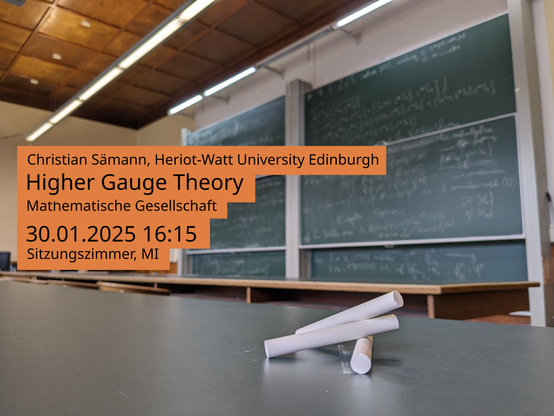
Heute zu Gast um 16:15 im Sitzungszimmer des Mathematischen Instituts für die #MathematischeGesellschaft #Göttingen:
Christian Sämann von der Heriot-Watt University Edinburgh mit
"Higher Gauge Theory"
#Mathematik #HigherGaugeTheory #GaugeTheory #GöttingenCampus
Spectral Response of Disorder-Free Localized Lattice Gauge Theories
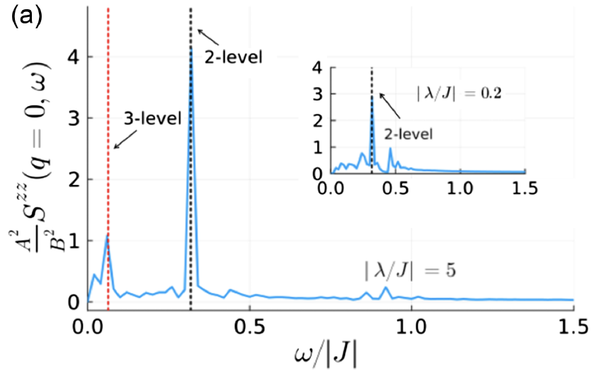
Certain lattice gauge theories exhibiting disorder-free localization have a characteristic response in spectral functions: a few sharp peaks combined with vanishing response in the zero frequency limit. These results can distinguish the disorder-free localized phase from conventional paramagnetic counterparts in frustrated magnets. Check out our latest PRL here:
We show that certain lattice gauge theories exhibiting disorder-free localization have a characteristic response in spatially averaged spectral functions: a few sharp peaks combined with vanishing response in the zero frequency limit. This reflects the discrete spectra of small clusters of kinetically active regions formed in such gauge theories when they fragment into spatially finite clusters in the localized phase due to the presence of static charges. We obtain the transverse component of the dynamic structure factor, which is probed by neutron scattering experiments, deep in this phase from a combination of analytical estimates and a numerical cluster expansion. We also show that local spectral functions of large finite clusters host discrete peaks whose positions agree with our analytical estimates. Further, information spreading, diagnosed by an unequal time commutator, halts due to real space fragmentation. Our results can be used to distinguish the disorder-free localized phase from conventional paramagnetic counterparts in those frustrated magnets which might realize such an emergent gauge theory.
I have neglected this channel, sorry lol. If you follow me you will probably find this interesting: https://arxiv.org/abs/2307.00442
We show that both the $\infty$-category of $(\infty, \infty)$-categories with inductively defined equivalences, and with coinductively defined equivalences, satisfy universal properties with respect to weak enrichment in the sense of Gepner and Haugseng. In particular, we prove that $(\infty, \infty)$-categories with coinductive equivalences form a terminal object in the $\infty$-category of fixed points for enrichment, and that $(\infty, \infty)$-categories with inductive equivalences form an initial object in the subcategory of locally presentable fixed points. To do so, we develop an analogue of Adámek's construction of free endofunctor algebras in the $\infty$-categorical setting. We prove that $(\infty, \infty)$-categories with coinductive equivalences form a terminal coalgebra with respect to weak enrichment, and $(\infty, \infty)$-categories with inductive equivalences form an initial algebra with respect to weak enrichment.
What is the #Hopf #Fibration?
The #HopfFibration commonly shows up in discussions surrounding #GaugeTheory and #Fundamental #Physics, though its construction is not so mysterious.
https://www.youtube.com/watch?v=nsHcKO7HvFY&ab_channel=Poppro
#Math #Maths #Mathematics #Manifold #Manifolds #Geometry #ManifoldGeometry #NonManifoldGeometry #Dimensions #Dimensionality #Coordinates #Coordinate #PositionSpace #3Sphere